
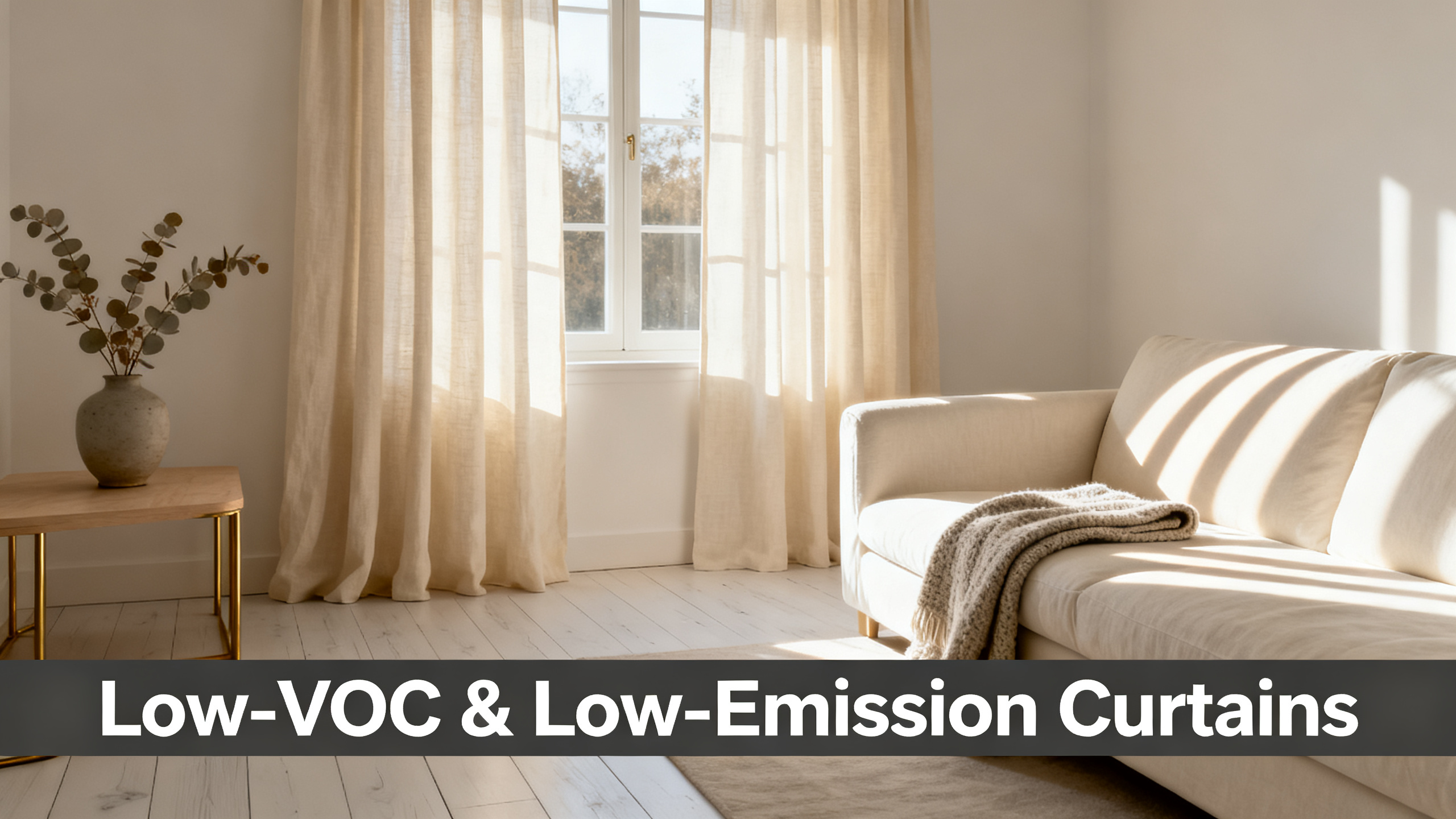
Walk into a curtain aisle and six terms quietly decide whether the panel you bring home is safe for a nursery or slowly leaking formaldehyde into the air your kid breathes for ten hours a night.
VOC. Off-gassing. Formaldehyde. OEKO-TEX Standard 100. GREENGUARD Gold. Low-emission. Master these and roughly 90% of the buying decision is already done.
I’ve shopped curtains for a nursery, an MCS-sensitive bedroom, and a south-facing office that needed blackout. The labels lie in three predictable ways every time.
This guide maps the vocabulary, then the fibers, then the certifications, then the lining trap, then the room-by-room call. Two Pages happens to have four SKUs that pass a strict low-VOC filter, and we’ll get to which one belongs in which room. Need the wider context first? Start with the complete sustainable and natural fiber curtains hub.
📋 The 6 terms primer
VOC
Volatile Organic Compound. Carbon-based chemical that evaporates at room temperature.
Off-gassing
The release of those VOCs into your room air, peak first 7 days, tapers by day 30 to 90.
Formaldehyde
The VOC hiding in no-iron resin, flame-retardant treatment, dye fixers.
OEKO-TEX Std 100
Textile certification testing 350+ chemicals in the finished fabric.
GREENGUARD Gold
Indoor-air emissions cert from UL Solutions. Measures what the textile releases, not what’s in it.
Low-emission
Marketing term with no fixed definition. Demand the certification number.

Editor’s pick for low-VOC indoor air
Doris 100% European Flax Linen Curtain
from $109/panel · 100% European Flax · OEKO-TEX Standard 100 yarn · Masters of Linen field-to-loom traceability · 117 gsm light-filtering · 6 natural colorways including undyed Natural. Final price depends on size and lining.
Use code JULY for 20% off · Free shipping over $300
The 6 Terms That Decide a Low-VOC Spec
VOC: what counts and what does not
VOC is a regulatory category, not a single chemical. The EPA volatile organic compounds and indoor air quality page defines it as any carbon-based compound that vaporizes at normal indoor temperatures.
Formaldehyde counts. Benzene counts. Acetone counts.
What does not count: water vapor, carbon dioxide, the smell of fresh laundry. The skim version: if a new product smells “chemical” three days after unboxing, that smell is VOCs you’re inhaling.
Off-gassing: the 7 to 90-day decay curve
Off-gassing follows a predictable curve. Day 0, peak emissions as the panel exits the plastic sleeve.
Day 7, roughly 50% of the initial VOC load has dissipated if the room is ventilated. Day 30, treated polyester reaches near-baseline. Day 90, the last residue from heavy chemical finishes fades.
📉 VOC off-gassing decay curve, typical curtain panel
Day 0
100%
Peak load post-unbox
Day 7
~50%
Ventilated room
Day 30
~15%
Treated poly near baseline
Day 90
~2%
Heavy finishes fully cleared
Undyed 100% linen reaches negligible levels by day 7. Polyester blackout liners with PVC or acrylic coating can hold residue until day 90.
Formaldehyde: where it hides in textile finishing
Formaldehyde is the VOC most likely to wreck indoor air quality on a curtain. It hides in no-iron resin (the chemistry that lets a polyester panel ship pre-pressed and not wrinkle for a year), in chemical flame-retardant treatments (required for some commercial-grade panels), and in some dye-fixing baths on cheap cotton.
The defense is structural, not magical. Pick a fiber that doesn’t need any of those treatments.
Linen wrinkles, so it doesn’t get the resin. Wool is naturally flame-retardant, so it doesn’t get the chemical treatment.
Undyed Natural colorways don’t get the fixer. That’s the whole story.
OEKO-TEX, GREENGUARD, European Flax, Masters of Linen: the one-liner each
OEKO-TEX Standard 100 tests the textile for chemical residue. GREENGUARD Gold tests for in-air emissions in a sealed chamber.
European Flax certifies the flax was grown in Western Europe. Masters of Linen adds that the spinning, weaving, and finishing all happened in Europe too.
Different questions, four different answers, all relevant.
How to Choose the Fiber: Low-Emission by Construction
Two Pages has 4 SKUs that pass the strict low-VOC filter. Here they are: Doris 100% European Flax, Erin Heavyweight 100% Linen, Patti Premium 100% Belgian Flax, and Karin 100% Pure Wool.
The bamboo Rae shades sit alongside as a non-textile alternative for windows where ventilation is the real answer. Everything else in the catalog is either a blend or treated.
100% linen: the default low-VOC pick
Linen leads because the manufacturing chain is short. Flax plant, mechanical retting (water, no chemicals), spinning, weaving, sometimes natural dye. No synthetic monomer base, no resin finish, no chemical bleaching when oxygen-bleached or undyed.
The Doris European Flax panel at 117 gsm is light-filtering linen with OEKO-TEX Standard 100 yarn certification.
Erin Heavyweight at 240+ gsm is the denser sibling, and the Natural 1011-3 colorway is undyed. Undyed is the single cleanest spec available on Two Pages right now.
100% wool: low-VOC if mothproofing is formaldehyde-free
Wool is naturally flame-retardant and thermally insulating. Karin Pure Wool at 250 gsm blocks roughly 80% of daylight on its own mass. The asterisk: wool needs mothproofing, and some mothproofing treatments use formaldehyde-based fixers.
Real talk on Karin specifically. Two Pages publishes the wool source (New Zealand) and OEKO-TEX yarn baseline but does not publish a formaldehyde-free mothproofing certificate cross-line.
If the room is a nursery or MCS-sensitive bedroom, email the trade desk for the mothproofing spec on the specific colorway before ordering. For a standard adult bedroom, the default spec is fine.
Cotton: undyed and unbleached only
Cotton is low-VOC when it’s organic, undyed or naturally dyed, and bleached with oxygen instead of chlorine. The cheap cotton panels at big-box stores rarely clear that bar. Look for GOTS certification on cotton specifically, since OEKO-TEX alone doesn’t cover the growing chemistry.
Bamboo shades versus bamboo viscose fabric: night and day
Bamboo gets confusing fast. Woven bamboo shades (the Rae Natural Bamboo Series S at $89.99/panel) are split bamboo culms processed mechanically.
Bamboo viscose fabric is bamboo dissolved in carbon disulfide and extruded as rayon. The first is low-VOC. The second carries solvent residue.
For window treatments, woven shades are the safer call when you want bamboo aesthetics in a sensitive room.
Polyester and linen-blends: the case against
Polyester emits residual ethylene glycol monomers from manufacturing. Add the typical no-iron finish, add the optional flame-retardant treatment, and a polyester panel has three potential VOC sources stacked on top of each other.
For a healthy adult ventilated living room, the math is acceptable after 30 days of unboxing. For a nursery, it’s not.
Linen-blends sit in the middle and the brand naming obscures which side they lean. The linen blend versus 100% linen breakdown walks through the wrinkle-versus-VOC trade in detail.
The short version for this guide: if low-VOC is the priority, choose 100% linen. If wrinkle-free drape is the priority and VOC is secondary, the blend wins.
⚠️ Greenwashing red flags to walk away from
▸ “Eco-friendly” on a label without a certification number to look up.
▸ “Natural fiber” on a panel that’s 30% linen / 70% polyester without disclosing the synthetic majority.
▸ “No harmful chemicals” with no third-party audit. The brand decides what counts as harmful.
▸ “OEKO-TEX” mentioned without the Standard 100 designation and a certificate number. Standard 100 is one of four schemes under the OEKO-TEX umbrella, and only Standard 100 covers what most buyers think they’re buying.
How to Choose the Certification Stack: OEKO-TEX, GREENGUARD, European Flax
The certification stack is where most low-VOC shopping gets weaponized. Brands cite labels in marketing without naming the scheme, and labels cover different things.
Sounds technical. Here’s why you care: a panel can be OEKO-TEX certified for residue and still off-gas for a month in your room. Different question, different test.
OEKO-TEX Standard 100: 350+ chemicals tested
OEKO-TEX Standard 100 is the most common chemical certification for textiles globally. It tests the finished fabric or the yarn for 350+ regulated and unregulated substances including formaldehyde, heavy metals (lead, cadmium, mercury), banned azo dyes, pesticide residue, and chlorinated phenols. A swatch tag with an OEKO-TEX Standard 100 certificate is verified safer than what EU REACH and US CPSIA regulations require.
The honest limit, as the OEKO-TEX Standard 100 textile certification page lays out: it measures chemical residue in the finished textile at the time of testing.
It doesn’t measure how much the textile will release into a sealed room over 30 days. For that you’d want GREENGUARD.
Pair OEKO-TEX with a 48-hour swatch pre-screen test before committing to a $400 panel order in a sensitive room.
Sustainable Curtains Buying Guide: OEKO-TEX, European Flax, GOTS
The companion guide that maps every certification mentioned here against the 4 fibers Two Pages actually sells in the eco lineup.
GREENGUARD Gold: indoor-air emissions, not residue
GREENGUARD Gold is a GREENGUARD Gold low-emission certification managed by UL Solutions. It tests how much VOC a product emits into a sealed chamber over time, expressed as micrograms per cubic meter of chamber air. That’s a fundamentally different test from OEKO-TEX. OEKO-TEX asks “what’s in this fabric.” GREENGUARD asks “what does this fabric release into your room.”
For curtains, OEKO-TEX dominates the market because few curtain brands invest in the chamber testing. As of 2026, the curtain industry overwhelmingly relies on OEKO-TEX Standard 100 plus fiber traceability instead.
Two Pages is no exception: their published certifications are at the OEKO-TEX yarn level, not GREENGUARD Gold. That’s a real gap, and worth flagging honestly.
What Does OEKO-TEX Certification Mean for Curtains?
The deep-dive on the 350+ chemicals OEKO-TEX Standard 100 tests, what the certification number on a swatch tag actually proves, and the 4 limits it does not cover.
European Flax and Masters of Linen: traceability cuts unknown-input risk
Neither European Flax nor Masters of Linen is a chemical certification per se. They certify the flax was grown in Western Europe (France, Belgium, Netherlands) with mechanical retting, GMO-free, and traceable back to the field that grew it. Masters of Linen adds that spinning, weaving, and finishing all happened in Europe too.
Why this matters for low-VOC: field-to-loom traceability reduces the unknown-input risk. You know what pesticides were and were not used.
You know the retting was mechanical, not chemical. The Doris panel from Two Pages is the only SKU in the lineup that carries Masters of Linen credentials right now.
Red flags: certifications with no number
Every legitimate textile certification has a number you can verify on the issuing body’s website. OEKO-TEX has a certificate database. GOTS has one. European Flax has one.
If a brand cites “OEKO-TEX” or “GOTS” on the product page without a number, treat it as marketing copy until the number appears.
🌿 Certification stack at a glance
OEKO-TEX Std 100
What: Residue in finished textile
Limit: Doesn’t measure in-air emissions
GREENGUARD Gold
What: Chamber emissions over time
Limit: Rare on curtains as of 2026
European Flax
What: Flax grown in Western Europe
Limit: Not a chemical test
Masters of Linen
What: Full European supply chain
Limit: Linen only, narrow scope

Lowest-emission tier: Erin Natural (undyed)
from $89.99/panel · 100% linen · Natural undyed 1011-3 colorway (no dye chemistry) · soft top header · 240+ gsm heavyweight drape. The least-treated panel in the Two Pages catalog when chemical sensitivity is the top constraint.
How to Choose the Lining and Finish: Where Most Specs Quietly Cheat
Picture the polyester blackout liner behind a beautiful linen panel. That hidden layer is where most “low-VOC” specs quietly cheat, because the panel face gets all the marketing and the liner gets none. The liner is what spends 18 hours a day breathing into your room.
Unlined: the lowest-VOC floor
An unlined linen panel is the cleanest spec possible from Two Pages. Single layer of certified fiber, no coating, no second-layer chemistry.
The trade is real: unlined linen filters light, it doesn’t block it. For a bedroom that needs morning darkness, unlined is a non-starter.
For a living room, office, or nursery where the goal is air quality plus filtered light, unlined wins.
Linen or cotton liner: drape weight without chemical load
A linen or cotton liner adds drape weight, light reduction (around 60 to 70%, not full blackout), and zero meaningful chemical load. The cost: roughly 25 to 35% more on the panel total, plus 2 to 4 days of additional lead time. For an MCS-sensitive bedroom or a nursery, this is the right spec almost always.
Poly blackout liner: the 30 to 40% VOC trade
A polyester blackout liner with acrylic or PVC coating blocks 99% of light. It also adds roughly 30 to 40% to the panel’s total VOC load compared to unlined, because the coating is the highest-emission layer in the assembly.
The defense: ventilate the panel for 48 to 72 hours outside or in a garage before hanging in a bedroom. That single step drops the in-room VOC peak meaningfully.
Flame-retardant treatments: when required, when avoidable
Residential curtains in most US jurisdictions do not require chemical flame-retardant treatment. Commercial applications (hotels, hospitals, daycares, public buildings) often do.
If flame retardancy is genuinely required for a daycare or rental, specify wool (Karin) for inherent flame resistance instead of a chemically-treated polyester panel. Wool’s molecular structure self-extinguishes without any added chemistry.
🪟 Lining and finish honesty matrix
Unlined
VOC: minimal. Light block: ~30%.
Best for living, office, nursery filter-light.
Linen / cotton liner
VOC: still minimal. Light block: ~65%.
Best for MCS bedroom, nursery wanting darker.
Poly blackout liner
VOC: +30-40%. Light block: 99%.
Acceptable for adult bedroom if pre-aired 72h.
Chemical FR treatment
VOC: elevated, persistent. Avoid unless code-required.
Sub with wool for inherent flame resistance.
Decision Tree by Room: Match the Spec to the Risk
The “right” low-VOC curtain depends on who breathes the air, how long, and how the room ventilates. Same panel can be excellent in a living room and wrong in a nursery. Here’s how I’d think about it room by room.
Nursery: Erin Natural undyed plus linen liner
The nursery is the highest-stakes room. Infant lungs are smaller, ventilation patterns at night are minimal (door closed), and exposure is concentrated over 10+ hours.
Default spec: Erin Heavyweight Natural 1011-3 undyed with optional linen liner. No poly liner, no flame-retardant treatment, no dyed colorway.
Best Hypoallergenic & Sustainable Curtains
The pick-list cousin of this guide: 7 panels ranked for nurseries, MCS-sensitive bedrooms, and pediatric asthma rooms with the certification stack laid out per pick.
MCS-sensitive bedroom: Doris European Flax plus pre-screen swatch
For multiple chemical sensitivity, the pre-screen test matters more than any certificate. Order a Doris Lance Joy 13-color swatch booklet, place it on a clean surface in a non-bedroom room, and smell-check at 24h, 48h, and 7 days. If you can’t detect any residual finishing odor at day 7, the panel is safe for your bedroom.
The default pick for MCS-sensitive adult bedrooms: Doris European Flax with linen liner, light-filter or unlined. The Doris European Flax in-depth review walks through the colorway behavior across north and south light.
Adult bedroom (standard): Patti or Doris, poly liner OK if ventilated
Standard adult bedroom, no specific sensitivity, normal ventilation patterns (door cracked, HVAC running, window opened weekly). The math changes. Either Patti Belgian Linen at $79.99/panel or Doris at $109/panel works, and the poly blackout liner is acceptable if you pre-air the panel for 72 hours before hanging.
Living and office: drape can dominate, low-VOC stays the floor
Living rooms and offices ventilate constantly (door open, foot traffic, HVAC mixing). VOC concentration stays low even with a poly liner.
The decision can pivot back to drape weight, light behavior, and colorway. Doris pleated reads as the most editorial; Erin reads as the most relaxed; Karin reads as the most architectural.
🏠 Decision tree by room
Nursery
Erin Natural undyed
Linen liner only
MCS Bedroom
Doris European Flax
Pre-screen 48h
Adult Bedroom
Patti or Doris
Poly liner OK + air 72h
Living Room
Any 100% linen pick
Drape can lead
Office
Any 100% linen pick
Drape can lead
📐 Drop & coverage for low-VOC configs
Config A: Unlined floor
100″ W × 96″ L unlined Erin Natural
Lowest VOC. Light filter only. Cart sim returns ~$220/panel.
Config B: Linen-lined
120″ W × 108″ L Doris + linen liner
Low VOC + 65% light block. ~$380/panel.
Config C: Full-wall undyed
180″ W × 120″ L Erin Natural unlined pair
Statement wall, zero dye. ~$480/pair.
Order the Doris Lance Joy 13-Color Booklet
Smell the actual fabric before committing. The 13-color booklet ships flat for $3.99 and lets a sensitive nose pre-screen the linen for any residual finishing odor in your home for 48 hours, instead of returning a $400 panel order.
What to Do Next: A 3-Step Low-VOC Curtain Plan
Coming back to the original question: what’s the simplest path from “I want low-VOC curtains” to a panel hung in the room? Three steps, in order.
Step 1: Audit the panels you already own
Walk into each room with windows. Lift the existing panel to your face.
If you can smell anything chemical after 6+ months on the rod, that panel is still off-gassing and probably came with a heavy finish. Those are the rooms to replace first.
Step 2: Order swatches and pre-screen 48 hours
Order the Doris Lance Joy booklet (or a Karin/Erin equivalent if you’re going wool or undyed linen first). Leave the swatch on a clean surface in a non-bedroom room.
Smell at 24h, 48h, and 7 days. If anything is detectable at day 7, escalate the spec (drop the dyed colorway, drop the liner, switch to undyed).
Step 3: Configure the low-emission spec on Two Pages
Open the configurator for the SKU your swatch test passed. Specify your width and drop.
For the lining field, the low-VOC default is unlined or linen liner. Only spec the poly blackout liner if the room is an adult bedroom with regular ventilation.
Use code JULY for 20% off, and free shipping kicks in at $300.
✅ Your 3-step low-VOC plan
1. Audit
Smell-test the panels you already own. Replace anything still chemical at 6+ months.
2. Pre-screen swatch 48h
Smell-test the swatch at 24h, 48h, 7 days. Escalate spec if anything is detectable at day 7.
3. Configure
Spec unlined or linen liner. Skip poly blackout in nurseries. Code JULY at checkout.
If it were my own three rooms, the order would land like this. Nursery: Erin Natural undyed, linen liner. MCS-sensitive bedroom: Doris European Flax, pre-screened.
Adult bedroom or living: Patti at the budget tier, Doris at the editorial tier, Karin if I wanted natural-fiber thermal.
Different rooms, different specs, same floor: no chemical wrinkle finish, no flame-retardant treatment, no undisclosed lining chemistry.
Start with the Doris European Flax Spec
100% European Flax, OEKO-TEX Standard 100 yarn, Masters of Linen field-to-loom traceability, 117 gsm, 6 colorways including undyed Natural. from $109/panel. Code JULY (20% off) · Free shipping over $300 · custom widths to 197″ · lead time 10-12 days.
FAQ
Do new curtains off-gas?
Yes, most do, to varying degrees. The off-gassing decay curve for treated polyester or no-iron resin-finished cotton typically peaks in the first 7 days post-unboxing and tapers significantly by day 30, with residual emissions detectable up to 90 days for heavily treated panels.
Undyed 100% linen panels off-gas the least because the only inputs are flax fiber, water, and mechanical retting. A simple defense: unbox the panels, hang outside or in a ventilated garage for 48 to 72 hours, then install. This drops detectable VOC load by roughly 60% before the panel reaches the bedroom air.
Are polyester curtains toxic?
“Toxic” overstates it for most adult bedrooms, but the chemistry is real. Polyester curtains can off-gas residual ethylene glycol monomers from manufacturing, plus any flame-retardant or wrinkle-resistant chemical finish applied at the mill.
For a healthy adult in a ventilated living room, the exposure is negligible after 30 days. For a pediatric asthma case, an MCS-sensitive person, or an unventilated nursery with the door closed 10 hours per night, the math changes. The lower-risk swap is 100% linen with no added finish, like the Erin Heavyweight in Natural undyed.
What does OEKO-TEX Standard 100 mean for curtains?
OEKO-TEX Standard 100 is a textile certification that tests the finished fabric or yarn for 350+ regulated and unregulated chemical substances. It covers formaldehyde, heavy metals, banned dyes, pesticide residue, and chlorinated phenols.
A panel with an OEKO-TEX Standard 100 certificate is verified safe by residue limits stricter than most national regulations including EU REACH and US CPSIA. The catch: OEKO-TEX measures residue in the finished textile, not in-air emissions over time. For nursery applications, pair OEKO-TEX with the 48-hour swatch pre-screen test.
What is GREENGUARD Gold and is it different from OEKO-TEX?
GREENGUARD Gold is an indoor-air emissions certification managed by UL Solutions. It tests how much VOC a product emits into a sealed chamber over time, measuring micrograms per cubic meter of air. OEKO-TEX measures chemical residue in the textile itself.
Both matter and they answer different questions: OEKO-TEX asks “what is in the fabric”, GREENGUARD asks “what does the fabric release into the room.” For curtains, OEKO-TEX Standard 100 is more common because most curtains do not undergo the GREENGUARD chamber testing. Few curtain brands carry GREENGUARD Gold as of 2026.
How long do new curtains off-gas before they are safe?
Depends on the construction. Undyed 100% linen panels reach negligible off-gassing within 7 days. OEKO-TEX certified 100% linen with light natural dye reaches negligible levels within 14 days. Polyester or polyester-blend panels with a chemical wrinkle finish typically take 30 to 60 days. Polyester blackout liners with PVC or acrylic coating can take 60 to 90 days.
The pre-screen test: unbox the swatch, leave it on a clean surface in a room you do not sleep in, smell it 24h, 48h, 7 days. If the residual odor is detectable at day 7, escalate the spec.
Are blackout curtains toxic?
The blackout layer is the question, not the curtain face. A 100% linen panel paired with a poly blackout liner adds roughly 30 to 40% VOC load compared to an unlined panel, because the blackout coating is typically acrylic or PVC.
For an adult bedroom that is ventilated daily, the trade is usually acceptable for the light-blocking benefit. For a nursery, prefer a triple-weave linen liner that blocks 90% of light without the coating, or a heavyweight wool panel that blocks 80% on its own mass. The Karin Pure Wool at 250 gsm is the natural-fiber blackout-adjacent answer.
Are flame-retardant curtains safe for kids?
Inherently flame-retardant fibers (wool, certain blends) are safe by their physical structure and require no chemical treatment. Chemically flame-retardant curtains (most commercial-grade poly panels for hotels, hospitals, public buildings) carry brominated or chlorinated chemical treatments that can off-gas and persist in dust.
For residential nursery use, avoid chemical flame-retardant treatment unless local code specifically requires it. If flame retardancy matters for a daycare or rental, specify wool (Karin) or ask for a “no added flame retardant” finish on linen panels.
What is the lead time for low-VOC custom curtains from Two Pages?
Doris 100% European Flax custom panels run 10 to 12 business days. Erin Heavyweight 100% Linen in Natural undyed colorway runs 7 to 10 days when configured unlined. Patti Belgian Linen runs 7 to 10 days for in-stock colorways and 10 to 12 days for custom widths. Karin Pure Wool runs 10 to 14 days.
Lead time extends 2 to 4 days if specifying linen lining instead of the default poly. Free shipping kicks in over $300, which a 2-panel order typically clears at the $109 Doris tier and always clears at the $119 Karin tier.
