
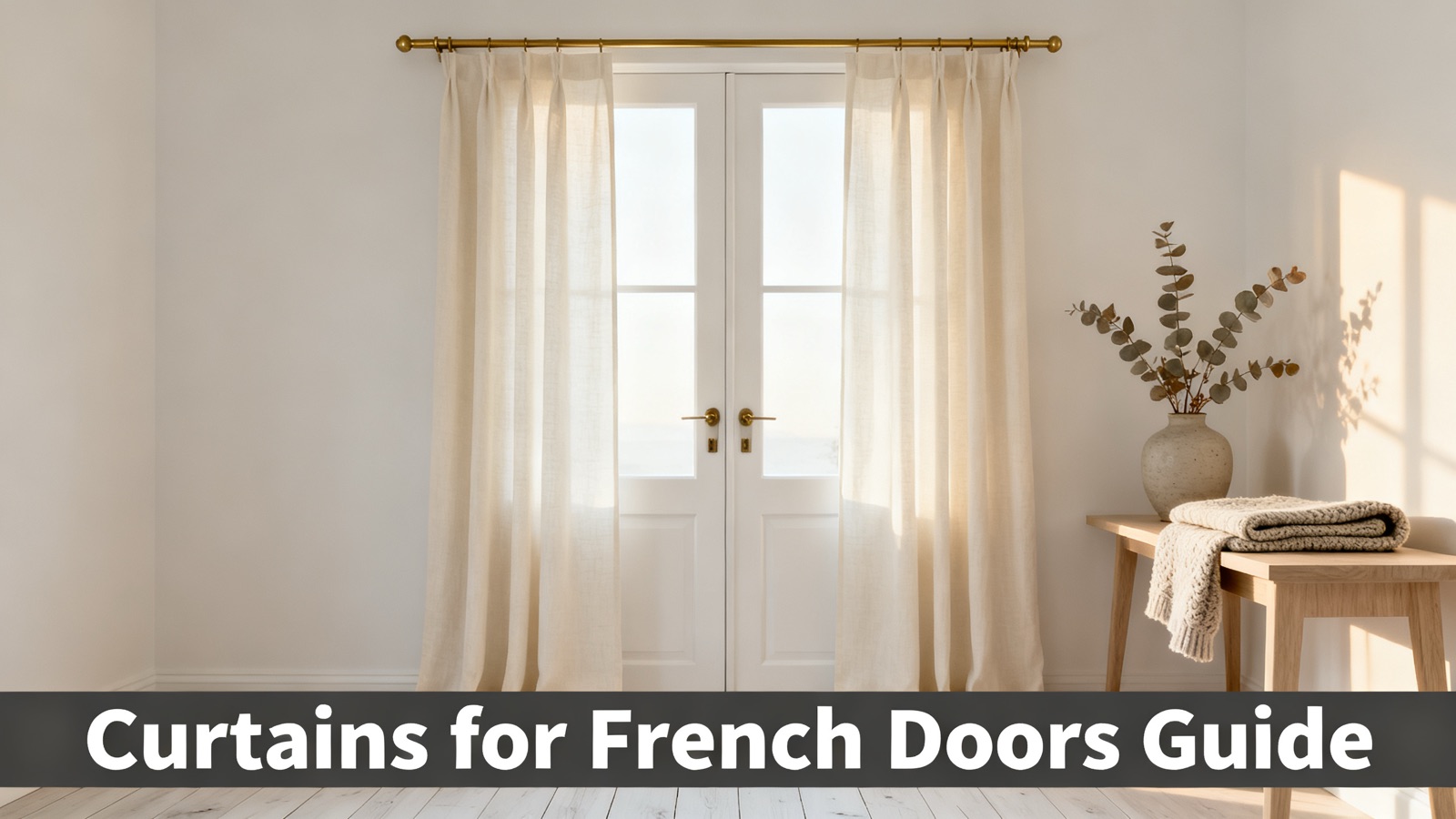
French doors are the piece of interior architecture people love and then quietly panic about at curtain time. The paned glass is the whole point of the design, but it is also full-height, west-facing on half of American homes, and swinging in and out of a room where you actually live. Standard rod-and-panel logic quits at the trim.
This hub is the map. There are only three questions worth answering before you buy anything: what actually fits, why the mount matters more than the fabric, and where each style earns its price. Get those three right and the product picks a themselves.
Three Questions This Hub Answers
1️⃣
What curtain types actually fit French doors?
Door-mount cellular, no-drill roman, cafe half-pane, flanking sidelight drapery. Four viable answers, one dead end.
2️⃣
Why does the mount matter more than the fabric?
French doors swing, so the panel either travels with the door or clears it entirely. Get that wrong and no fabric saves the install.
3️⃣
Where in the house does each style earn its price?
Bedrooms want blackout cellular. Living rooms want flanking linen. Kitchens want cafe. The room writes the spec.

If your problem is the other kind of glass door, the one that slides on a track instead of swinging, the mounting geometry flips. See our guide to sliding glass door treatments for the parallel hub.
The Three Questions, Answered
Start with the shortlist of what fits. On French doors, four curtain types actually work at scale: door-mounted cellular shades (usually magnetic, cordless, sometimes blackout), no-drill roman shades (bracket-clipped to the glazing bead), cafe-height panels on a tension rod covering only the lower panes, and flanking sidelight drapery on a wall-mounted rod that lets the doors themselves stay clear. That is the list. Standard traverse rods spanning the door opening are the dead end because they either block the swing or shed the panel every time the door moves.
The mount matters more than the fabric because French doors do something curtains almost never have to deal with: they move on a hinge. Every product on the shortlist above solves that in one of two ways. Either the panel is bolted to the door (rod-pocket, no-drill roman, magnetic cellular) and swings with it, or the panel is mounted to the wall well outside the swing arc (flanking sidelights, cafe tension rods that clear the door plane). You cannot mount a rod on the door frame directly above the trim and hope for the best. The trim vibrates, the panel wags, and by month three the mount rattles loose.
Three Header Layouts That Work on French Doors
🪟
Door-Mounted Rod-Pocket Panel
Top and bottom rod sleeve on the door itself. Panel travels with the swing, glass stays covered.
🎀
Cafe Height Pinch Pleat
Tension rod at pane midpoint, covers only the lower glass. Daylight in, street view out.
🏛️
Wall-Mount Flanking Sidelight
Full-length panels on a wall rod above and beside the trim. Doors stay operable, panels frame them.
Where each style earns its price is a room question, not a taste question. Bedrooms want cellular blackout because sleep is measured in hours of true dark. Formal living rooms want flanking linen because the drape length reads architectural. Kitchens want cafe because you want to cook in daylight and still not stare at your neighbor while you do it. Nurseries want cordless anything because loose lift cords are a hazard. That is the entire logic, and the rest of this hub is just filling it in.
Material 101
Fabric on a French door has three jobs: cover the glass, control the light, and hold its shape when the door moves. Four fabric families do those jobs in different combinations, and Two Pages configures them across every collection. Linens filter warmly and drape softly. Cottons carry weight, tolerate lining, and take dye deeply. Cellular honeycomb is not a fabric at all, it is a structural polyester cell that seals to the glass. Woven roman fabrics live in between, tailored enough to fold cleanly and heavy enough to block glare. Every Two Pages panel and shade referenced in this hub is OEKO-TEX Standard 100 certification compliant, which matters if the room in question is a nursery or a bedroom for anyone with fabric sensitivities.
| Fabric family | Weight (gsm) | Light behavior | Best on French doors when… | Typical Two Pages price |
|---|---|---|---|---|
| Linen & linen blends | 180-350 | Soft filter, warm cast | Doors are flanked by wall (sidelight/full-length config) | from $59.99/panel |
| Cotton & cotton blends | 200-400 | Filtering to room-darkening with lining | Cafe height on lower glass panes | from $49.99/panel |
| Cellular honeycomb | N/A (structural) | Sheer to 100% blackout by cell type | Door-mount is required and blackout is the target | from $108.99/shade |
| Woven roman fabrics | 220-320 | Filtering (blackout with lining) | Door-mount aesthetic with tailored fold profile | from $69.99/shade |
Linen & linen blends
Linen is the fabric people mean when they picture a curtain in a French-door room. It filters daylight into that specific warm cast that makes even a north-facing living room feel like a south-facing one. The Two Pages workhorse in this category is the Liz Linen Drape Pleated, a 10% linen / 90% polyester blend at 350 gsm that hangs like the pure-linen version at a fraction of the price and does not wrinkle at the fold points.
On French doors specifically, linen almost never door-mounts. It flanks. You put a wall rod above the trim, drop full-length panels on either side, and let the doors themselves stay unencumbered. The linen frames the architecture instead of covering it. That configuration also lets you use a lining, which linen desperately needs if the doors are on a west or south exposure, because unlined linen at 180 gsm passes enough UV to fade the panel and warm the room in equal measure.

Cotton & cotton blends
Cotton is the cafe-curtain fabric. It takes a tension rod cleanly, holds a pinch pleat, and comes in weights that survive a kitchen without going limp. The Two Pages Custom Cafe Curtains Pleated collection is built on three cotton or cotton-blend bases (Patti 100% linen, Jawara linen-cotton, Isabella heavy cotton) and configures down to 18 inches wide by 18 inches drop, which is what you need for a French door pane. Cotton also darkens well when you add a room-darkening or blackout lining, and it takes prints far better than linen does, so if the room wants pattern, this is the family.
Cellular honeycomb (structural)
Cellular is not a fabric. It is a folded-polyester structure where hexagonal air pockets create the shading and the insulation at the same time. Two Pages ships cellular in single-cell and double-cell versions, and the Aura No-Drill Blackout Cellular Window Shades Cordless collection uses a 100% blackout cell that seals to the glass on a magnetic mount. The result is a shade that also functions as thermal insulation against the door pane, which is the coldest surface in most rooms in winter and the hottest in summer. This is the only fabric family where you get true blackout in a single product, no lining upgrade required.
Woven roman fabrics
Woven romans are the middle path. They door-mount like cellular, they read as fabric like linen, and they tailor cleanly when raised because of the fold-and-stack construction. The Britt Bengoechea Flat Fold No-Drill Roman Shade is the designer entry in this category (husk, oatmeal, and clay colorways at $119/shade), and the Celia Patterned No-Drill Roman is the pattern entry at $69.99. Woven romans are filtering by default. If you want blackout, you spec the roman with a room-darkening liner, and you lose about 15% of the tailored profile at the fold points.

Lining is the second half of the material conversation, and Two Pages configures it in four tiers across every panel collection.
Lining Options (Liz Linen & Two Pages Configurable Panels)
Unlined
Sheer, daylight through
+$0
~10% shading
Privacy lined
Daytime privacy, soft light
+$25/panel
~70% shading
Room darkening
Bedroom-grade dim
+$35/panel
~90% shading
100% blackout
True dark, 2-pass coated
+$55/panel
100% shading
Use Cases: Where Each Style Works
The room writes the spec, and the reason is that each room asks a different question of the curtain. Bedrooms ask for dark. Living rooms ask for architecture. Kitchens ask for daylight without the neighbors. Once you know which of those three sentences applies to your French doors, the fabric and mount choose themselves.
Bedrooms & nurseries
Bedrooms are the room where French doors get their reputation for being annoying. The doors usually lead to a private patio or a balcony, which means the room is west or south facing, which means dawn arrives at 5:47 in July whether you asked for it or not. The right answer is almost always a door-mounted blackout cellular shade. The Aura No-Drill Blackout Cellular Window Shades Cordless collection nails this because the honeycomb cell seals to the glazing bead, the magnetic mount does not damage the door frame, and the shade travels with the swing so you can open the doors without dismounting anything.
Best Blackout Curtains for French Doors
Focused breakdown of true 100% blackout options for bedrooms and home theaters with French door access.
In a nursery, the same shade applies plus one extra rule: cordless is mandatory. Aura ships cordless by default. If you want the softer look of drapery instead, you can still door-mount rod-pocket linen panels with a blackout lining, but you need top-and-bottom rod sleeves so the panel does not billow when the door moves. That is the only drapery configuration that qualifies as safe in a room where a child sleeps.
Living rooms & formal entries
Living rooms flip the question. The doors here usually lead outdoors and the point of the room is often to show them, not cover them. The right move is a wall-mounted flanking pair of full-length panels, drapery language that reads as architecture. Liz Linen Drape Pleated in a neutral colorway does this at $59.99 per panel, and if the room needs more tailored formality, the Britt Bengoechea Flat Fold No-Drill Roman Shade can go door-mounted alongside the flanking linen for a layered look. For daytime privacy without losing the light, look at Liz Linen in a privacy-lined configuration or the sheer options that diffuse daylight without darkening the room.

Kitchens, dining & breakfast nooks
Kitchens are the room where French doors most often lead to a backyard or a herb garden, and the treatment problem is specifically the lower half of the glass. You want breakfast light. You do not want the neighbor across the fence watching you make it. That is exactly what cafe curtains exist to solve: pleated panels on a tension rod at the mid-pane, covering only the bottom half of the glass. Custom Cafe Curtains Pleated at $49.99 per panel is the entry into this category, and it configures narrow enough (18 inches wide, 18 inches drop) to actually fit a paned French door instead of overhanging it.


Dining rooms with French doors leading onto a patio deserve pattern. A Celia Patterned No-Drill Roman Shade in a woven natural does more to warm a dining room than a plain shade will. It also door-mounts, which keeps the doors operable when the party spills onto the patio.
Coverage Patterns for French Doors
Full Pane, top to bottom
Door-mount shade or panel over the entire glass area.
Use for: bedrooms, blackout, night privacy
Half Pane (cafe)
Lower panes only, upper glass stays clear for daylight.
Use for: kitchens, breakfast nooks, ground-floor street exposure
Flanking Sidelights
Full-length panels above and beside on a wall rod, doors stay uncovered.
Use for: living rooms, formal entries, patio-facing façades
French Door Curtain Ideas
30+ styled looks across cafe, full-length, sidelight, and shade configurations to spark direction.
The Five Picks Worth Knowing
Five products from the Two Pages catalog do most of the heavy lifting on French doors. Each of them earns its place because the mount type, coverage pattern, and price fit an actual room use, not a marketing bucket. For a full head-to-head with tier, price, and scoring, see our five picks for French doors ranked by tier, including the specific configurations that beat magnetic mounts on wider doors.
The Five Picks Worth Knowing
Overall Pick
Aura No-Drill Blackout Cellular
Door-mount, 100% blackout, magnetic. Best for bedrooms.
from $108.99/shade
Designer
Britt Bengoechea Flat Fold Roman
Tailored no-drill, woven fabric. Best for living rooms.
from $119.00/shade
Pattern
Celia Patterned No-Drill Roman
Cotton-blend woven pattern, no-drill. Best for dining rooms.
from $69.99/shade
Flanking
Liz Linen Drape Pleated
Full-length sidelight panels, 38 colors, 6 linings.
from $59.99/panel
Budget Classic
Custom Cafe Curtains Pleated
Lower-pane only, tension rod, timeless French look.
from $49.99/panel
Read the grid as an if-then. If the doors lead to a bedroom, Aura. If the doors lead to a formal living room, Britt Bengoechea plus a flanking Liz Linen pair. If the doors are in a dining room with personality, Celia. If the doors already have wall room around them for full-length drapery, Liz Linen alone. If the doors are in a kitchen, Custom Cafe. Every other configuration is a variation on one of those five.
Flanking Panel Pick
Liz Linen Drape Pleated
from $59.99/panel
- 38 colors, 9 header styles, 6 linings including 100% blackout
- Custom widths from 18″, perfect for narrow sidelights or full flanking pairs
- OEKO-TEX certified, 350 gsm heavyweight linen blend
Code JULY for 20% off · Free swatches shipped
Mounting: The Part Everyone Gets Wrong
Three mount types cover every viable French-door configuration: magnetic, adhesive bracket, and tension. Magnetic requires a ferrous metal glazing bead on the door, which most modern French doors have but full-wood interior French doors do not. Adhesive works on painted or matte trim, but only if the paint has cured for at least 30 days, otherwise the bracket peels the finish off with it. Tension rods clear the glass entirely, bracing between two vertical stops. Wall-mounted screwed brackets are a fourth option, but only when the panels are flanking sidelights well outside the door swing.
Measurement is where the most people lose money. On door-mount shades, measure the visible glass pane itself, not the door frame or the trim. The mount clips to the glazing bead, and the shade width should equal the glass width plus roughly half an inch of overlap on each side. On flanking panels, measure from a rod placement 4 to 6 inches above the trim down to the floor, so the panels never brush the door hardware or catch under the door itself when it swings inward.
How to Hang Curtains on French Doors (No Drilling)
Step-by-step on magnetic rods, tension rods, and adhesive brackets: without cracking the trim.
Rod height for the flanking-panel configuration is the number one first-time-buyer mistake. People install the rod flush with the top of the door trim and end up with panels that hang inside the door swing. The fix is trivial: mount the rod at least 4 inches above the trim, and 8 inches wider than the trim outline on each side. That leaves the panels resting entirely outside the swing arc when the doors open.
📏 Pro Tip: On door-mount shades, measure the visible glass pane, not the door frame. The magnetic or bracketed mount clips to the glazing bead, and you want about half an inch of shade overlap on each side of the glass. For flanking panels, measure from a rod placement 4 to 6 inches above the trim down to the floor, so the panels never brush the door hardware.
FAQ: Fast Answers to Common French-Door Curtain Questions
Do curtains have to be door-mounted on French doors?
Not always. Door-mounted panels or shades (rod-pocket, no-drill roman, magnetic cellular) travel with the swing and cover the pane fully. Wall-mounted flanking panels above and beside the trim leave the doors themselves clear, which reads more formal. Cafe-height tension rods split the difference by covering just the lower glass and mounting to the door pane midpoint. The room use decides which one you actually want.
Can you get true 100% blackout on paned French doors?
Yes, cellular shades are the shortest path. A door-mounted honeycomb like Aura No-Drill Blackout Cellular gets you a 100% shading rate in a single product because the cells hug the glass and the mount seals the edges. Fabric drapes with 100% blackout lining also work, but only in a flanking wall-mount configuration where the panels overlap the door frame by 3 to 4 inches on each side.
Do no-drill mounts work on painted or matte trim?
Magnetic mounts need a ferrous metal glazing bead on the door, which most modern French doors have but full-wood interior doors do not. Adhesive brackets work on painted or matte trim but the paint needs 30 or more days of full cure before install, otherwise the bracket peels the finish when removed. Tension rods bypass the trim entirely, they brace between two vertical stops.
Cafe curtains or full-pane, which reads more traditional?
Cafe curtains are the older, more classically French look, especially in kitchens and dining rooms opening onto a garden. Full-pane door-mounted panels read more transitional-modern. Neither is wrong, but if the house is farmhouse or Colonial-style, cafe height fits the vernacular. Contemporary or transitional interiors lean full-pane or flanking sidelights.
What if the panels keep catching the door swing?
The panel is either too long or the mount is on the trim instead of the door. Move the rod to the door itself (door-mounted rod-pocket), or shorten the drop to sill-length not floor-length. Flanking wall-mounted panels should be 4 to 6 inches clear of the door swing arc at maximum open position. If clearance is impossible, switch to a door-mounted cellular shade and skip the drapery entirely.
Related Hubs & What to Read Next
French doors are one of five window-shape hubs on the Two Pages editorial map. If your project actually spans more than one door or window type, or if the doors themselves are a variant (sliding, arched, extra-tall), the parallel hubs below carry the same style of deep dive on their own geometries.
Related Two Pages Hubs
🚪
Sliding Glass Door Curtains
Track-mount instead of swing: parallel hub with a different geometry.
🪟
Bay Window Curtains
Bent rods and 3-panel arrangements for angled window banks.
📏
Extra Long & Floor-to-Ceiling
If your French doors sit under 10-foot ceilings, drop length changes the math.
🍼
Nursery & Kids Room Curtains
Cordless is non-negotiable, and blackout wins bedtime.
Methodology & Editor’s Bottom Line
This hub was built by cross-checking every configurable panel, roman, cellular and cafe collection on twopagescurtains.com against French-door-specific geometry and use cases. The picks and configurations were then anchored against verified Judge.me photos and the 4.5 out of 5 across more than 5,000 verified Trustpilot reviews that Two Pages has accumulated, rather than against vendor copy alone. The result is a hub that tells you what to buy, why the mount matters more than the fabric, and where each style earns its keep.
How This Hub Was Built
📚 47 collections screened
Every configurable panel, roman, cellular and cafe collection on twopagescurtains.com was cross-checked against French door geometry.
📐 5 fit criteria
Mount type, coverage pattern, lining depth, header compatibility, and price-to-coverage were scored for each pick.
⭐ Owner signal cross-checked
Verified Judge.me photos and Trustpilot patterns anchored the room-fit claims, not vendor copy.
The Two Pages editorial team specializes in translating textile engineering into buying decisions for owners of custom window treatments. If you want a human read on your specific configuration, the free Two Pages design consult is worth the twenty minutes. Bring your door dimensions, your room exposure, and a photo of the trim, and you walk out with a spec.
🎁 Not sure how a fabric will read against your French door trim? Order up to 5 free swatches
Tape them to the glass and read the real color in your room’s actual light before configuring. $8.99 shipping, 3-5 day delivery.
Editor’s bottom line: If you are reading this hub because the French doors are already installed and you have to solve the treatment this month, buy the Aura No-Drill Blackout Cellular. It is the safest default across the widest range of doors, rooms, and expectations. Everything else in the picks grid is an upgrade for a specific room use, not a replacement.
Aura No-Drill Blackout Cellular Shade
from $108.99/shade
The safest starting point for most French doors: no drilling, full blackout, travels with the swing.
Code JULY for 20% off · Free shipping over $300 · 10-14 day lead time
