
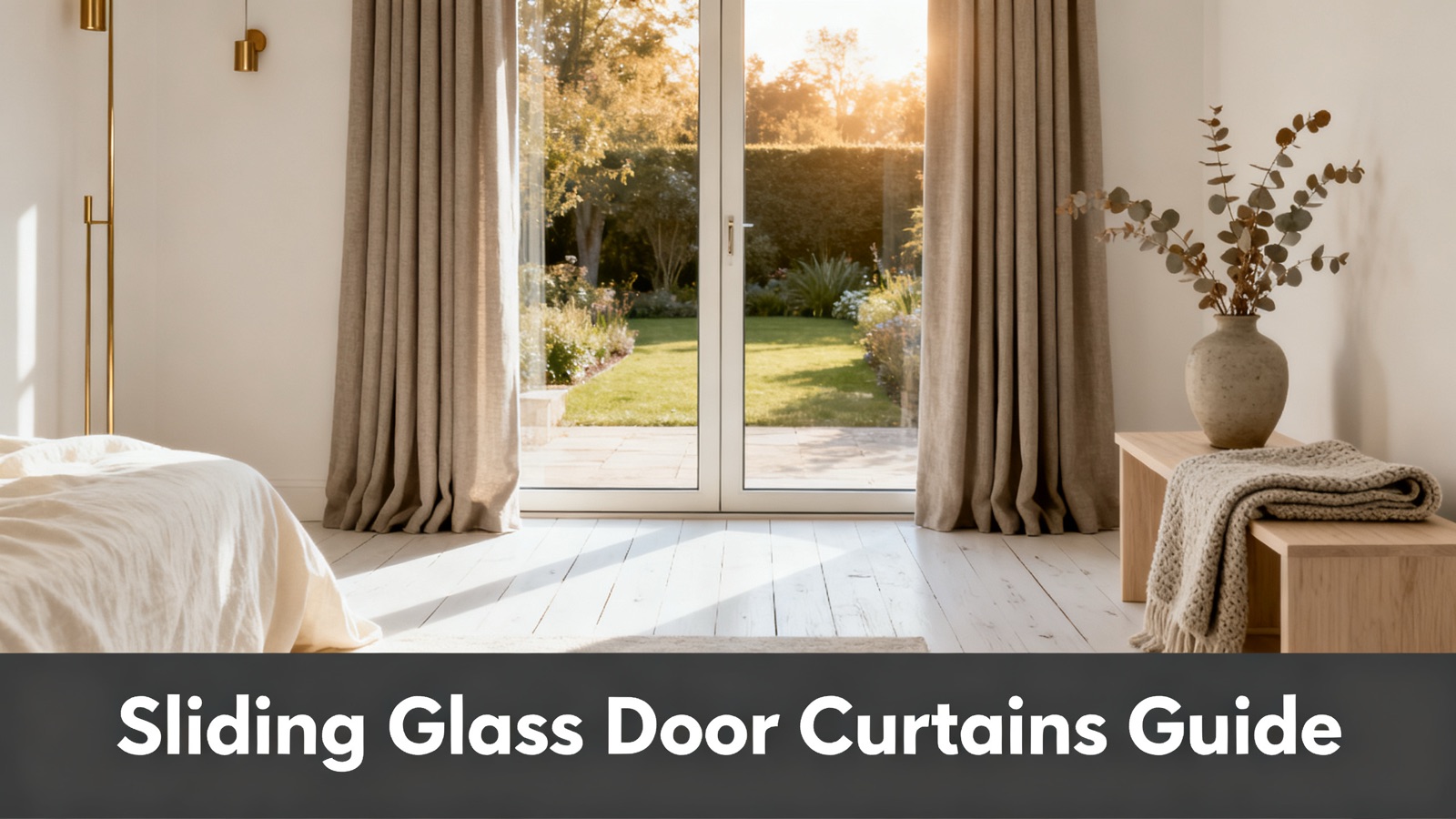
Sliding glass doors are the widest, tallest, and most exposed piece of glass in most homes. That changes the shopping problem completely.
We pulled specs on 24 curtain and shade collections that Two Pages and its peers ship for sliding openings, cross-referenced them with verified owner reviews on Judge.me and Trustpilot, and mapped what actually holds up on a 96 inch drop.
Quick answer: three fabric families win for sliding glass doors
If you want the short version, three fabric families cover about 90 percent of what people actually put on sliding glass doors.
Light-filtering linen or linen blends for daylight rooms, heavyweight cotton drapery for winter-facing rooms that need thermal help, and 99% blackout kits with ceiling track for bedrooms or media rooms. The rest is a question of drop, header, and how wide the opening actually is.

Editor’s pick for wide sliders
Liz Linen Ripple Fold Drapery
Wave-track ripple fold, up to 288″ wide × 130″ drop, four lining options, 38 colors. from $119.99/panel. Final price depends on size and lining. Code JULY for 20% off. Free shipping over $300.
How we compared 24 curtain and shade collections
Sources: catalog data, verified owner reviews, certifications
Every collection in this guide was scored on public catalog data (composition percentage, gsm, shading rate, max custom width and drop, header options, lining options, lead time, base price per panel).
We layered on verified buyer reviews from Judge.me for owner-observed drape behavior, wrinkle rebound after shipping, and lining performance in real light, plus OEKO-TEX Standard 100 certification status on linen and linen-blend collections. You can review the certification framework on the OEKO-TEX Standard 100 page.
Criteria weight: drop range, header, lining, price
For sliding glass doors specifically, four criteria carry more weight than they do for standard windows.
Drop range matters because door frames start higher than most windows. Header matters because wide openings show pleat bunching more than narrow ones. Lining matters because sliders are the biggest energy leak point in most rooms. Price per panel matters because you almost always need two panels or a wave configuration, so cost doubles fast.


Why sliding glass doors are different from standard windows
A standard window sits inside a wall, framed on four sides, usually under 60 inches wide. A sliding glass door starts at the floor, runs 80 to 96 inches tall, and stretches 60 to 144 inches wide before you count doorwall configurations.
That geometry breaks three habits that work on windows. Ready-made panels (52 or 60 inches wide) leave gaps. Standard rods (28 to 84 inches) do not extend enough for stack-back clearance. Traditional pinch pleats read fine on a narrow window but visibly bunch on an 8 foot span.
The four Two Pages collections that fit sliding glass doors
Liz Linen Drape Pleated: the light-filtering best-seller
Liz Linen is the Two Pages workhorse. It ships from $59.99 per panel, weighs 350 gsm, and combines linen with viscose for a slightly heavier hand than pure linen (which prevents the flimsy look that pure linen can take on very wide sliders).
You get 38 colors, four lining options (unlined, cotton, blackout, thermal blackout), and memory training on request so the pleats hold their shape after shipping. For a typical 72 inch slider, expect the configurator to land around $130 to $180 per panel with cotton lining and standard drop.
Read the full Liz Linen Drape review for the full spec and owner-photo audit.
Liz Linen Ripple Fold Drapery: the fluid wide-panel drape
For doorwalls (opening widths over 96 inches) or great-room sliders, the pleated version starts to look busy. Ripple Fold is the answer.
Ripple Fold is the same Liz Linen fabric, mounted on a wave carrier that spaces the fabric evenly with soft S-curves instead of pleats. Max size is 288 inches wide × 130 inches drop and the base price is from $119.99 per panel, which sounds higher until you compare it to two pleated panels plus hardware.
Read the full Liz Linen Ripple Fold review for the wave-track hardware compatibility notes.
Isabella Heavyweight Cotton Drapery: the thermal winter-slider
If the slider faces north or the room runs cold in winter, weight helps. Isabella Heavyweight Cotton Drapery is a 24% cotton, 76% polyester blend at 500 gsm, which is close to the upper end of what Two Pages ships in a residential drapery.
Base price is from $89.99 per panel, and paired with the thermal blackout lining you get a still-air pocket between fabric and glass that measurably slows heat loss. ENERGY STAR documents this behavior in its window attachments guidance.
Read the full Isabella Heavyweight Cotton review for lining-by-lining thermal data.
Atlanta Ceiling Track Blackout Kit: 99% blackout with hardware
Atlanta is a different animal. It ships as a kit: a 252 gsm polyester blackout panel, an aluminum ceiling track pre-drilled for flush mount, roller hooks, end caps, connectors, and screws. One SKU covers panel plus hardware.
It sizes in two ladders (8 ft and 8.5 ft tall) across six width tiers from 3 to 18 feet, and the shading rate is 99% blackout. Base price is from $200.99 per kit. Choose this if the slider opens directly onto a bedroom, if you rent and cannot drill into the door frame (ceiling mount stays with the ceiling), or if you want a bedroom-partition option for a studio.
Read the full Atlanta Blackout Kit review for size ladder guidance.
Specs at a glance: four Two Pages collections
| Collection | Material | gsm | Max size | From |
|---|---|---|---|---|
| Liz Linen Drape Pleated | 10% linen / 45% viscose | 210 | 150″ W × 130″ L | $59.99/panel |
| Liz Linen Ripple Fold | 10% linen / 45% viscose | 210 | 288″ W × 130″ L | $119.99/panel |
| Isabella Heavyweight Cotton | 100% cotton | 265 | 150″ W × 130″ L | $89.99/panel |
| Atlanta Blackout Kit | 100% polyester | 252 | 18′ W × 9′ L (kit) | $200.99/kit |
Prices are base configuration. Your actual configurator quote depends on width, drop, header, and lining.
Pricing by configuration: what to budget for a 72″ slider
Two Liz Linen panels, cotton lining, 96″ drop, pleated header.
One Ripple Fold panel, 144″ W × 100″ L, cotton lining, wave track.
Atlanta Medium A (fits 4’6″ to 6′ wide × 8′ tall) plus ceiling track.
Lining options at Two Pages, ranked by daylight blocked
Same fabric, four different daytime feels.
Softest, most translucent, best for airy rooms.
Adds weight and structure, standard choice.
Bedrooms and nurseries, hard cut of daylight.
Adds a still-air pocket for winter-facing sliders, reduces perceived draft by 2 to 4 degrees.
99% blackout kit
Atlanta Ceiling Track Blackout Kit
Panel + aluminum ceiling track + roller hooks + connectors, sized for spaces 3′ to 18′ wide × 8-9′ tall, ships as one SKU. from $200.99/kit. Final price depends on span. Free shipping over $300.
Comparisons: sheer, blackout, shades, panel track
Once you know the fabric families that work, the second decision is treatment type. Curtains are only one of five paths, and each has a clear-cut window (pun accepted) of use cases where it wins.
Sheers and blackouts split by daytime versus nighttime priority. Shades (bamboo, cellular) split by aesthetic (visible weave) versus insulation performance. Panel track systems live between vertical blinds and drapery for very wide openings.
Curtains vs Blinds for Sliding Glass Doors
Vertical blinds, panel track, and drapery compared on drop range, light control, stack-back, kid safety, and 10-year cost. Decision matrix with three personas.
Sheer curtains for sliding glass doors
Sheers keep the outside view visible while softening glare. That trade is exactly right for living rooms, dining spaces, and any slider that opens onto a garden or view you actually want to keep.
Look for lightweight linen or linen blend around 150 to 180 gsm, unlined, in ivory, natural, or oatmeal tones. Our best sheer curtains for sliding glass doors roundup ranks five collections by drop, opacity, and header compatibility.
Blackout curtains for sliding glass doors
Blackout wins in bedrooms and media rooms. The right lining is more important than the fabric face here: a linen panel with a blackout lining performs the same job as a heavy polyester blackout, at higher price and better feel.
The Atlanta ceiling track kit remains the easy answer if you want a single SKU that includes hardware and delivers 99% shading. If you prefer a designed drape, Liz Linen with blackout lining does the same job in a softer envelope.
Bamboo and cellular shades for sliding glass doors
Bamboo shades add a visible natural weave and a coastal feel, but on sliding doors they need horizontal traverse or panel-track carriers to actually retract.
Cellular shades (honeycomb) are the highest R-value window covering per dollar, especially in vertical cellular configurations designed for sliders. They win on thermal performance, they lose on softness. Choose them when energy bills matter more than drape.
Panel track systems
Panel track is the modern replacement for vertical blinds. Flat fabric panels ride an overhead carrier, sliding one behind the other rather than pleating.
They excel on very wide openings (over 120 inches) and where you want a hard, architectural line. The trade is that they read modern, sometimes commercial, and lose the softness of a drape.
Comparison grid: five treatments across six criteria
| Treatment | Light control | Drop range | Softness | Insulation | Wide-span |
|---|---|---|---|---|---|
| Sheer linen | Low | High | High | Low | Med |
| Lined drapery | Med | High | High | Med | High |
| Blackout drapery | High | High | Med | High | High |
| Cellular shades | Med | Med | Low | High | Med |
| Panel track | Med | Med | Low | Low | High |
The blackout drapery row scores highest on the multi-criterion balance for most sliding-door owners, which is why Liz Linen with blackout lining is the most common Two Pages configuration for this use case.
Decision flowchart: which treatment fits your slider?
→ Blackout drapery (Atlanta kit or Liz Linen + blackout lining).
→ Sheer or lined linen (Liz Linen unlined or cotton-lined).
→ Ripple Fold or panel track (Liz Linen Ripple Fold up to 288″).
→ Isabella cotton + thermal blackout or vertical cellular shades.
Guides: how to measure, hang, and pick hardware
Three how-to blocks unblock most owners: measuring correctly, mounting cleanly, and picking a rod or track that fits the actual opening. If your slider is wider than 96 inches, hardware becomes the deciding constraint before fabric even matters.
How to Measure for Sliding Glass Door Curtains
Step by step: rod height above frame, panel width for stack-back clearance, drop to floor vs puddle, and the four measurements Two Pages needs at checkout.
How to measure for sliding glass door curtains
Measurement summary for people who want the short version now, the deeper guide later. Width equals door frame plus 12 to 18 inches of stack-back clearance on each side. Drop equals rod height (mount 4 to 6 inches above frame) to floor, minus 0.5 inch for clearance.
Two Pages checkout asks for finished panel width, finished panel drop, header type, and lining. Nothing about rod length, which is your own hardware call.
Sliding Door Curtain Rod & Track Ideas
Wave track vs traverse rod vs ceiling track, wall mount vs ceiling mount, extra-wide extension setups, and hardware compatible with double panels up to 18′ wide.
How to hang curtains over a sliding glass door
Ceiling mount reads taller and cleaner on modern sliders. Wall mount is easier for renters and works fine when the ceiling is textured or beamed. Extend the rod at least 6 to 9 inches past the frame on each side so panels stack off the glass.
If your slider is wider than 96 inches, budget for two brackets minimum on wall mount, or ceiling track with a center support for kits like Atlanta.
Two Pages headers: which work on wide sliders
Best for wide, wave carrier
Standard, up to 96″ clean
Casual, easy glide, med
Sheers, no traverse
Rings, tailored casual
Concealed, minimal
Formal, needs stack space
Modern, sharp fold
Casual, avoid on wide
For sliders over 100 inches wide, Ripple Fold, Inverted Pleat, and Grommet handle the span most cleanly. Tab Top and Rod Pocket create too much friction to slide smoothly on a long rod.
Choosing rods, tracks, and wave systems
Width = frame + 12″ to 18″ per side. Drop = rod height (4″ to 6″ above frame) to floor, minus 0.5″. Rod extension = frame + 6″ to 9″ per side. Wave track = order carrier 4″ to 6″ wider than rod length.
Calculators, swatch tools, and how to shortcut a bad order
The two tools that shortcut a bad order are the Two Pages pricing calculator (embedded on every product page) and the swatch booklet. Together they cost less than a takeout dinner and eliminate the two biggest post-order regrets: wrong color, wrong config price.
Two Pages pricing calculator
Enter width, drop, header, and lining. The calculator returns your finished panel price in real time, before checkout. Best used with your actual measured width, not an estimate.
Embedded on every product page at twopagescurtains.com.
Order swatches before you commit. A 5 by 8 inch physical linen swatch under your actual morning light tells you what a 96 inch drop will look like. Product photos never will.
Order the Liz Linen swatch booklet — $3.99
38 physical linen swatches shipped to your door. See how each color reads against your floor, wall paint, and morning light before committing to a wide sliding-door panel. Refundable against your first order.
Inspiration: style directions with real drop, header, lining
Same slider, three moods. The variable is not the room, it is the fabric plus header plus lining combination. If you want more configurations, our 30+ sliding glass door window treatment ideas gallery pairs each look with the exact spec that shipped.
Filtered daylight
Liz Linen unlined, natural or ivory, Ripple Fold, ceiling mount. Reads airy at any hour.
Neutral drape
Liz Linen cotton-lined, oatmeal, pinch pleat or inverted pleat, wall mount 6″ above frame.
Full blackout
Atlanta ceiling track kit in charcoal or graphite, or Liz Linen with thermal blackout lining.
Coastal light-filter direction
Ivory or natural Liz Linen, unlined, Ripple Fold on a ceiling-mounted wave track. The drape reads translucent in daylight and softly opaque at night without ever going dark.
Warm-modern neutral direction
Oatmeal or khaki tones, cotton-lined for slight structure, pinch pleat or inverted pleat, wall-mounted 6 inches above the frame. Works with warm woods, ceramic accents, and any furniture in the sand-to-caramel range.
Contemporary blackout direction
Charcoal or graphite tones, thermal blackout lining, ceiling mount to visually stretch the wall. If you want an all-in-one kit rather than lining upsell, see our best blackout curtains for sliding doors ranking (Atlanta consistently pins the top).
Liz Linen color preview: 12 of 38 shades
Approximate swatches. Order the physical booklet to confirm under your actual daylight before committing.
Two Pages pricing, promo codes, and trade program
Two Pages ships everything in this guide directly, with a Shopify configurator behind each product page. Standard lead time is 15 to 25 business days from order confirmation. Free shipping over $300 applies to all US orders.
The default promo code is JULY (20 percent off sitewide) and applies to Liz Linen, Isabella, Atlanta, and most residential drapery. Use WOVEN (20 percent) if you cross-shop bamboo shades. Trade professionals (designers, stagers, procurement) get VIP22 (22 percent) on luxury lines after enrolling in the trade program. Heck Solid Acrylic Outdoor is worth a look if your slider opens onto a covered patio or pergola and you want a matching outdoor curtain for the exterior side.
Frequently asked questions about sliding glass door curtains
What are the best curtains for a sliding glass door?
Three fabric families cover 90 percent of sliding glass door setups. Light-filtering linen or linen blends (like Two Pages Liz Linen Drape, from $59.99/panel) diffuse afternoon glare while keeping the outside view usable. Heavyweight cotton drapery (like Isabella, from $89.99/panel) adds thermal insulation for winter-facing sliders. 99% blackout kits with ceiling track (like Atlanta, from $200.99/kit) are the answer when the slider opens directly onto a bedroom or streams east-morning sun. Wave headers or ripple fold configurations drape more consistently across the wide expanse than pinch pleats, which can bunch at the seams on doors over 96 inches.
How wide should curtains be for a sliding glass door?
Measure the door frame plus 12 to 18 inches of stack-back clearance on each side. That gives your panels somewhere to sit when open without covering the glass. For a standard 72 inch sliding door, plan for 96 to 108 inches of curtain width, split across two panels. Wider sliders (doorwalls at 96 to 144 inches) benefit from a ripple fold or wave-track system because the header stays flat across the span. Two Pages configures Liz Linen Ripple Fold up to 288 inches wide by 130 inches drop, which handles most modern great-room sliders in a single continuous panel run.
Should curtains cover the whole sliding door or just the glass?
Cover the whole opening, floor to just above the frame. Standard practice is to mount the rod 4 to 6 inches above the door frame (or ceiling-mount for a taller vertical line) and drop the panel to the floor with a 0.5 inch clearance so it does not drag. Half-length cafe curtains work for kitchen or bath windows, but they visually shrink a sliding door and leave the top glass unfiltered against afternoon sun. Full-drop panels also block cold air infiltration around the frame in winter.
Are sheer or blackout curtains better for a sliding glass door?
It depends on the room. Sheers work for living rooms and dining areas where you want daylight to filter through while softening the outside view. Blackout curtains work for bedrooms, nurseries, and media rooms where light control at 5 a.m. or during afternoon naps is the priority. A common middle path is a sheer front panel plus a blackout back panel on a double rod or ceiling track, so you can rotate through the day. Two Pages ships Liz Linen with four lining options (unlined, cotton, blackout, thermal blackout), which lets a single collection cover both use cases without switching brands.
Can you hang regular curtains over a sliding glass door?
Yes, provided the rod extends 6 to 9 inches beyond the frame on each side so the panels stack off the glass when open. Standard ready-made panels (52 to 60 inches wide) rarely cover a 72 inch slider without a gap, so you either need two pairs (four panels total) or a custom width. Two Pages configures any width up to 288 inches and any drop up to 130 inches, so a single ordered pair covers most standard and doorwall installs.
Do curtains help insulate a sliding glass door in winter?
Blackout and thermal linings measurably reduce cold air infiltration around a sliding door frame. Adding a 252 gsm blackout panel or a thermal blackout lining to a linen or cotton curtain creates a still-air pocket between panel and glass, which slows heat loss. The effect is documented in ENERGY STAR guidance on window attachments. It is not a replacement for a well-sealed door, but it can move the perceived temperature 2 to 4 degrees on a cold night and reduce condensation on the glass side.
Methodology recap and how we maintain this guide
Update cadence and reviewer credit
We re-audit this guide every 90 days: verify catalog prices, refresh owner-review pulls from Judge.me, confirm certifications, and re-rank collections if any spec changes. New collections enter the guide only after they carry at least 20 verified reviews across at least two sizing tiers.
This guide is maintained by the Two Pages editorial desk, which combines textile analysis (fabric composition, gsm behavior, header engineering) with residential window-treatment specifics. If you spot a spec drift, catalog change, or price mismatch, flag it and we correct in the next 90 day cycle.
Start here
Liz Linen Drape Pleated
The Two Pages best-seller for sliding glass doors: 350 gsm linen blend, memory training, four lining options, 38 colors, from $59.99/panel. Code JULY for 20% off. Free shipping over $300.
