
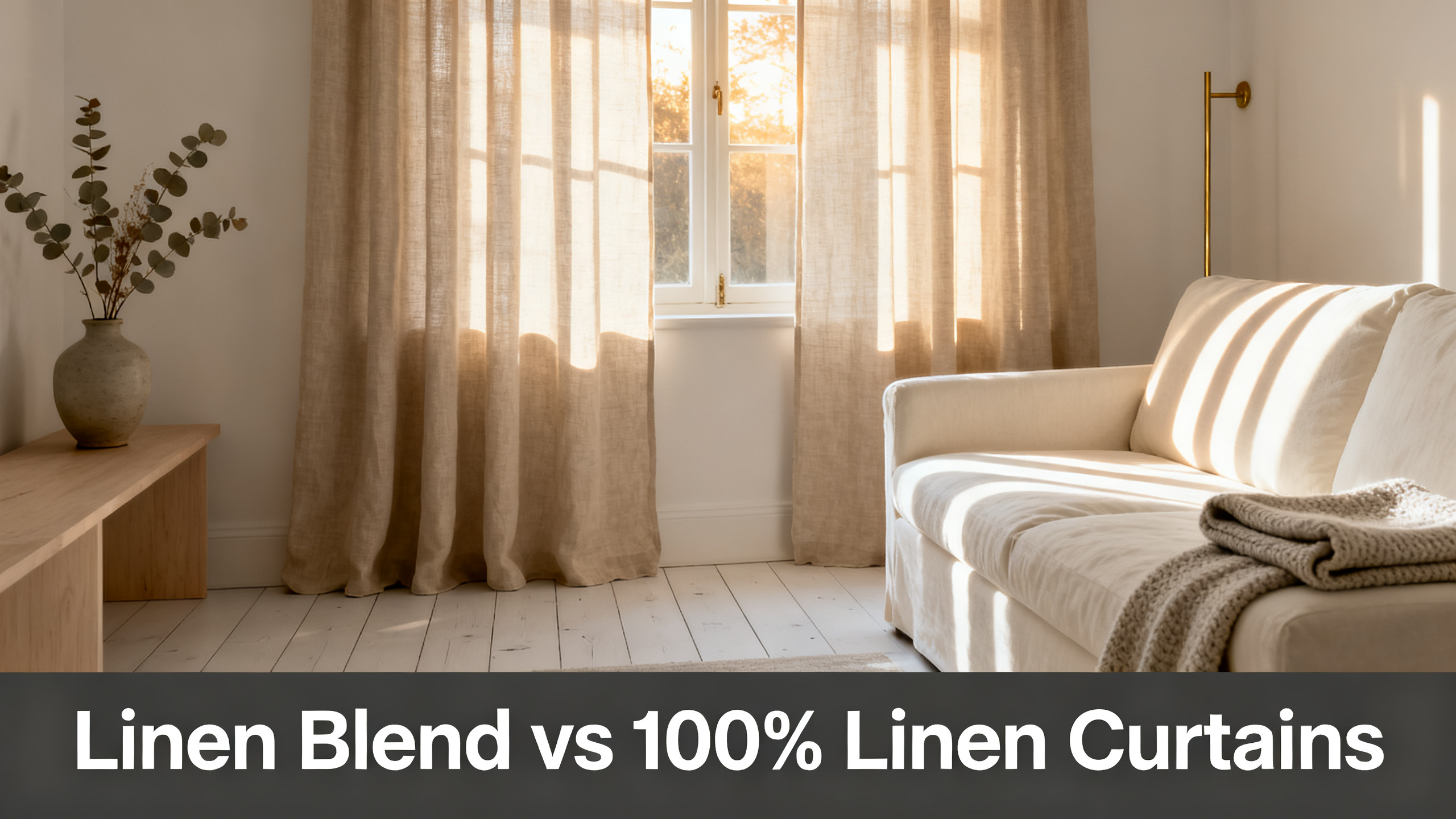
Here’s the deal with the word linen on a curtain label: it tells you almost nothing on its own. A panel sold as a “linen drape” can be 10% linen and 90% polyester, or it can be 100% Belgian Flax with field-of-origin certification. Same word. Two different products. Four times the lifespan gap.
The shortcut that actually works: 4 questions answer 90% of the decision. What is the composition really. How much wrinkle do you tolerate. Will you wash it like linen or like a sheet. Does the certification stack matter for your room. Two Pages has exactly one honest blend (Liz) and three real 100% linen panels (Patti, Doris, Erin), which is the rare lineup that lets you compare both sides without leaving the same brand. The wider context lives in our complete sustainable natural fiber curtains hub.
Question 1
Composition truth
What does the percentage line on the product page actually say? 10% / 90% is a different product from 100%.
Question 2
Drape priority
Day-one wrinkle-free crispness? Blend. Lived-in softening over months? Pure linen.
Question 3
Care tolerance
Hang-dry over 24 hours after each wash? Pure linen works. Tumble-low and forget? Blend.
Question 4
Certification need
Field-of-origin traceability matters? Only pure linen carries Masters of Linen.

Editor’s pick for accessible 100% linen
Patti Premium 100% Belgian Flax Linen Curtain
from $79.99/panel · 100% Belgian Flax Linen · 140 gsm medium weight · 9 muted colorways · the entry-tier proof that pure linen does not have to start at $200. Final price depends on size and lining.
Use code JULY for 20% off · Free shipping over $300
Composition: What “Linen” Actually Means on a Label
Linen is a fiber pulled from the stems of the flax plant. The stems are soaked (retting), broken, and combed into long line fibers and shorter tow fibers, which are then spun into yarn. That is the textile family. The deeper context lives in our full linen curtains pillar guide.
The legal fuzz is in how a finished panel can be marketed. There is no minimum linen percentage required to call a curtain a “linen drape” in the US market. A panel can be 5% linen and still wear the label, as long as the composition tag underneath spells it out.
The Liz Linen Drape Pleated from Two Pages is the honest version of this trick. The label says “Liz Linen,” the composition page says 10% linen / 90% polyester at 350 gsm heavyweight, the OEKO-TEX certified slub texture mimics linen, and ASID included it in the 2025 Fall Design Product Guide. None of that is hidden. You just have to read past the collection name to find it.
On the 100% line, Two Pages publishes three real options. Patti Premium 100% Belgian Flax Linen at 140 gsm. Doris 100% European Flax at 117 gsm, the only panel in the lineup carrying Masters of Linen credentials. Erin Elegant 100% Linen at 240+ gsm heavyweight. All three list the composition percentage on the product page in the first specs block.
Patti 100% Belgian Linen vs Liz Linen Blend: Which to Buy?
The head-to-head walkthrough on the exact two panels this guide keeps comparing, drape behavior, owner feedback after one wash, and which one earns the price gap.
The natural-fiber blend nuance matters too. Jawara Luxury Linen Cotton is 79% linen / 21% cotton at 274 gsm, and Ron Linen Herringbone is a linen-cotton weave at 205 gsm. These are not synthetic blends. Both fibers are plant-based, both biodegrade, both soften over wash cycles. Treat them as textile cousins of pure linen, not as the same category as the Liz polyester-majority blend.
| Two Pages panel | Composition (real) | Weight | Label says |
|---|---|---|---|
| Liz Linen Drape Pleated | 10% linen / 90% polyester | 350 gsm | “Linen Drape” |
| Patti Premium Belgian Flax | 100% Belgian Flax Linen | 140 gsm | “100% Belgian Flax Linen” |
| Doris European Flax Pleated | 100% European Flax (Masters of Linen) | 117 gsm | “100% European Flax Linen” |
| Erin Elegant 100% Linen | 100% Linen (heavyweight) | 240+ gsm | “100% Linen” |
| Jawara Luxury Linen Cotton | 79% linen / 21% cotton | 274 gsm | “Linen Cotton Curtain” |
| Ron Linen Cotton Herringbone | Linen / cotton herringbone | 205 gsm | “Linen Herringbone” |
Read that table once and the rest of the guide gets easier. Pure linen is binary, either the panel is 100% or it is not. Blend honesty is on a spectrum, from 90% polyester at one end to 21% cotton at the other.
Drape & Hand-Feel: The Paradox Buyers Don’t See Coming
Real talk: the 350 gsm Liz blend drapes straighter on day one than the 140 gsm Patti pure linen, and that surprises everyone who walked in expecting linen weight to mean linen behavior. The reason is polyester. The 90% polyester majority gives Liz high dimensional stability, which is the textile word for “holds the pressed shape after unpacking.”
Pure linen does the opposite at first. The fiber is stiff out of the box, it remembers fold lines, and it relaxes over weeks rather than hours. By month three the Patti panel sits beautifully against the wall. On day one it looks like someone unpacked it from a box, which it was.
Liz Linen Drape Pleated: Full Honest Review
The full detailed read on the 10% linen / 90% polyester blend that gets called linen, what it does well, where the “linen” label is a stretch, and why ASID still gave it a 2025 nod.
Hand-feel tells the same story from a different angle. Pure linen has a dry, crisp texture at first touch that softens noticeably over 30 wash cycles, roughly 12 to 18 months of living-room use. Blends keep their day-one hand-feel for years because polyester does not soften.
Trustpilot owner feedback splits cleanly on this. Liz reviewers praise the no-wrinkle photo-day finish and the wide 38-color palette. Patti and Doris reviewers praise the way the panel “relaxes into the wall” over weeks, the language they use is sensory, not technical.
Weight
350 gsm Liz vs 140 gsm Patti
Heavier blend, lighter pure linen. The blend wins day-one weight perception.
Drape on day one
Blend straighter
Polyester dimensional stability gives the blend a smooth photo-ready finish out of the box.
Wrinkle index
Pure linen wrinkles, blend resists
Linen creases after wash. Blend stays pressed. Neither is wrong, they are different room signals.
Hand-feel at year 3
Linen softer, blend same
Pure linen ages into the room. Blend day-one is also year-three.
If it were my client and they photograph the room often or hate ironing, I’d put the blend on the list. If they want the panel to age into the room, the call is pure linen, every time.

The honest blend pick: Liz Linen Drape Pleated
from $59.99/panel · 10% linen / 90% polyester · 350 gsm heavyweight · OEKO-TEX certified yarn · 38 colorways · ASID 2025 Fall Design Product Guide pick. The right call when drape consistency and wrinkle resistance matter more than fiber purity.
Care & Lifespan: The 30-Wash Threshold
Picture the moment, month four, when the Patti panel starts feeling like sun-warmed sand instead of crisp paper. That is the 30-wash threshold doing its job. Industry studies and customer-letter archives like the linen ageing primer at how pure linen softens with each wash cycle place the inflection between 25 and 30 cycles.
The protocol that earns this softening: machine wash cold, gentle cycle, no fabric softener, no dryer. Hang the panel from its own curtain rod for line-drying. The weight pulls the wrinkles out as it dries, which is the easy trick most owners discover by month two.
Blend washing is more forgiving. Liz at 350 gsm polyester majority tolerates machine wash warm and tumble-low, the trade-off being zero softening over time. Dimensional stability cuts both ways. The full Erin pure linen versus Liz blend deep-dive walks the wash-cycle behavior of both panels with side-by-side owner reports.
Lifespan in years separates the families even further. Pure linen panels at the Patti, Doris, and Erin tier typically last 12 to 15 years with normal use. Linen-cotton natural blends like Jawara last 8 to 12 years. Polyester-majority blends like Liz last 5 to 8 years before the slub texture starts pilling and the color starts shifting.
Years until visible wear
Pure linen (Patti, Doris, Erin) · 12-15 years
Linen-cotton blend (Jawara, Ron) · 8-12 years
Linen-polyester blend (Liz) · 5-8 years
Estimates based on Two Pages composition data and Trustpilot owner reports across a 24-month window.
The real-money math is the part that flips most decisions. $59.99 Liz × 2 panels × one replacement over 12 years = $719. $79.99 Patti × 2 panels × no replacement = $319.96 same span. Pure linen often wins the long-term invoice even though it loses the day-one sticker comparison.
Certification & Sustainability: When the Label Stack Matters
Both Liz blend and the three pure-linen panels carry OEKO-TEX Standard 100 yarn certification. The full OEKO-TEX Standard 100 textile certification tests the finished textile for harmful chemical residue: heavy metals, formaldehyde, banned dyes, pesticides. It is a chemical safety baseline. It does not prove fiber origin.
The field-of-origin layer only pure linen can carry. Doris 100% European Flax holds Masters of Linen credentials, the strictest tier, which means the fiber is traceable to a specific French or Belgian flax field and the spinning, weaving, and finishing all happen in Europe. The deeper read on Doris credentials lives at European Flax and Masters of Linen field-to-loom certification.
Doris 100% European Flax Linen: Full Review
The deep-read on the only Masters of Linen certified panel in the Two Pages catalog, with drape behavior across 6 colorways and post-wash owner feedback.
The blend ceiling is a structural one, not a Two Pages choice. A 90% polyester blend cannot be field-traceable, by definition. OEKO-TEX yarn is the only meaningful certification a synthetic blend can hold. That is not a deception, it is the physics of the product.
OEKO-TEX Standard 100
Tests finished textile for harmful chemical residue. Covers: heavy metals, formaldehyde, banned dyes. Carried by: Liz, Patti, Doris, Erin.
European Flax
Flax grown in Western Europe, mechanical retting, GMO-free, field-traceable. Carried by: Doris.
Masters of Linen
European Flax + spinning + weaving + finishing all in Europe. The strictest tier in the US market. Carried by: Doris only.
Belgian Flax
Flax grown in Belgium, traceable to region not field. Carried by: Patti.
The biodegradability gap is the longest-term part of the conversation. Pure linen composts in 18 to 36 months when untreated. Linen-cotton blends in 24 to 48 months. Polyester-majority blends never biodegrade and shed microfibers with every wash cycle, which is the part most “linen blend” marketing skips.
⚠️ Greenwashing red flags: “linen-look”, “linen-style”, “rustic linen feel”, “linen-inspired” without a published composition percentage on the product page. The defense is simple: demand the percentage and the certification number before buying. If a brand does not publish it, assume the worst about both.
Two Pages publishes both on Liz, Patti, Doris, Erin, Jawara, and Ron. That alone is the floor of what a brand should do. Anything less should not be in your cart.
Pricing by Configuration: What 100% Linen Actually Costs
The price gap is smaller than buyers expect. Liz blend starts $59.99/panel. Patti 100% Belgian Flax starts $79.99/panel. Doris 100% European Flax with the cert stack starts $109/panel. The upgrade from blend to real linen at the entry tier is $20 per panel.
Blend tier
$59.99
per panel base
Liz Linen Drape Pleated
10% / 90% · 350 gsm · 38 colorways
Entry pure tier
$79.99
per panel base
Patti Premium 100% Belgian Flax
100% Belgian Flax · 140 gsm · 9 colorways
Premium cert tier
$109
per panel base
Doris 100% European Flax
Masters of Linen · 117 gsm · 6 colorways
Real configurator pricing for a standard 100″×96″ living room window with 2 panels unlined: Liz ~$240, Patti ~$280, Doris ~$340. Adding the 150 gsm blackout poly liner adds roughly $120 across the three tiers. Memory training adds ~$30 per panel on the pleated headers.
Drop & coverage by window size
Standard window
50″W × 84″L
2 panels unlined Patti: ~$220
Living room window
100″W × 96″L
2 panels unlined Patti: ~$280
Sliding door span
144″W × 108″L
2 panels blackout Patti: ~$455
If it were my budget and I had four windows to cover, I’d skip the $160 saving and take the Patti. Two windows in a small apartment, the math is closer and the blend is defensible. Real talk: this decision is room-count math, not principle.
Decode the label yourself: order the Liz 38-color booklet
Touching a blend next to pure linen is the only way to feel the difference your eye does not catch. The Liz Linen Blend booklet ships flat for $3.99 and shows all 38 Liz colorways at real-fabric scale before you commit to a $400+ panel order.
What to Do Next: A 3-Step Decoder Plan
Two Pages publishes composition on every product page. That is the whole story. Stop reading marketing copy and run the three-step plan:
Step 1
Audit the panels you own
Read the composition tag on what you already hang. Most “linen” panels in US homes are 10-30% linen. Knowing baseline matters before upgrading.
Step 2
Order a blend + pure linen swatch combo
Liz booklet ($3.99) + Patti booklet ($2.99). Touching both side-by-side in your own light is the deciding moment.
Step 3
Configure on Two Pages
Pick header, lining, and size on the chosen panel page. Lead time 7-12 days. Code JULY for 20% off at checkout.
Quick synthesis if you want to skip the swatch step. Liz if you want day-one perfection and a 38-color palette without spending $80. Patti if you want real linen at the lowest legitimate price. Doris if the certification stack is the deciding factor. And if you want heavyweight 100% linen at midweight pricing, the Erin Elegant 100% Linen Pleated at $89.99/panel is the underrated pick most buyers skip past.
Go premium pure linen: Doris 100% European Flax
100% European Flax, Masters of Linen field-to-loom traceability, OEKO-TEX Standard 100 yarn, 117 gsm light-filtering, 6 colorways. from $109/panel. Code JULY (20% off) · Free shipping over $300 · custom widths to 197″ · lead time 10-12 days.
FAQ
What percentage of linen makes a “linen blend” curtain?
There is no legal minimum in the US curtain industry. A panel labeled “linen drape” or “linen blend” can contain anywhere from 5% to 95% linen, with the rest being polyester, rayon, cotton, or viscose. The Liz Linen Drape Pleated from Two Pages is 10% linen / 90% polyester and is sold as a “linen drape” because the slub texture mimics linen.
The defense is to read the composition line on the product page before buying. Two Pages publishes the percentage on Liz, Patti, Doris, Erin, Jawara, and Ron product pages.
Do linen blend curtains wrinkle less than 100% linen?
Yes, significantly. A 10% linen / 90% polyester blend like Liz at 350 gsm holds a pressed look for months because polyester has high dimensional stability. A 100% linen panel like Patti at 140 gsm or Doris at 117 gsm will show soft creases after every wash and will only relax through hang-dry over 24 to 48 hours.
If wrinkle-free crispness is non-negotiable, the blend is the right pick. If a lived-in textured look is what you want, pure linen is correct.
Is 100% linen worth the extra cost over a linen blend?
For lifespan and certification, yes. A pure linen panel from Two Pages (Patti at $79.99, Doris at $109, Erin at $89.99) typically lasts 12 to 15 years with normal use. A polyester-majority blend like Liz at $59.99 lasts 5 to 8 years before the slub texture starts to pill.
Over 12 years, the Liz panel is replaced once or twice while the Patti is not. The math often favors pure linen on the long-term invoice, even though the day-one price gap is $20 per panel.
What does “European Flax” certification mean for a linen curtain?
European Flax is a certification managed by CELC (the European Confederation of Flax and Hemp). It guarantees that the flax fiber is grown in Western Europe, processed using mechanical retting without harmful chemicals, and traceable back to the specific field that grew it.
Masters of Linen is the higher tier: it adds that spinning, weaving, and finishing all happened in Europe too. The Doris 100% European Flax panel from Two Pages carries Masters of Linen credentials, the strictest tier currently available for linen curtains in the US market.
Are linen-cotton blend curtains the same as linen-polyester blends?
No, treat them as two different products. Linen-cotton blends like Jawara at 79% linen / 21% cotton or Ron Linen Herringbone are natural-fiber blends: both fibers are plant-based, both biodegrade, both age similarly with wash cycles.
Linen-polyester blends like Liz at 10% / 90% are synthetic-majority blends: the polyester does not biodegrade, sheds microfibers in every wash, and behaves like polyester for care purposes. The “linen blend” label covers both, which is why the composition percentage matters more than the label itself.
Why does pure linen feel rough at first and soft after months?
Pure linen fiber is a stiff cellulose strand straight from the flax plant. The retting process and weaving leave the fiber relatively crisp at first touch. With every wash cycle, the fibers relax and the texture softens.
Most owners report a clear change around 25 to 30 wash cycles, which corresponds to roughly 12 to 18 months of normal living-room use. Linen-blend panels skip this curve because polyester fibers do not soften, so the day-one hand-feel is also the year-five hand-feel.
Can I machine wash 100% linen curtains?
Yes for Patti, Doris, and Erin Two Pages panels, with three caveats. Machine wash cold, gentle cycle, no fabric softener, and air dry. Hanging from the curtain rod for line-drying works well because the weight of the panel pulls wrinkles out as it dries.
Avoid the dryer entirely, the heat shortens the fiber lifespan. The Liz polyester blend tolerates tumble-low and is more forgiving for households that do not want a wash-day protocol.
Which Two Pages linen panel is closest to “pure linen at blend pricing”?
Patti Premium 100% Belgian Flax Linen Curtain Pleated at $79.99 per panel is the answer. It is the only 100% linen panel in the Two Pages lineup priced under $80 base. The composition is verified Belgian Flax linen at 248 gsm medium weight, with 9 colorways and OEKO-TEX certified yarn.
Doris and Erin are both excellent pure-linen panels but start at $109 and $89.99 respectively. If the entire decision hinges on “real linen for the smallest premium over a blend”, Patti is the right pick.
Final Verdict
The label is the first lie. The spec sheet is the truth. The swatch is the proof. Two Pages publishes all three on every panel, which is why the comparison in this guide is honest: real numbers, real fiber percentages, real owner reports. Read the composition line, order the booklet, then configure. That sequence answers the question your future room is going to ask you.
