
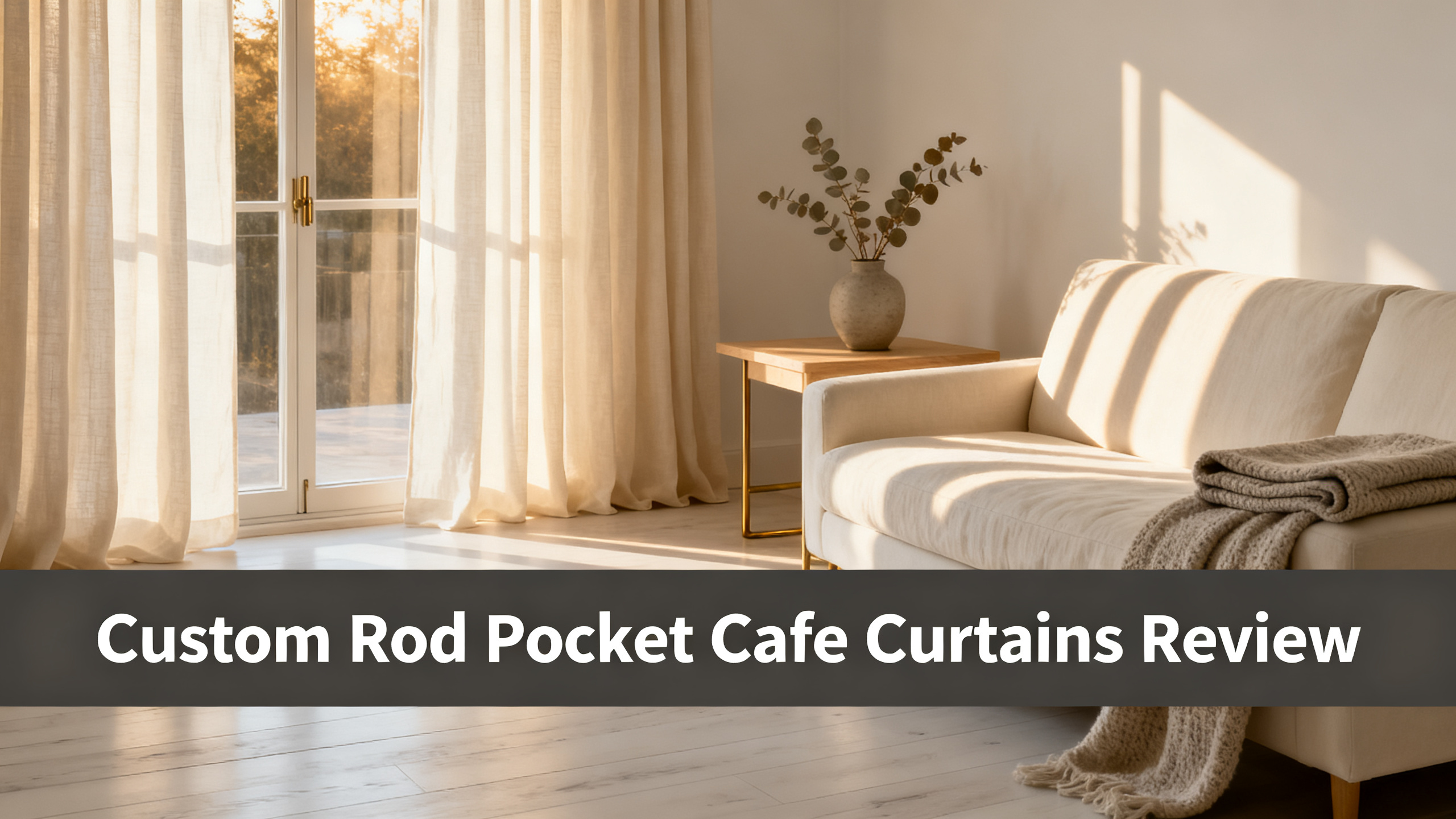
Picture the kitchen window above your sink. It is roughly 28 inches tall, the bottom sash starts at hip height, and from about 4pm the southern light turns the whole counter into a glare strip. You do not want a full-length drape sweeping the floor next to the dishwasher. You want a tier curtain that filters the worst of the sun, gives you a touch of privacy from the neighbor’s porch, and still lets the upper sash do its honest daytime job.
That is the exact slot Two Pages built its cafe curtain buying guide hub around, and the Custom Rod Pocket Cafe Curtains is the picker product that powers most of it. One header style (rod pocket, 3 inches), one purpose (cover the lower half of a window), and 16 fabric collections to choose from, priced from $49.99/panel at the Liz tier all the way to $119.99/panel for Britt Bengoechea or Jyll Mackie.
This review is an analytical pass, not a personal install diary. The brief here is to read the catalog, the spec sheet and the configurator carefully, surface the two trade-offs Two Pages does not put in the headline, and tell you when this build is the right call. Affiliate disclosure upfront per FTC affiliate disclosure guidance.

Editor review pick
Custom Rod Pocket Cafe Curtains
From $49.99/panel. Final price depends on size, fabric collection and lining. Use code JULY if active at checkout. Free shipping over $300.
Quick verdict
The Custom Rod Pocket Cafe Curtains build earns a 3.9 out of 5 from this analysis. The picker is genuinely flexible and the fabric range is the widest of any cafe build at this price tier, but the rod pocket header is the simplest performer in the Two Pages catalog and you pay for that simplicity in drape control.
Review score
Best for: kitchen tier windows, bathroom privacy, breakfast nooks, bay sills and any panel that stays mostly closed.
Main caution: the rod pocket slides slowly and the free memory shaping bonus is excluded on this header configuration.
If it were my kitchen, the rod pocket build would be the right call for the window above the sink and the wrong call for the patio-door tier I open ten times a day.
Drape and finish: how the rod pocket actually behaves
The rod pocket is the simplest header in window treatments. The fabric has a sewn sleeve at the top, 3 inches tall by default on this Two Pages build, and the rod threads straight through it. No rings, no hooks, no clips. The trade-off is friction. The fabric grips the rod, so opening and closing the panel takes a small tug each time, and the bunched gathers tend to clump rather than glide.
Header style visualizer (rod pocket in context)
Rod pocket
Simplest install, slowest slide, soft top look, no visible hardware
Pinch pleat
Structured folds, holds shape, supports the memory shaping bonus, slower install
Grommet
Fastest glide, modern metal eyelets, no soft drape at the top
That sliding behaviour matters less than it sounds, because most cafe and tier curtains live in a single position. Kitchens, bathrooms and breakfast nooks rarely need a panel that opens and closes ten times a day. The rod pocket gives you a clean soft top and a quick install, and the friction stops being a problem the moment the panel is set.
Pleated cafe build, same picker
If the rod pocket sliding bothers you, the pinch pleat configuration of the same picker holds its shape and keeps the memory shaping bonus.
The other drape variable is the fabric weight. A featherweight Doris at 170 gsm drapes loosely and lets backlight pass through with a soft glow. A heavy Isabella at 500 gsm hangs like a shop drape, which is overkill on a 28-inch tier window and reads almost theatrical. For most kitchen and bathroom cafe installs, the sweet spot sits between 240 and 350 gsm, which is where the Liz, Kyla, Patti, Jawara and Sara Le collections all live.
Pros and cons at a glance
Pros
- Widest fabric range in any Two Pages cafe build (16 collections)
- Custom width and length, no preset sizing
- $49.99 entry tier with Liz and Kyla is competitive against ready-made cafe panels
- Clean soft top look with no visible hardware
- Designer collab tier reaches Britt Bengoechea, Sara Le, Jyll Mackie, Rebecca Hughes
Cons
- Free memory shaping bonus excluded in rod pocket config
- Slow slide, not for panels you open daily
- Heavy fabrics (Isabella 500 gsm) read overstyled on short windows
- No hooks included, since the header threads on the rod directly
- Rings and rods sold separately
Pricing by configuration: 16 fabric tiers from $49.99 to $119.99 per panel
The picker prices off the fabric collection you pick, then layers width, length and lining on top. The base price you see from $49.99/panel is the starting line for the Liz collection, not the typical cart total. A 50 by 36 inch unlined Liz panel lands close to base. A 100 by 45 inch lined Sara Le panel doubles or triples it.
Pricing by configuration (rod pocket cafe tiers)
Entry tier
From $49.99/panel
Liz, Kyla. Best for renters and kitchen builds where budget matters more than fiber purity.
Mid tier
$59.99 to $79.99/panel
Liz upgrade, Holly, Isabella, Joy, Celia, Linnea, Ron, Patti, Jawara. The most flexible band.
Designer collab tier
$89.99 to $119.99/panel
Sara Le, Doris, Britt Bengoechea, Rebecca Hughes, Jyll Mackie. Pattern-led and story-led picks.
Same Liz fabric in pleated cafe
For a deeper look at the Liz 350 gsm hand specifically in a cafe length, the pleated Liz cafe review breaks down drape, dye lots and color range.
The middle tier is where most buyers actually land. Isabella at $64.99/panel is the heavy cotton blend if you want substantial body, Patti at $79.99/panel is the pure Belgian flax linen option, and Jawara at $79.99/panel sits in the 73% linen 27% cotton sweet spot. Joy slots in at $69.99, Holly and Ron at $64.99, all sharing the same rod pocket mechanic above.
The designer collab tier is where the price climbs fast. Sara Le at $89.99/panel brings the floral prints into the cafe length. Britt Bengoechea and Rebecca Hughes at $119.99/panel are the heritage-print, pattern-forward picks for buyers who treat the cafe curtain as the visual centerpiece of the kitchen rather than a quiet backdrop. Doris at $109.99/panel is the lightweight pure linen if a translucent cafe is the goal.
Price the right tier first
Move from $49.99 Liz to $119.99 designer collab without leaving the configurator
The picker lets you swap fabric collection, lining and exact width-by-length before committing. Run the kitchen window numbers before ordering swatches.
Specs deep-dive: rod pocket 3 inches, 16 fabrics, lining add-ons
The rod pocket sleeve is 3 inches by default, which fits standard rods between 0.75 and 1 inch in diameter comfortably, and tension rods up to about 1 inch. Two Pages will also build a 2-inch pocket on request if you contact support before ordering. Anything thicker, like a 1.25 or 1.5 inch decorative rod, deserves a clearance check in the configurator first.
Rod pocket vs the other 8 headers
Two Pages offers 9 header styles. The rod pocket trade-offs make most sense when read against pinch pleat, grommet, back tab and tab top.
Boring numbers, real impact. Each fabric collection has its own composition and weight, and the rod pocket cafe build uses those as-is. Here is the full matrix from the catalog spec sheet.
| Collection | Composition | Weight | Tier price | Best fit |
|---|---|---|---|---|
| Liz | 10% linen, 90% polyester | 350 gsm heavyweight | $49.99 | Kitchen and bath, easy care |
| Kyla | 10% linen, 90% polyester | 240 gsm medium | $49.99 | Lighter cafe, more drape movement |
| Patti | 100% Belgian Flax Linen | 248 gsm medium | $79.99 | Dry breakfast nook, elevated look |
| Jawara | 73% linen, 27% cotton | 274 gsm heavyweight | $79.99 | Linen-cotton hand without polyester |
| Doris | 100% linen | 170 gsm lightweight | $109.99 | Translucent cafe, backlight glow |
| Isabella | 76% polyester, 24% cotton | 500 gsm heavyweight | $64.99 | Maximum body, only for tall windows |
| Sara Le | 90% polyester, 10% linen | 350 gsm heavyweight | $89.99 | Floral and plaid prints |
| Stefana Silber | 90% polyester, 10% linen | 350 gsm heavyweight | N/A in feed | Block print designer collab |
| Britt Bengoechea | 10% linen, 30% cotton, 60% polyester | 280 to 440 gsm | $119.99 | Pattern-led centerpiece cafe |
| Holly, Joy, Celia, Linnea, Ron | Brand-specific blends | Varies | $64.99 to $69.99 | Mid-tier flex |
The lining decision is its own variable. Cafe curtains traditionally hang unlined, since the whole point is to filter rather than block. The picker still offers blackout, cotton and interlining options if privacy or insulation rank higher than diffused light, and each one bumps the panel price by a tier-dependent amount.
Lining comparison for cafe-length panels
Unlined
Default. Filters light, keeps the soft cafe feel.
Cotton lining
Adds body, slight privacy. Works well with lightweight Doris and Patti.
Blackout
Cuts the cafe purpose. Only useful for ground-floor bathroom privacy.
Interlining
Adds thermal weight. Overkill on a 28-inch tier window in most US climates.
The picker ships hooks only with pleated headers. Rod pocket builds skip hooks since none are needed, and rings and rods are always sold separately. Standard custom drapery lead time runs around 10 to 12 business days for production, plus shipping. If you want a measurement before ordering, the Two Pages in-home measurement service is a paid option, though it is mostly geared to full drapery installs rather than a single cafe panel.
Real customer installs and product photos


The six catalog shots show the same Liz fabric in the two main colorways: Ivory White and Beige White. They cover the header detail, the bottom hem, the mid drape and the side panel, which is more than most cafe listings provide. They do not show the panel installed in a real kitchen at scale, which is where verified buyer photos help.
Real customer installs
Real rooms photographed by verified Two Pages buyers
Verified
Who should buy this build, who should skip
The rod pocket cafe build is the right call when the window is short, the rod position is fixed, and the panel does not need to move much. Kitchen tier windows above a sink, breakfast nooks under a bay, half-windows in a bathroom, the bottom sash of a tall divided window: those are the four scenarios where it earns its place.
Who is it for?
Kitchen owner
Wants glare control above the sink without a full drape.
Bath renter
Needs ground-floor privacy on a half-window, tension-rod compatible.
Breakfast nook host
Layering a tier curtain over a bamboo shade for warmth and texture.
Bay sill decorator
Three custom widths to match a bay window, no off-the-shelf size matches.
Skip this build if you open and close the panel daily, if the window is taller than 45 inches and you want a true tier-over-tier setup, or if you fell in love with a print that needs the structured fold discipline of pinch pleats. Heavy fabrics on short rods are also a no-go, since a 500 gsm Isabella cafe panel looks compressed rather than draped at this length.
📏 Measurement tip
The three common cafe lengths are 24 inches (true tier, covers the lower sash on a standard double-hung), 36 inches (covers the lower half plus a few inches of upper sash), and 45 inches (used for tall windows where a half-drop is the design intent). Measure from the rod center to where you want the hem to land, then subtract 1 inch to account for handcraft tolerance.
Swatch the fabric tier before pricing the panel
Liz 350 gsm reads heavier than Kyla 240 gsm in a kitchen window backlight. Two Pages dye-lot variance also makes a swatch the cheapest insurance on a custom order.
FAQ
What is a rod pocket cafe curtain?
A rod pocket cafe curtain is a short tier curtain with a sewn sleeve at the top, the rod pocket itself, that threads directly onto a curtain rod or tension rod with no rings, hooks or pleats. It covers the lower half of a window or hangs as a single tier, usually 24, 36 or 45 inches long. Two Pages sells it as a custom-cut version across 16 fabric collections from $49.99/panel.
Do rod pocket cafe curtains slide easily on the rod?
Less than rings or grommets. The rod pocket grips the rod by friction, so opening and closing is slower and the gathers tend to bunch. For cafe and tier installs that mostly stay closed, kitchens, baths and nooks, this is fine. For a panel you open daily, a grommet or back tab build slides cleaner.
What fabric works best for kitchen cafe curtains?
For grease-prone kitchens, a polyester-blend like Liz (10% linen, 90% polyester, 350 gsm) or Kyla (240 gsm) handles cleaning better than pure linen. For dry breakfast nooks or bay sills, Patti 100% Belgian Flax Linen at 248 gsm reads more elevated. Doris at 170 gsm is the most translucent if backlight is the goal.
What rod size fits this curtain?
The Two Pages rod pocket is 3 inches by default. That fits standard 0.75 to 1 inch diameter rods comfortably, plus tension rods up to 1 inch. For thicker decorative rods at 1.25 inches and above, confirm clearance in the configurator or request the 2-inch pocket option via Two Pages support.
Can I get this rod pocket cafe curtain blackout?
Yes, by adding a blackout lining in the configurator, though that pushes the price up and undermines the soft filtered light a tier curtain is meant to deliver. Most cafe installs stay unlined or use a sheer interlining for privacy without killing the daylight. For pet and child safety on cord-related window products, the CPSC window covering safety guidance is the reference, though rod pocket cafes are cord-free by design.
Does the memory shaping bonus apply to rod pocket cafe curtains?
No. Two Pages reserves the free memory shaping service for pleated headers, where steam-trained folds actually hold. Rod pocket relies on the rod and gravity, so the shaping bonus is excluded for this configuration. If memory shaping matters to you, the pleated cafe build is the right pick.
Final verdict
The Custom Rod Pocket Cafe Curtains earns its place as the simplest custom cafe build Two Pages makes, and the most flexible on fabric. From $49.99/panel at the Liz tier to $119.99/panel at the designer collab tier, with a clean 3-inch rod pocket header, custom-cut to your exact width and length: that is a pretty honest proposition for a kitchen, bath, breakfast nook or bay sill where the panel does not move much. The two trade-offs (slow slide and excluded memory shaping) are real but priced into the simplicity, and if your install matches the use case, this build is the right call. If you need structured folds, daily-open behaviour or a tall window solution, walk one step over to the pleated cafe build instead.
Final verdict CTA
Choose the Rod Pocket Cafe build when the window is short, the bar is fixed, and the room wants relaxed
3-inch rod pocket, 16 fabric tiers from $49.99 to $119.99/panel, custom-cut to your exact width and length. Best for kitchens, baths, breakfast nooks and bay sills where the panel rarely opens. Use code JULY if active at checkout.
