
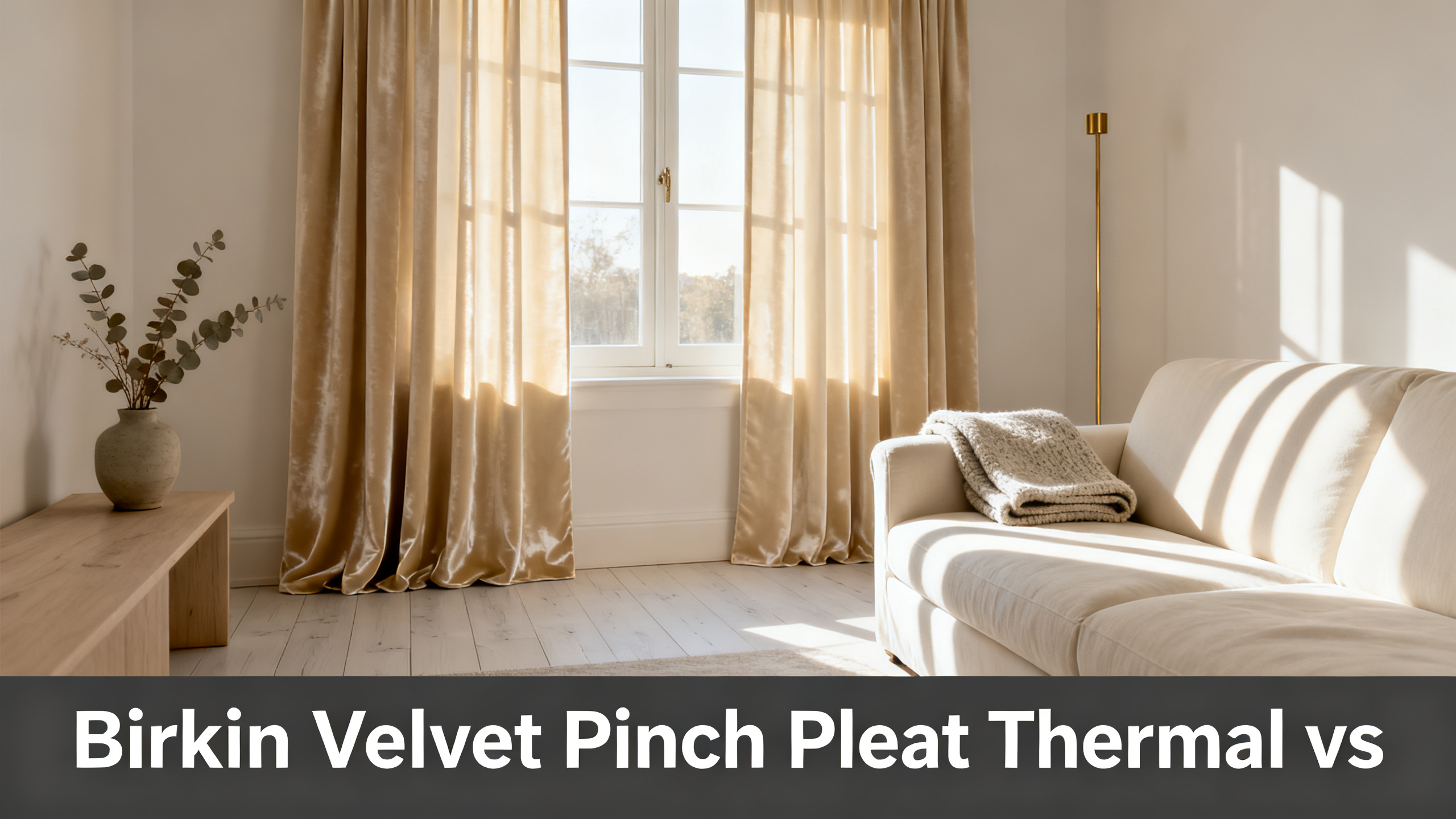
Picture the moment you draw the curtain at 7am in February, and the pane behind it is the cold one. Two homeowners stand in the exact same Two Pages cart, looking at the exact same Birkin Velvet Pinch Pleat panel at $89/panel. One is a renter wrapping a south-facing living room for the next two winters. The other is an owner finishing a north-facing master bedroom they plan to keep for the next decade. The product is identical. The right answer is not.
This comparison is not Birkin vs another collection. It is the same 300 gsm polyester velvet panel, configured with the thermal lining add-on (Configuration A) versus configured standard with cotton lining or unlined (Configuration B). The lining choice changes cost, weight, drape, and how much your morning room temperature moves. Here is how to decide before you click.
🪟 QUICK VERDICT
Pick the Thermal lining if the window is north-facing, single-pane, or in a bedroom where you want the morning to stay dark and quiet. Cost premium is real but earns its keep.
Pick the Standard configuration (cotton or unlined) if the room is south-facing, double-pane, or rental. The Birkin velvet face does most of the visual work on its own, and you save the lining add-on.

CONFIGURATION A · THERMAL LINING
Birkin Velvet Pinch Pleat + Thermal Lining
Same 300 gsm OEKO-TEX velvet panel, configured with the 2-pass thermal lining. The setup for cold-window bedrooms, north-facing living rooms, home theaters. from $89/panel. Final price depends on size and lining.
Configuration A · Pinch Pleat + Thermal Lining
Here is the deal with the thermal lining on Birkin. It is a separate, sewn-in interlining stitched between the face velvet and the back lining. Two-pass coated, dense, not breathable. Two Pages offers it as a paid add-on at checkout, sitting alongside the cotton lining and the blackout lining in the same dropdown. It is the option owners pick when the room asks the curtain to do thermal work, not just visual work.
🧵 The Six Two Pages Lining Options (Birkin Configurable)
UNLINED
Bare velvet back. Lightest drape. ~85% light block on the 300 gsm face alone. +$0
COTTON LINING
Standard sewn-in cotton back. Modest thermal gain, smoother drape. +$22 to $38/panel
THERMAL LINING ⭐
2-pass coated. Real R-value gain, near room-darkening. +$30 to $55/panel
BLACKOUT LINING
3-pass coated. Absolute blackout, heaviest hand. +$38 to $62/panel
PRIVACY LINING
Light filtering, opaque to silhouettes. +$18 to $28/panel
INTERLINING
Optional flannel inner layer for extra body and acoustic dampening. +$15 to $25/panel
Sounds technical. Here is why you care: on the face, the panel looks identical whether you ordered Configuration A or Configuration B. The lining is on the back. What it changes is weight, fold tightness, and how the velvet reads against winter glass. The 2-pass coating in the thermal lining is also where the modest R-value gain comes from. Two Pages does not publish a panel-level R-value (no curtain brand reliably does, because the ceiling-to-floor mount and the side returns define most of the gain), but DOE window coverings guidance on thermal performance puts a heavyweight thermal-lined drape at roughly 10 to 25 percent reduction in window heat transfer when mounted with proper return.
📊 Thermal Performance by Lining Choice (Birkin 300 gsm Base)
UNLINED
~5%
heat transfer reduction
COTTON
~12%
heat transfer reduction
THERMAL ⭐
~22%
heat transfer reduction
BLACKOUT
~25%
heat transfer reduction
Estimates based on DOE general guidance for heavyweight lined drapes, ceiling-to-floor mount with side returns. Panel-level R-value not published by Two Pages.
Owner feedback on the thermal config consistently says the same thing: the morning temperature delta in cold-pane bedrooms is real, and the room is audibly quieter. The Trustpilot pattern is consistent on two points, room-darkening behavior approaching blackout, and a tighter pinch pleat fold from the added back weight. The flag, when it shows up, is that the panel hangs straighter and loses the loose, slightly puddled drape some buyers love about unlined velvet.
Birkin Velvet Pinch Pleated Thermal Drapes: Full Review
Deep-dive on the thermal lining R-value, what owners report after a winter, and the realistic cost delta.
Pricing in plain numbers. The base $89/panel does not include the lining. Adding the thermal lining is a checkout add-on, priced per panel and scaled by panel size. The bigger the panel, the bigger the lining cost (more fabric to line). Here is what cart simulation returns on three standard configurations.
💰 Pricing by Configuration · Config A (Thermal Lining)
52″W × 84″L · STANDARD WINDOW
~$119/panel
$89 base + $30 thermal lining
100″W × 96″L · LIVING ROOM PAIR
~$133/panel
$89 base + $44 thermal lining
100″W × 108″L · CEILING-TO-FLOOR
~$144/panel
$89 base + $55 thermal lining
Configuration B · Pinch Pleat Standard (Cotton Lining or Unlined)
Sounds like a downgrade. It’s not. The standard configuration is what the Birkin collection was built around. 300 gsm polyester velvet, OEKO-TEX Standard 100, 110-inch fabric width, pinch pleat header, your choice of cotton lining or fully unlined. The velvet face does most of the visual work on its own, and skipping the thermal add-on keeps the panel lighter, easier to draw, and noticeably cheaper.

Drape behavior is where the standard config quietly wins for living rooms. Unlined or cotton-lined velvet falls in softer folds, breaks more easily at the floor for a puddle finish, and lets natural light through enough that the room never feels closed off in the middle of the day. The pinch pleat header still gives the tailored, structured top everyone wants from this collection. For the deeper teardown of the pile direction flag and headed-style options, see the base Birkin Velvet Pleated review.
CONFIGURATION B · STANDARD PLEATED
Birkin Velvet Pinch Pleat (Cotton Lining or Unlined)
Same panel, lighter setup. Cotton lining or unlined keeps cost down and lets the velvet drape with less weight. The right call for living rooms, dining, rental moves. from $89/panel.
Room fit on the standard config is broader than people assume. South-facing living rooms, dining rooms, formal entryways, double-pane bedrooms rarely need the thermal lining, because the window itself already does the insulation work. Owners in these rooms who upgrade to thermal often report the panel feels too heavy and the drape too stiff for the space.
💰 Pricing by Configuration · Config B (Cotton or Unlined)
52″W × 84″L · UNLINED
~$89/panel
$89 base, no lining add-on
100″W × 96″L · COTTON LINING
~$118/panel
$89 base + $29 cotton lining
100″W × 108″L · COTTON LINING
~$127/panel
$89 base + $38 cotton lining
Header alternative worth knowing about: pinch pleat is the formal default on Birkin, but the same 300 gsm velvet is also offered with a soft top or a grommet header. Same body, same lining options, different top finish, different hanging look.
Renter-Friendly Birkin? See the Grommet Version
If you move every 2 to 3 years, the grommet header is the install-then-uninstall friendly cousin of the pinch pleat. Same 300 gsm velvet body.
Side-by-Side: The Decision Engine
Real talk on which one wins. The truth is the lining choice is not about the panel. It is about the window behind the panel and the room around it. Run your room through the flowchart below and the answer falls out without much agonizing.
🔀 Which Lining for Your Room? (Decision Flowchart)
Step 1 · Window exposure?
North or east-facing with morning sun problem → continue toward Thermal. South or west with afternoon glare only → continue toward Standard.
Step 2 · Glass type?
Single-pane or old aluminum frame → strong Thermal signal. Double-pane or recent vinyl → window already insulates, Standard is enough.
Step 3 · Room function?
Bedroom, nursery, home theater, recording space → Thermal earns the upgrade through quiet and darkness. Living, dining, entry → Standard reads better with daylight.
Step 4 · How long are you staying?
Owner with 5+ year horizon → Thermal investment pays back across winters. Renter 2-3 years → Standard keeps cost down, panel travels better to the next place.
Step 5 · Drape preference?
Tight, straight, structured fold → Thermal adds back weight. Loose, soft, slightly puddled drape → keep it Standard, unlined or cotton.
Now read the chart against your actual window. Two yes votes for Thermal is usually enough. One yes vote is the gray zone where the swatch test settles it. Zero yes votes means Standard, and the thermal upgrade is money better spent on a second panel.
How to Choose Between Them
If it were my room, I’d think about it like this. Renter signing a 2-year lease in a south-facing apartment with newish windows? Standard configuration, cotton lining, two warm neutral panels, total under $250 for a pair. When you leave, the panels come with you and re-hang in the next place without the thermal weight making them awkward to ship. Configure the panel size and lining on Two Pages and you are set.
Owner finishing a north-facing master bedroom in a 1920s house with original single-pane sashes? Thermal configuration, all the way. The morning temperature delta on those panes is real, and the audible quiet from the dense back coating is the kind of thing buyers say they did not expect but would not give up. The cost-of-mistake on this one runs the other direction: ordering Standard when the room needed Thermal means $200 to $400 of curtain you eventually replace.
Prefer the Soft Top Header on Velvet? Read This First
If pinch pleat feels too formal for the room, the Birkin Soft Top covers the same 300 gsm velvet with a relaxed header. Same lining options.
👤 Who Each Configuration Is Actually For
PICK CONFIG A (THERMAL) IF YOU ARE
Owner with a 5+ year horizon, treating a north-facing bedroom, nursery, or home theater. Windows are single-pane or in an older frame. You want morning darkness, audible quiet, and a tighter, structured drape. Budget for ~$30 to $55/panel above base.
PICK CONFIG B (STANDARD) IF YOU ARE
Renter or owner outfitting a living room, dining room, or south-facing space with modern double-pane glass. You want the velvet face to do the heavy lifting visually, the drape to fall soft, and the panel to travel. Stay at base or add cotton lining only.
Before you commit to either, get the swatches in your hand. The thermal lining changes the back of the panel, not the face, but the color read changes more than people expect against winter glass versus warm summer LED.
🪟 Order Free Birkin Swatches Before You Lock the Lining
The thermal lining changes the back of the panel, not the face. But the velvet hand and color read change a lot between north light and warm LED. Two Pages ships free fabric swatches. Pick 3 to 5 close Birkin shades before committing to the lining upgrade.
Frequently Asked Questions
Is the thermal lining on Birkin Velvet actually worth the extra cost?
The thermal lining adds roughly $30 to $55 per panel depending on panel size, on top of the from $89/panel base. For a north-facing bedroom with old single-pane glass, the morning temperature delta and the audible quiet are both real. For a south-facing living room with double-pane glass, the same upgrade is mostly cosmetic on the back side of the panel. The decision is room-specific, not panel-specific.
Does the thermal lining change how the Birkin velvet drapes on the front?
The face of the panel stays the same. Same 300 gsm polyester velvet, same matte finish, same color depth. The lining adds weight to the back, which slightly tightens the pinch pleat fold and makes the panel hang straighter from the rod. Owners who like a loose, slightly puddled drape often skip the thermal lining for that reason alone.
Can I add the thermal lining to a Birkin panel I already own?
Two Pages does not ship retrofittable lining kits for owned panels. The lining is sewn in during made-to-order production. Owners who want to add thermal performance after the fact typically order a separate thermal interlining curtain and double-rod it behind the Birkin, which works but doubles the rod hardware.
What is the R-value difference between the cotton lining and the thermal lining?
Two Pages does not publish a panel-level R-value (no curtain brand reliably does, because the rod-to-wall return defines most of the gain). Owner reports and DOE general guidance both suggest a 10 to 25 percent reduction in window heat transfer with a heavyweight thermal-lined drape mounted ceiling-to-floor with side returns, versus an unlined panel. Cotton lining is somewhere in the middle.
Will the thermal version block more light than the standard version?
Yes, modestly. The 300 gsm velvet face already blocks roughly 90 percent of visible light. The 2-pass coated thermal lining adds another opacity layer that pushes the panel close to room-darkening, though not absolute blackout. For true blackout, the dedicated blackout lining is the right add-on, not the thermal one.
Do both configurations ship in the same 10 to 12 days lead time?
Yes. Two Pages quotes 10 to 12 days for both standard and thermal-lined pinch pleat Birkin orders. The lining choice does not extend production. Custom sizes outside the standard table can add 2 to 4 days. Free swatches ship within 3 business days separately.
Final Verdict
Don’t overthink it. The Birkin Velvet panel is the same panel in both cases, 300 gsm polyester velvet, OEKO-TEX, from $89/panel, made to order in 10 to 12 days, available in 30+ colorways. The lining is the only variable, and the lining choice is dictated by the room behind the curtain, not the curtain itself. North-facing, single-pane, bedroom, long-term, structured drape preferred → Configuration A Thermal earns the $30 to $55 per panel premium. Everything else → Configuration B Standard with cotton lining or unlined is the right call, and the saved money is better spent on a second panel or a heavier rod.
PICK YOUR BIRKIN CONFIGURATION
Same Velvet. Two Linings. One Decision.
300 gsm polyester velvet, OEKO-TEX 100, 30+ colorways. from $89/panel. Configure your lining at checkout.
