
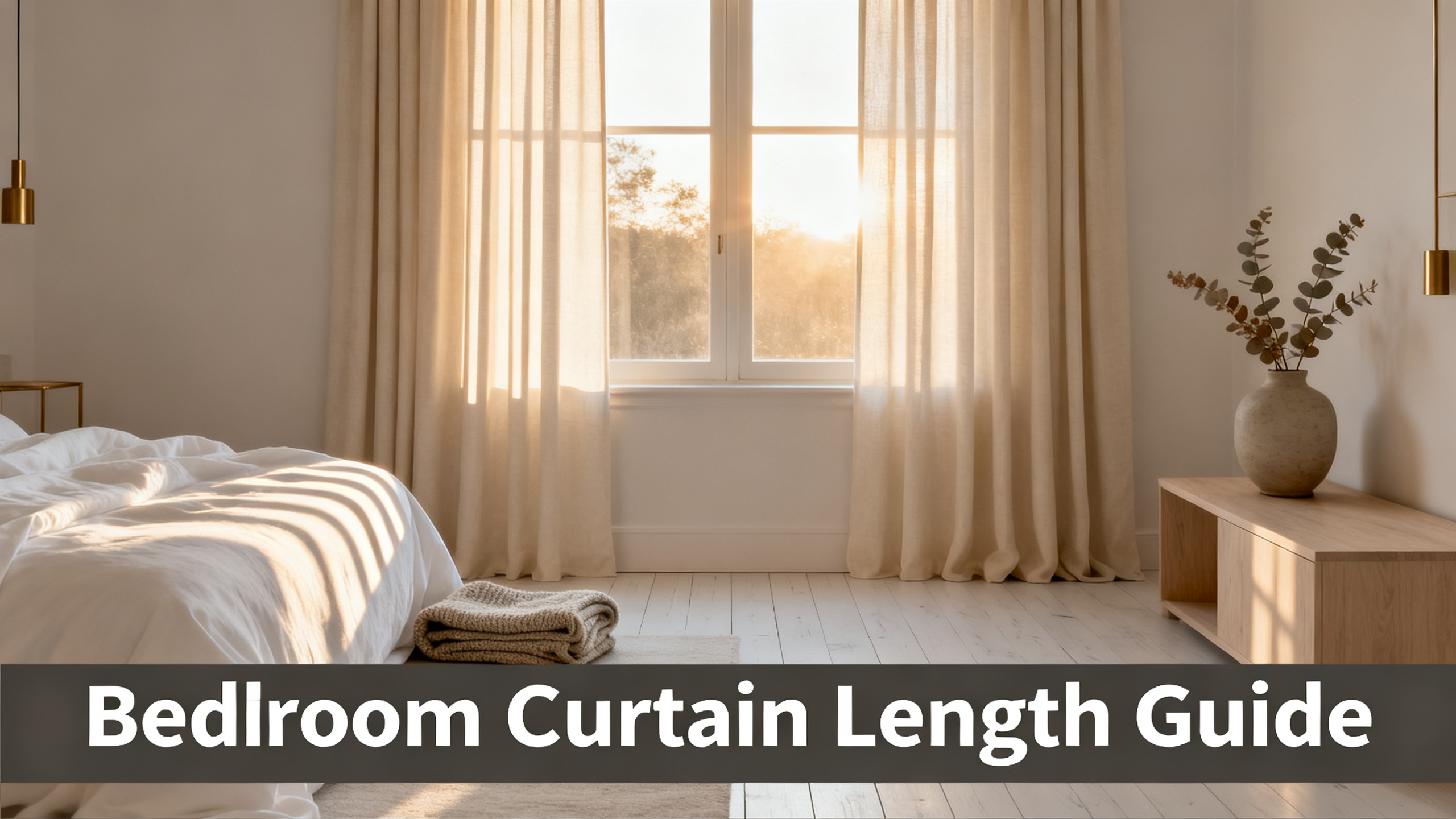
Renter, owner, first-home buyer: your bedroom drop math is not the same. And the 4am summer light does not care which one you are. The panel that reads as intentional in a rental studio with a frame-mounted rod is the same panel that reads as accidental in a master with a ceiling-mounted rod, because the drop moved by 6 to 12 inches and nobody accounted for it.
This guide walks the three bedroom decisions in order (drop, header, lining), maps standard 84/95/108 to real bedroom ceilings, and prices the Two Pages configurator per persona so the panel you order matches the room you sleep in. For the wider bedroom scope on styling, blackout picks, and window-treatment ideas, our complete bedroom curtains hub maps the neighbouring guides.
🛏️ Persona triage: three profiles, three drop rules
🔑 Renter
Frame-mount rod, no ceiling drilling. Drop lands on 84 or 95 inches ready-made. Lining stays cotton or thermal. Total spend $120 to $180 for two panels.
🏠 Owner
Ceiling-mount ok. Drop pushes to 108 ready-made or 116 to 120 custom. Lining goes coated blackout for sleep quality. Total spend $220 to $360 for two panels.
🌱 First-home buyer
First custom order. Drop calibrated with +1 inch overshoot to close the blackout hem gap. Lining thermal or blackout. Total spend $180 to $260 for two panels.

Editor’s pick for bedroom blackout
Lila 100% Blackout Drape Pleated
from $89.00/panel · custom drops 63 to 200 inches · 12 colors · triple pleat header · 100% light blocking coated fabric. Final price depends on size and lining.
Use code JULY for 20% off · Free shipping over $300
How to Choose the Drop for a Bedroom
Picture a 6-inch gap between the panel hem and the hardwood on a Saturday at 6am: that gap is your entire sleep on a June morning. Bedroom drop is not a styling choice, it is a sleep infrastructure decision. For the wider vocabulary on kiss, break, and puddle at the floor, our sibling general curtain length guide covers the four length families with the styling context. This piece stays in the bedroom.
The single biggest lever on bedroom drop is not the panel. It is the rod position, and rod position depends on whether you can drill the ceiling. Renters live with frame-mount at 4 to 6 inches above the window casing, which caps the drop at 84 or 95 inches ready-made in most 8-foot bedrooms. Owners can go ceiling-mount, which pushes the drop to 108 ready-made or 116 to 120 custom in the same room. Our companion piece on how to hang bedroom curtains walks the bracket placement math for each mount option.
How to Measure for Curtains: Complete Guide
Rod-to-floor math, where to place the rod against a bedroom frame, and why the window casing is the wrong reference point for the drop.
The four bedroom drops in one grid
Two ready-made drops carry 80% of bedrooms in North American housing stock, and two custom brackets carry the rest. 84 inches is the 8-foot ceiling default with the rod at frame level. 95 inches is the 8-foot ceiling with the rod high-hung 8 to 12 inches above the frame. 108 inches is the 9-foot ceiling standard. 120 to 140 inches custom covers vaulted 10-foot rooms and lofted masters. Cathedral bedrooms go to 160 to 200 inches on the Two Pages custom range.
| Bedroom ceiling | Rod position | Recommended drop | Format |
|---|---|---|---|
| 8 ft (96 in) apartment or starter | Frame level | 84 in | Ready-made |
| 8 ft high-hang tall-window illusion | 8 to 12 in above frame | 95 in | Ready-made |
| 9 ft (108 in) master | Frame or ceiling | 108 to 116 in | Ready-made or custom |
| 10 ft vaulted | Ceiling | 120 to 140 in | Custom |
| Cathedral lofted master | Ceiling | 160 to 200 in | Custom |
Bed footprint and why puddle heavy is out in 80% of bedrooms
The bedroom furniture that lives closest to the drapes is the bed, and beds have a footprint that the living-room armchair does not. If the bed sits within 8 inches of the window wall, medium and heavy puddle are the wrong call because the extra fabric gets trapped between the mattress skirt and the wall, brushed by pillows, and dragged by anyone getting up on that side of the room. Puddle heavy is out in 80% of bedrooms for exactly this reason.
Short puddle at plus 3 inches can work in a master where the bed clears the wall by 8 inches or more and the flooring is hardwood or tile that vacuums cleanly. For everything else in the bedroom, kiss at plus 0 or gentle break at plus 1 to 2 inches is the honest answer.
📐 Drop and coverage: Lila Blackout pricing by bedroom ceiling
Starter apartment
84 in
8 ft ceiling, frame mount. from $89.00/panel Lila ready-made.
8 ft high-hang
95 in
Rod 8 to 12 in above frame. from $95.00/panel Lila ready-made.
9 ft master
108 to 116 in
Ready-made 108 or custom 110 to 116. from $109.00/panel custom.
10 ft vaulted
120 to 140 in
Custom only. from $129.00/panel Lila configured with triple pleat.
Now that the drop math is settled, the header choice narrows to three options that actually seal light in the bedroom.
How to Choose the Header for a Bedroom
The header is where the fabric meets the rod, and in the bedroom it does three jobs at once: it sets the drop from rod-top to hem, it defines the pleat structure that controls how the panel hangs open, and it determines whether the panel seals light on the side of the window or leaks a bright vertical line. Three headers from the Two Pages line matter for the bedroom: triple pleat, grommet, and soft top.
The triple pleat creates a side seal of roughly 2 inches where the pleated fabric folds against the wall, which is why it is the default bedroom pick in most owner masters. The pleats hold the fabric flush to the return dimension of the rod, so morning light does not slip between the panel and the wall. On a bedroom with a west-facing evening exposure, the side seal saves 15 to 20 minutes of golden-hour glare on the pillow.
🛏️ Three bedroom headers, one comparison
🧵 Triple pleat
Side seal 2 in. Best light control. Owner master default. Available on Lila, Liz, Jawara.
⭕ Grommet
Side seal 0.5 in. Easy daily pull. Renter default. Available on Liz, Lila grommet SKU.
🎀 Soft top
Side seal 1 in. Casual budget. Kids’ room or guest bedroom. Available on Liz soft top SKU.
The grommet header is the renter bedroom pick because it pulls smoothly on a tension rod without hand-training the pleats. The trade-off is a side seal of only 0.5 inches, which means a 1-inch vertical light line at the edge of the panel on a summer morning. If sleep quality is the priority, layer a sheer behind the grommet blackout or upgrade to a triple pleat. If ease of use wins, live with the light line.
The double-rod bedroom layers a sheer in front of a blackout behind on two separate rods, each with its own header. The sheer usually rides on a grommet or soft top for daytime pull, and the blackout locks on a triple pleat for night-time seal. The 0.5-inch depth offset between the two rods matters: too tight and the layers tangle, too loose and the sheer casts a visible shadow on the blackout at dawn.
How to Layer Sheers and Blackout in the Bedroom
Double-rod setup, drop matching between sheer and blackout, and the 0.5 inch offset that keeps the two layers from tangling on close.
Return dimension is the depth of the rod bracket from wall to rod-front, and it decides how far the panel wraps back toward the wall on the side. In a bedroom the recommended return is 4 inches minimum, because anything shallower leaves a wedge of light behind the panel that reads as a bright line on the ceiling by 5am in summer.
If it were my ground-floor rental bedroom, I would grommet with cotton lining before touching a triple pleat with blackout coating. The daily-use ergonomics of a grommet header on a tension rod outweigh the 15 minutes of morning light on a Sunday.

Versatile Drop, 38 Colors: Liz Linen Drape Pleated
from $59.99/panel · custom drops 63 to 200 inches · 38 colors · 90 gsm linen blend · pairs with cotton or blackout lining for the bedroom. The default pick when the ceiling is 8 to 9 feet and the light control target is 85 to 95%.
How to Choose the Lining for a Bedroom
Real talk on blackout: coated fabrics are the only thing that kills 100% of the light, and yes, they feel a little plasticky on the back. That trade-off is worth understanding before you commit a custom drop. The Two Pages catalogue offers four linings that make sense in the bedroom: unlined, cotton, thermal, and coated blackout. The National Sleep Foundation bedroom darkness guidance recommends full darkness for circadian recovery, and full darkness in fabric terms means coated blackout with the drop overshoot handled properly.
Shading rate scales predictably by lining. Unlined runs 30 to 50% of light blocked in a 90 gsm linen. Cotton lining moves that to 65 to 75%. Thermal lining climbs to 85 to 92%. Coated blackout reaches 99 to 100%. The OEKO-TEX Standard 100 textile certification applies to the Liz, Jawara, and Kyla base fabrics on the Two Pages line, which matters in the bedroom because you are in prolonged skin contact with the panel edge every time you draw it closed.
Best Blackout Curtains for the Bedroom (5 Picks)
The 5 curtains that actually kill the 4am summer light, ranked by drop range, header options, and shading rate on the Two Pages catalogue.
The lining changes the drop because it adds weight to the panel. A coated blackout adds 40 to 80 gsm on top of the base fabric weight, which pulls the hem down slightly and impacts how the drop hangs at the floor. In practical terms a 108-inch Liz Linen unlined panel that kissed the floor cleanly at plus 0 will now break at plus 0.5 to plus 1 when relined with coated blackout, because the extra weight elongates the panel under gravity.
🌙 Lining shading rate ladder
Unlined
30 to 50%
Base fabric only. Light filtering for guest rooms only.
Cotton lining
65 to 75%
Renter default. Adds 25 gsm. Breathable in summer.
Thermal
85 to 92%
Adds 40 gsm. Insulates against north-facing winter drafts.
Coated blackout
99 to 100%
Adds 60 to 80 gsm. Slight plastic hand. Owner master pick.
The blackout hem gap: why plus 1 inch is the rule
Where the blackout hem gap trap gets people: ordering a 108-inch drop on a 108-inch rod-to-floor and thinking 100% coated means 100% dark. It does not, because the panel does not seal against the floor. Light bounces off the hardwood and rises through the 0.25 to 0.5-inch gap where the hem stops short of contact, and the room lights at 4am.
The rule on a bedroom blackout is straightforward: order the drop at least 1 inch longer than rod-to-floor. On a 108-inch measurement, order 110 or 111 inches custom. The extra inch closes the hem gap by resting the panel against the floor and killing the reflected morning bounce. On a triple pleat with coated blackout, that plus 1 setup is the difference between 100% dark and 90% dark on a June morning.
Warning: the blackout hem gap
A 108-inch coated blackout panel on a 108-inch rod-to-floor leaves a 0.25 to 0.5-inch gap at the floor. Reflected morning light rises through that gap and lights the room at 4am. The fix is a plus 1 inch drop overshoot: order 110 to 111 inches custom on a 108-inch measurement. Handcraft tolerance of 0.5 to 1 inch on custom orders is standard, so the plus 1 overshoot also insures against a shorter-than-spec production run.
How to Price the Configuration
Base prices on the four bedroom-relevant panels break down cleanly. Lila 100% Blackout Drape Pleated starts at $89.00 per panel for the 84-inch ready-made and scales incrementally per inch on the custom range. Liz Linen Drape Pleated starts at $59.99. Jawara Luxury Linen Cotton Curtain Pleated starts at $79.99. Kyla Linen Drapery Pleated starts at $49.99 and caps at 108 inches ready-made. Configure the Lila directly on the Lila Blackout custom drop configurator page to see the per-inch pricing update live.
The configurator adds cost predictably. Header change from triple pleat default runs plus $8 to $18 per panel depending on the target header. Lining change runs plus $12 to $28 per panel, with coated blackout at the top of the range. Custom drop beyond 108 inches runs roughly plus $0.85 per inch above 108, so a 120-inch Lila lands at about $99.20 base plus the lining and header adds. Memory training for pleat retention runs plus $5.
Two Pages configurator: Lila Blackout at 116 in custom, coated blackout lining, triple pleat
Base 84 in Lila Blackout: $89.00
Custom drop 116 in (+32 in × $0.85): +$27.20
Coated blackout lining (already integrated): $0.00
Triple pleat header (default on Lila): $0.00
Memory training: +$5.00
Panel total: $121.20 before promo
With code JULY (20%): $96.96 per panel
Code JULY applies to all bedroom sizes and stacks on the base configurator total. Free shipping over $300 lands in practice at two Lila panels in most 9-foot masters, or three Liz panels in most 8-foot bedrooms with cotton lining. The threshold hits without any add-ons in most owner scenarios.
🛏️ Persona-matched picks, priced
🔑 Renter pick
Kyla Linen Drapery Pleated, 84 in ready-made, cotton lining. Frame-mount tension rod.
from $49.99/panel
🏠 Owner pick
The Jawara Luxury Linen Cotton at 116 in custom, cotton lining, triple pleat.
from $79.99/panel
🌱 First-home pick
Lila Blackout Drape Pleated at 111 in custom (plus 1 in overshoot on 110 rod-to-floor), triple pleat.
from $89.00/panel
Lead time is 5 to 7 business days on ready-made 84 and 108 inch bedrooms, and 8 to 12 business days on all custom drops. If your target is a specific move-in date or a photo shoot, plan two weeks ahead and factor the handcraft tolerance of 0.5 to 1 inch into your drop overshoot decision. Dye lot varies slightly between production runs on the linen line, so ordering all bedroom panels in a single order rather than two separate ones is worth the coordination on colour consistency.
Order the 38-Color Liz Linen Booklet Before You Commit a Drop
Bedroom light shifts from 4am blue to 7am gold and the color you loved on-screen may not survive that swing. The booklet ships for $3.99 and shows all 38 colorways at scale before you lock a custom drop that cannot be resized after production.
What to Do Next
The bedroom decision reduces to three practical steps. Step 1: measure the drop rod-to-floor three times, once with a laser, once with a tape, once from the opposite side of the room to catch any ceiling tilt. Round up to the nearest inch. Step 2: order the Liz Linen colour booklet at $3.99 to preview the 38 colorways under bedroom light before locking a custom drop that cannot be resized after production. Step 3: configure the persona-matched panel on the Two Pages configurator.
📋 3-step bedroom plan
Step 1
Measure the drop
Rod-to-floor, three times, round up.
Step 2
Order the booklet
$3.99, 38 colours, bedroom light preview.
Step 3
Configure the panel
Lila for sleep, Liz for versatility, Jawara for owner luxury.
The synthesis by profile stays clean. Lila covers the absolute blackout for master bedrooms where sleep quality is the priority. Liz covers the versatility and colour depth for bedrooms where light control is 85 to 95% and design flexibility matters more than 100% darkness. Jawara covers the premium linen cotton hand for owner masters that want the fabric to read as an investment.
Configure Your Bedroom Drop with Lila Blackout
12 blackout colors, 3 header options, custom drops 63 to 200 inches, coated 100% light-blocking fabric. from $89.00/panel. Code JULY (20% off) · Free shipping over $300 · Lead time 8 to 12 business days.
Frequently Asked Questions
How long should bedroom curtains be?
Bedroom curtains should touch the floor at minimum, and blackout panels should exceed the rod-to-floor measurement by at least 1 inch to close the morning light gap that forms where the hem meets the hardwood. The three clean options are kiss the floor (plus 0 inch for unlined curtains), gentle break (plus 1 to 2 inches, the classic bedroom proportion), and short puddle (plus 3 inches, only if the bed clears the wall by 8 inches or more). Curtains that stop 3 or more inches above the floor never work in the bedroom because they read as accidental and leak light.
What is the standard length for bedroom curtains?
The four ready-made drops sold across the market are 63, 84, 95, and 108 inches. In the bedroom the useful subset is 84 and 108, because 63 fits only apron or short basement windows and 95 is a specific 8-foot-high-hang case. 84 inches is the 8-foot ceiling default with the rod at frame level. 108 inches is the 9-foot ceiling standard. Anything past 108 shifts to custom, which the Two Pages configurator handles up to 200 inches.
Should bedroom curtains touch the floor?
Yes in almost every bedroom, no in three specific cases. The three exceptions are apron-length windows above a wall radiator or a built-in bench, café-curtain setups in basement bedrooms where the panel covers only the lower half for privacy, and short high-set windows in loft bedrooms where floor length would drape over unrelated furniture like a dresser or reading chair. In every other bedroom, floor contact is the visual anchor that makes the panel read as intentional, and the light seal that makes the panel functional.
What length curtain for a 9-foot ceiling bedroom?
For a 9-foot (108-inch) bedroom ceiling with the rod hung 4 to 6 inches above the window frame at frame-level, the typical drop is 108 inches ready-made for kiss, 110 to 112 inches custom for a soft break, or 114 inches for a short puddle if the bed clears the wall by 8 inches or more. If the rod is hung ceiling-mounted rather than frame-mounted, the drop moves up to 116 to 120 inches. Two Pages custom Lila Blackout and Liz Linen ship any drop in the 108 to 200-inch range on 8 to 12 business days.
Should I get 84 or 96 inch curtains for the bedroom?
84 inches is the correct default for the 8-foot bedroom with the rod at the window frame top. 96 inches (specifically 95 in Two Pages sizing) fits the same 8-foot bedroom only if the rod is hung 8 to 12 inches above the frame for the tall-window illusion, which pushes the drop past the ready-made 84 threshold. If your rod-to-floor measurement lands between 90 and 100 inches, the honest answer is to configure a custom drop rather than force the ready-made 95 and end up with a 2-inch light gap at the floor.
Is puddle length okay in the bedroom?
Short puddle at plus 3 inches is okay in a master bedroom where the bed clears the wall by 8 inches or more and the flooring is hardwood or tile that vacuums easily. Medium puddle at plus 6 and heavy puddle at plus 10 to 14 are usually the wrong call in the bedroom because the extra fabric traps dust and pet hair against the bed, catches on the vacuum head, and requires 20 minutes a week of fold-management to keep clean. In renter apartments and kids’ bedrooms, skip puddle entirely and specify kiss or gentle break at the configurator.
What length should bedroom blackout curtains be?
Bedroom blackout panels should be at least 1 inch longer than the rod-to-floor measurement because the coated backing adds 40 to 80 gsm of weight that pulls the hem down and reveals a bright line at the floor if the drop is calibrated exactly to rod-to-floor. The Lila 100% Blackout Drape Pleated at $89.00 per panel ships coated at 250 gsm total and configured with a plus 1 to plus 3 inch drop overshoot to close the hem gap. In a 9-foot ceiling bedroom that means ordering 110 or 111 inches custom on a 108-inch rod-to-floor rather than the ready-made 108.
Can I get custom bedroom curtain lengths from Two Pages?
Yes. The full bedroom-relevant line (Lila 100% Blackout Drape Pleated, Liz Linen Drape Pleated, Jawara Luxury Linen Cotton, Kyla Linen Drapery Pleated, and the entire Ripple Fold family) ships in custom drops from 63 to 200 inches. Custom lead time is 8 to 12 business days versus 5 to 7 for in-stock ready-made. Custom pricing scales incrementally per inch on the configurator and is displayed at cart before payment. Handcraft tolerance is 0.5 to 1 inch on custom orders, which is standard across the custom bedroom drapery market and worth budgeting into the drop overshoot decision.
