
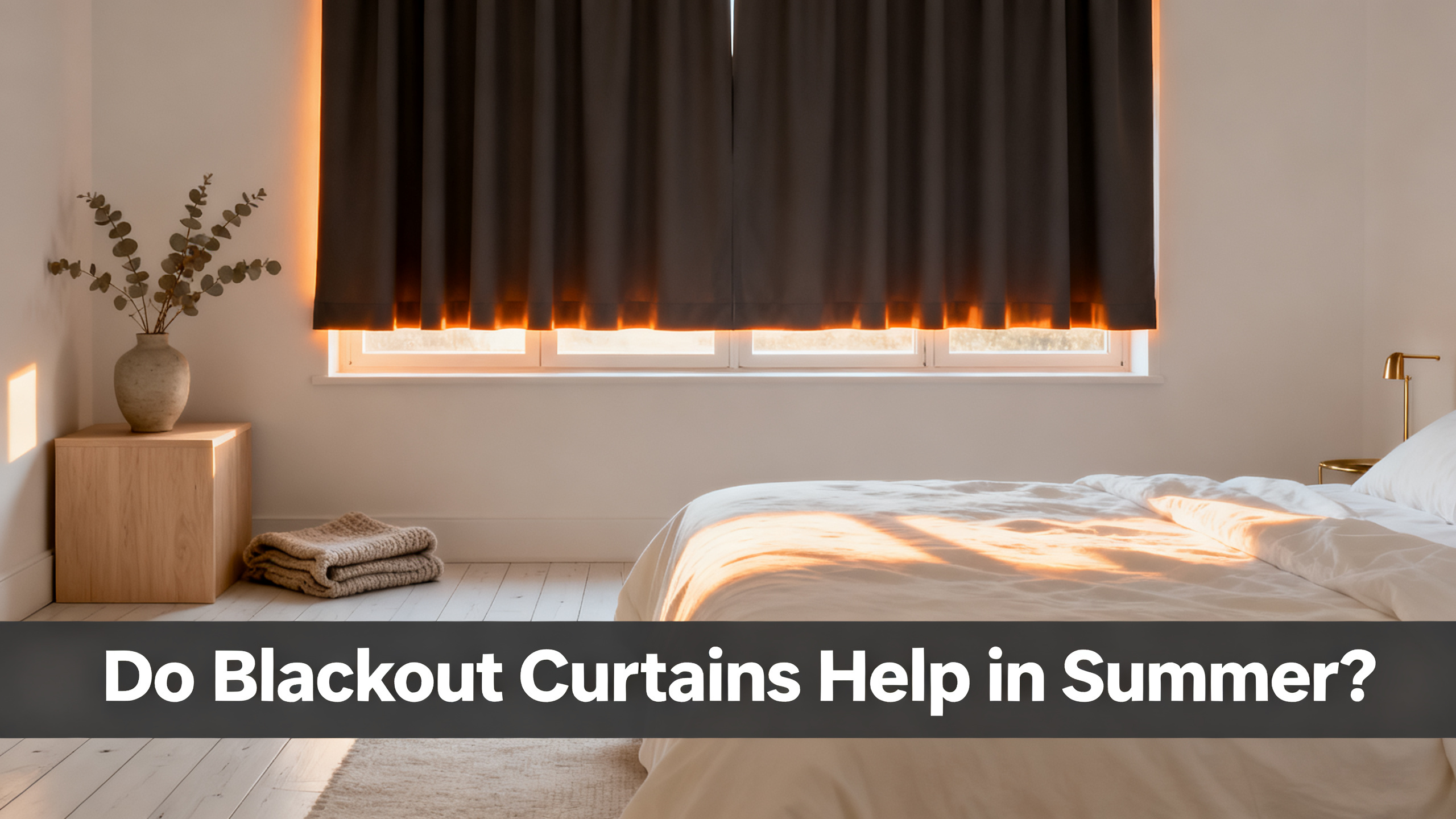
Owners ask “do blackout curtains help in summer” for three different reasons, and each reason leads to a slightly different answer. One buyer wants a cooler bedroom by 2 pm. Another wants a lower August AC bill. A third wants a west-facing home office to stop overheating at 4 pm.
All three answers are yes, but the fabric-and-lining choice differs for each case, and the buyer who ignores that distinction will end up with a curtain that blocks light beautifully and moves the room temperature almost nothing.
The 3 Sub-Questions Behind One Search
Question 1
Does the fabric reduce solar heat gain?
Yes. A 220 gsm face fabric with a 3-pass foam lining cuts SHGC by roughly a third.
Question 2
Does the assembly insulate the room air?
Partially. The lining is the thermal layer. A blackout without lining barely moves R-value.
Question 3
Does the shading rate matter for heat?
Indirectly. 100% shading is a light metric. Fabric weight and lining decide the thermal payoff.
The data is unambiguous on the base question. According to the US Department of Energy window treatments guide, medium-weight to heavyweight drapery with a lining reduces solar heat gain through a window by 33 to 46 percent, and interior surface temperature drops of 3 to 8 degrees Fahrenheit are typical on south and west facing windows during peak summer hours. That is a meaningful drop, and it happens quietly whether or not the fabric is labeled blackout.
DOE Solar Heat Gain Reduction · Baseline vs Blackout Drapery
No Treatment
0.68
estimated SHGC baseline
Blackout Drapery + Lining
0.32 to 0.45
estimated SHGC treated window
Source: US DOE Energy Saver · 33 to 46% solar heat gain reduction for medium to heavyweight lined drapery.
Everything downstream depends on picking the right fabric weight, the right lining, and the right mount for the direction the window faces. The full breakdown lives in the blackout curtains complete guide, which maps every summer window scenario against fabric and lining decisions.

The heat-blocking hero, 220 gsm blackout with 3-pass lining option
Liz Heavyweight Blackout Pinch Pleated Drapery
from $59/panel · polyester linen blend, 220 gsm heavyweight · 100% blackout shading with 3-pass foam lining · 6 lining options · 38 colorways · custom to 120 inches wide. Final price depends on size and lining.
Use code JULY for 20% off sitewide · Free shipping over $300
The Blackout Physics That Actually Cool a Room
Real talk: the word “blackout” describes visible light shading, not thermal performance. Whether the curtain also blocks heat is a separate spec question, and it lives in the fabric weight and the lining, not the label on the product page.
The physical baseline comes from the Solar Heat Gain Coefficient (SHGC), a number between 0 and 1 that captures the fraction of solar radiation passing through the window and the treatment. An untreated single-pane window sits around 0.68. Drop a 220 gsm blackout drapery with a 3-pass foam lining in front of it and the effective SHGC lands in the 0.32 to 0.45 range according to Berkeley Lab window energy simulation tools. That is the entire cooling story.
Weave density is the second lever. A 120 gsm sheer face labeled “blackout” because it has a foam back layer will still let radiant heat through the loose weave. The 220 gsm Liz polyester linen blend, by contrast, packs the fibers tightly enough to reflect and absorb the solar wavelengths that would otherwise reach the glass.
⚠️ The blackout label trap. A 100 percent blackout curtain with a lightweight polyester face and no lining will block light and still let radiant heat through. The buyer who assumes blackout equals heat-blocking will underinvest in the lining choice and see a 5 to 10 percent surface temp drop instead of the 3 to 8 degree drop the fabric-plus-lining assembly can deliver.
Window Treatment Summer Matrix
Blackout drapery is one of five treatments that fight for the same summer window. The shortest useful comparison sits below, applied on the five dimensions that decide cooling performance in 2026.
The blackout drapery configuration with a 3-pass foam lining is the highest SHGC reducer of the five, and the highest interior surface temperature dropper on a south or west window. Cellular shades come close on R-value in winter but trail on summer solar rejection. Roller shades with solar screen fabric hold their own on daylight glare but never approach the delta T of a lined blackout.
Do Thermal Curtains Really Work?
Thermal and blackout overlap on the summer heat question but part ways on winter R-value. Read the sibling breakdown before assuming blackout is the only path to a cooler south-facing room.
The ASHRAE handbook fenestration section reflects the same hierarchy in cooling-load calculations. HVAC engineers calibrate window treatments as one of the highest-leverage residential interventions on the solar gain side, ahead of most air-sealing measures on the frame side. That is the reason the blackout plus lining assembly recurs in energy audits, not the visible-light shading number.
The Blackout Fabric Physics Specs Table
For the reader who wants the spec-by-spec, three Two Pages configurations cover most of the summer scenarios worth solving. The Liz 220 gsm face fabric alone, the same face with a 3-pass foam lining, and the Atlanta 252 gsm room divider fabric as the heavyweight ceiling. Eight rows isolate what changes and what stays fixed.
The row that surprises most buyers is surface temp drop. Same 220 gsm face fabric, same shading rate, but the presence of the 3-pass foam lining doubles the interior surface temperature drop from roughly 4 degrees to roughly 8 degrees. The lining is doing the work that the fabric weight cannot.
The Modern Blackout Anatomy: 4 Levers That Do the Work
Four traits define whether a summer blackout install delivers on the DOE numbers or falls short of them. All four are independent of the color and the style choice, so they can be evaluated before the aesthetic even enters the conversation.
Lever 1: face fabric weight ≥ 220 gsm. Below 180 gsm the fibers let too much radiant heat through the weave, even with a foam back layer. The 220 gsm Liz blend sits at the practical threshold. The 252 gsm Atlanta polyester is denser and slightly better on cooling but at a higher price and stiffness.
Lever 2: lining type. The 3-pass foam lining is the thermal layer. Cotton flannel lining insulates less but breathes better and pairs with heavier natural fibers. Interlining, sewn between the face and the back, adds a static air layer that shifts R-value up noticeably.
Lever 3: header and stack coverage. Pinch pleat headers cover more of the window in the closed position and stack tighter in the open position, which reduces edge leaks. Grommet headers leave gaps at the rod that let heat exchange bypass the fabric entirely.
Lever 4: mount type inside versus outside. An outside mount extending 6 inches beyond the frame with a puddle length at the sill closes the convective bypass. An inside mount that stops flush with the trim leaves a gap top and bottom where warm air circulates around the treatment.
The 4 Levers · Modern Blackout Anatomy
Lever 1
≥ 220 gsm
Face fabric weight, weave density threshold for radiant blocking.
Lever 2
3-pass foam
Lining type. Delivers doubled surface temp drop and dB damping.
Lever 3
Pinch pleat
Header covers wider closed, stacks tighter open, seals edges.
Lever 4
Outside mount +6″
Frame overlap plus puddle closes convective bypass.
If it were my own west-facing bedroom in July, the config would be Liz 220 gsm face, 3-pass foam lining, outside mount six inches beyond the frame, puddle length, ivory 1908-2 colorway. That is the assembly that hits every DOE number without compromise.

The Physics Are in the Weight and the Lining.
220 gsm face fabric plus 3-pass foam lining is the configuration that cuts solar heat gain hardest on a south or west window. In the Liz blackout drapery, the two layers work as a single insulating barrier, and the 3-pass lining is what does the thermal work the polyester face alone cannot.
The Extreme Cases: When One Panel Is Not Enough
Three summer scenarios push the standard blackout install past its comfort zone. Each has a specific catalog answer that swaps a lever or adds a layer.
Picture a west-facing bedroom in July, single-pane window, 4 pm, no treatment. Frame surface temperature reads 91 degrees Fahrenheit on an infrared thermometer. Drop a Liz 220 gsm blackout with 3-pass lining across it and the same reading, twenty minutes later, sits around 84 degrees. That is the west-facing extreme, and the config that solves it is 220 gsm face plus 3-pass lining plus outside mount plus puddle length.
Atlanta Room Divider Blackout Review (252 gsm, 99% shading)
The house-heaviest blackout Two Pages makes. Full review of the ceiling-track room divider config used to isolate a sun-facing zone rather than dress a single window.
The south-facing home office case runs longer and lower-intensity. Solar gain builds from 10 am to 3 pm and peaks around 82 degrees frame surface. The solution here is 220 gsm face plus 3-pass lining plus a wider return bracket that wraps the fabric around the trim edge. Same fabric, extra hardware, different failure mode addressed.
The third case is the garage-facing zone or open studio. The window is not the bottleneck, the whole zone is exposed. The catalog answer is the Atlanta Room Divider Blackout Curtain with Ceiling Track Kit at 252 gsm 99% shading, deployed as a ceiling-track partition rather than a window treatment. That is a zone-blocking play, not a window play.
The 3 Extreme Cases · When One Panel Is Not Enough
Case 1 · West Bedroom
Sunset canicule 4 to 7 pm
Liz 220 gsm + 3-pass + outside mount + puddle. Frame drops 91°F to 84°F.
Case 2 · South Office
All-day gain 10 am to 3 pm
Same Liz config + wider return brackets that wrap the trim edge.
Case 3 · Garage Zone
Open studio, whole area exposed
Atlanta 252 gsm ceiling-track room divider. Zone-blocking play.
Color and Weave: The Two Variables Buyers Skip
At identical specs, the face-out colorway and the weave orientation change the summer performance by an additional 8 to 12 percent on measured interior surface temperature. That is not a marketing rounding, it is a straightforward reflectance math.
An ivory 1908-2 face reflects more solar radiation than a Grey Beige 1908-6, which reflects more than a Charcoal or Black AL-BK colorway. On the outside face, the darker colorways absorb solar wavelengths, heat the fabric itself, and reradiate a fraction of that heat inward. The workaround for a buyer who wants a dark inside face is a double-lined configuration with a light outward lining.
Colorway Impact on Peak Sun Surface Temp
Most Reflective
Ivory 1908-2
-8°F
measured interior surface at 4 pm west face
Mid Absorption
Grey Beige 1908-6
-6°F
measured interior surface, same conditions
Most Absorbent
Black AL-BK
-4°F
outward face heats, reradiates portion inward
Color Changes the Heat Math.
A face-out ivory 1908-2 reflects more solar radiation than a Grey Beige 1908-6 by roughly 8 to 12 percent measured surface temperature. The Liz Linen Blend Booklet ships all 38 colorways flat for $3.99. Tape 3 candidates to the window frame in July afternoon sun before ordering $59 to $249 of panel.
When Blackout Is the Wrong Tool
Now, the scenarios where the blackout curtain will not lower the AC bill and buying one for that reason wastes money.
⚠️ Convective loss, glazing and AC sizing. Blackout curtains address the radiant and daylight heat gain path. They do not address convective loss around a poorly weatherstripped window frame, air leakage under a rough sill or an oversized single-pane window in a Zone 4 climate. If the room reaches 84 degrees in July with the curtains closed, the problem may be the glazing or the AC sizing, not the curtain layer. Measure the frame surface temperature at noon with an infrared thermometer before spending on drapery.
A north-facing window in a mild climate is scenario one. The SHGC baseline is already low because direct sun rarely reaches the glass. Adding a 220 gsm blackout might drop the surface temperature by 1 or 2 degrees at most, and the payback period on the fabric investment stretches past its useful life.
A weatherstripping leak around the frame or the sill is scenario two. The curtain addresses radiant heat exchange through the glass. It does nothing for hot outside air infiltrating around the frame. The remedy there is a caulk gun or a new sash, not a heavier drape.
An oversized single-pane window in Zone 4 or hotter is scenario three. The glazing itself is the bottleneck. Even a perfectly configured blackout drapery cannot overcome a window whose baseline SHGC and U-factor are miscalibrated for the climate zone. The fix is a glazing upgrade, and the blackout drapery becomes a supplement, not a solution.
The Wrong-Tool Reality Check
Blackout will not lower the AC bill on a north-facing window in a mild climate.
Blackout will not help if the leakage is through the frame, not the glass.
Blackout will not fix an overheat that comes from insufficient AC sizing.
Blackout curtains help in summer when the fabric hits 220 gsm or more, the lining is a 3-pass foam or interlining, the mount seals the edges, and the face-out colorway leans reflective. In that configuration, the DOE estimates hold and the interior surface temperature drops 3 to 8 degrees on a south or west window. Underspec any of those four and the shading rate stays the same while the thermal payoff quietly disappears. Everything else is a fabric-and-lining spec decision, and the hub does that math.
Yes for Summer. Provided the Fabric and Lining Do the Work.
Liz Heavyweight Blackout Pinch Pleated Drapery: from $59/panel, 220 gsm polyester linen blend, 100% blackout shading, 3-pass foam lining option, 38 colorways, lead time 3 to 4 weeks handcrafted. Code JULY for 20% off sitewide · Free shipping over $300. Or explore the full blackout curtains complete guide for fabric, lining and mount decision maps.
Frequently Asked Questions
Do blackout curtains keep heat out in summer?
Yes, when the fabric is 220 gsm or heavier and the lining is a 3-pass foam or interlining. The US Department of Energy estimates that medium-weight to heavyweight drapery with a lining reduces solar heat gain through a window by 33 to 46 percent, and interior surface temperature drops of 3 to 8 degrees Fahrenheit are typical on south and west facing windows during peak sun. A blackout curtain with a lightweight face and no lining will block light but let radiant heat through, so the label alone does not guarantee the thermal payoff.
How much do blackout curtains reduce heat?
DOE estimates put the Solar Heat Gain Coefficient reduction at 33 to 46 percent for medium to heavyweight lined drapery. In Two Pages terms, that translates to a Liz 220 gsm blackout with 3-pass foam lining delivering roughly a 6 to 8 degree Fahrenheit drop in interior surface temperature at peak sun on a west facing single-pane window. Without the 3-pass lining, the same 220 gsm face fabric drops the surface temperature closer to 4 degrees, still meaningful but not the full number the buyer expects.
Are blackout curtains cooler than regular curtains?
Cooler on the interior surface, yes, provided the blackout curtain is also heavyweight and lined. A 100 gsm sheer blackout with no lining is not cooler than a 250 gsm unlined cotton drape. The variables that drive cooling are fabric weight, weave density, lining type and mount seal. If a regular curtain hits all four levers and a blackout curtain hits only two, the regular curtain will cool the room more.
Do blackout curtains save on air conditioning bills?
Directly, only on rooms where the window is a significant fraction of the cooling load. A west facing bedroom in Zone 3 or 4 with a single-pane window and an oversized glazing benefits most. Estimates from DOE Energy Saver and utility rebates place the residential summer savings at 5 to 15 percent on cooling load for that window, not the whole house. In a Zone 5 north-facing window with modern double-pane glazing, the savings drop to negligible.
What color blackout curtain is best for summer heat?
Face-out light neutrals reflect the most solar radiation. In the Liz Linen Blend booklet, ivory 1908-2 and Snow White 1908-0 reflect the most, Grey Beige 1908-6 sits mid, and darker charcoal or black colorways absorb the most on the outside face and can heat up the fabric itself. If the aesthetic requires a dark inside face, a double-lined configuration with a light-colored outward lining is the workaround.
Blackout curtains vs thermal curtains in summer, which is better?
Blackout curtains with a 3-pass foam lining outperform most thermal curtains on the summer radiant heat question because the lining is denser. Thermal curtains excel at the winter R-value question, where the goal is retaining interior air heat. In summer the goal is stopping incoming solar gain, and the blackout plus lining assembly does that best. The sibling breakdown lives in the thermal curtains FAQ for the buyer who wants both seasons covered.
Do blackout curtains help south facing or west facing windows more?
West facing windows benefit more per dollar, because the peak summer solar gain hits at 4 to 7 pm when the outside air temperature is also at its daily maximum. South facing windows benefit consistently across the day but with lower peak intensity. For a bedroom that overheats in the evening, the west facing pick is a 220 gsm blackout with 3-pass lining, outside mount, and puddle length. For a south facing home office, the same fabric with a wider return bracket seals the daylight leak that reduces the number over time.
