
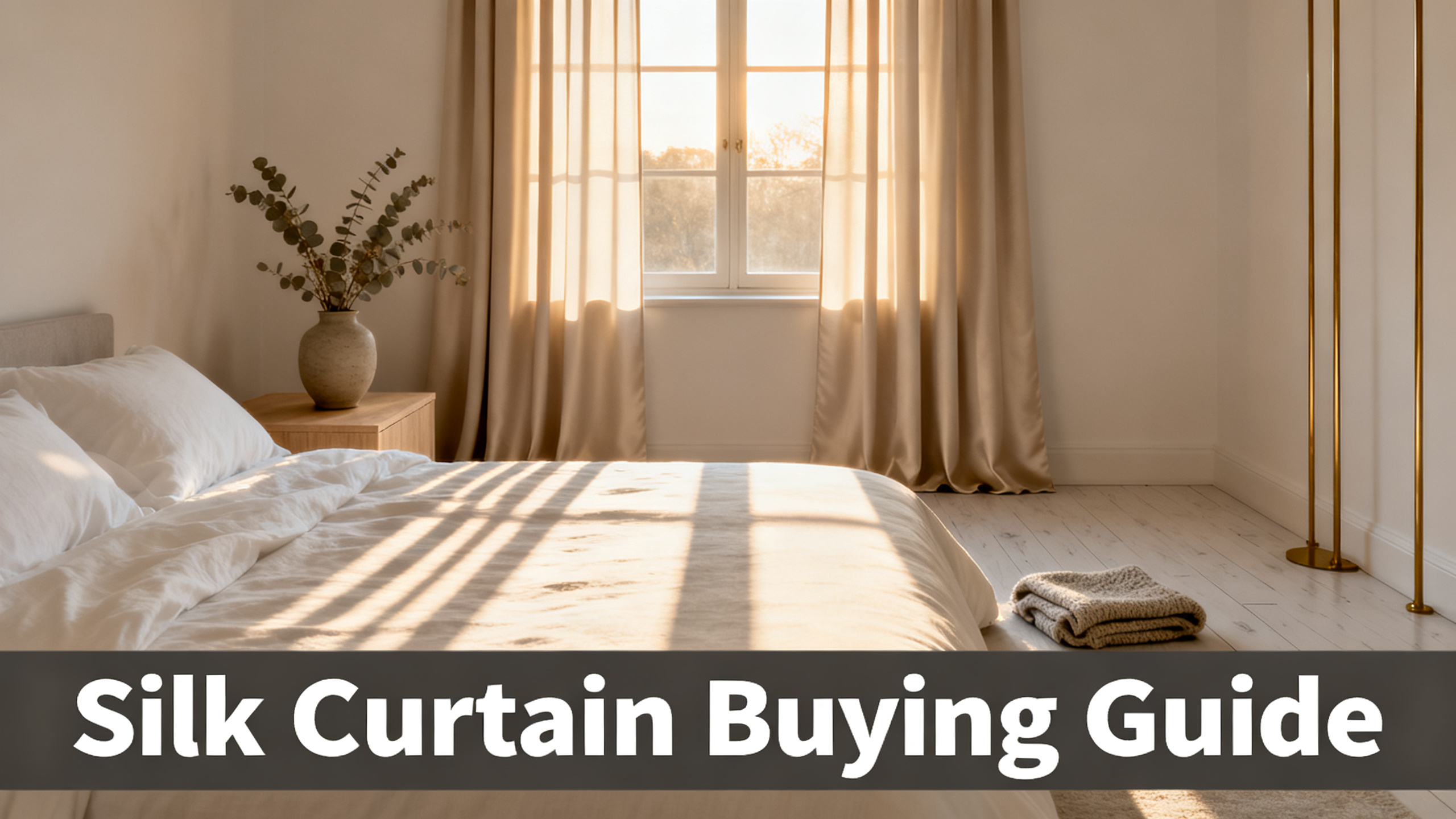
Four questions answer 90% of the silk curtain decision. Budget per panel, room exposure, header style, lining. Answer them once, and every product page in the Two Pages silk catalog starts making sense.
Silk is the fiber that photographs like nothing else on a rod, and it also degrades faster under UV than any other natural fiber for drapery. The gap between “gorgeous” and “faded in 3 years” is entirely a matter of understanding those four questions before you configure. This guide walks each one against the only true 100% silk line Two Pages carries, the Selman Dupioni Silk collection in three headers, with real cart pricing and the honest constraints the fiber comes with. If you want the broader natural fiber picture that surrounds this decision, the complete natural fiber curtains hub lays out the whole pilier.
Question 1
💰 What is the budget per panel?
Under $80 rules out real silk. Selman starts at $119.
Question 2
☀️ Which way does the window face?
South or west + no lining = 2 to 3 year lifespan.
Question 3
🧵 Formal drape or daily glide?
Pinch pleat vs grommet vs soft top decides this.
Question 4
🛡️ Can the room accept a lining?
Silk lifespan depends on this more than on price.

Editor’s pick for real 100% silk
Selman Dupioni Silk Drapery Pleated
from $119/panel · 100% pure dupioni silk, 120 gsm lightweight · 22 colorways from Ivory Beige to Indigo · natural slub texture, characteristic sheen shift · lead time 10 to 14 days. Final price depends on size and lining.
Use code JULY for 20% off · Free shipping over $300
How to Choose the Material: Real Dupioni Silk vs Faux Silk vs Silk Blend
Two Pages carries exactly one 100% dupioni silk line, and it comes in three headers. That simplifies the material decision more than most catalogs, because there is no “silk blend” or “silk-touch polyester” alternate to weigh against. Real talk on what shoppers actually encounter online: three tiers dominate the silk curtain market in 2026.
The first tier is 100% dupioni silk, real protein fiber woven from mulberry silkworms with a specific double-cocoon origin. The second tier is silk blend, usually mixed with polyester or viscose at 30 to 70 percent silk content. The third tier is faux silk, which is 100% polyester engineered to visually mimic silk sheen with zero real fiber. Selman is 100% dupioni across every SKU. The Dupioni silk fiber origin and slub structure reference from the International Sericultural Commission is the cleanest primer on why the double-cocoon yarn produces the visible slub and the sheen shift you cannot fake with polyester.
Selman Dupioni Silk Pleated: Full Honest Review
The deep-dive on Selman’s 120 gsm dupioni slub, sheen behavior across morning and evening light, drape after 1 week hanging, and owner feedback on lining trade-offs.
Silk sits in a specific eco position that owners often misread. It is a natural protein fiber and it is biodegradable in around 12 to 24 months in landfill conditions. It is also the product of sericulture, which carries a real environmental footprint the Textile Exchange sustainability positioning for silk documents openly. Silk is not “greener than linen” and it is not “worse than polyester.” It is its own category, and the honest framing matters if certification is a hard requirement. Two Pages does not publish an OEKO-TEX Standard 100 certificate on the Selman product page. If certified dyestuff safety is a must-have, the broader natural fiber certification framework covers Two Pages’ linen SKUs where OEKO-TEX is documented.
| Fiber | Sheen | Drape body (120 gsm base) | UV lifespan unlined | Care | Base price (Two Pages) |
|---|---|---|---|---|---|
| 100% Dupioni Silk (Selman, 120 gsm) | High, visible sheen shift | Light, floaty | 2 to 3 years south-facing | Dry clean only | from $119/panel |
| Velvet (Birkin, 300 gsm) | None, absorbs light | Heavy, sculpted | 5 to 8 years south-facing | Steam clean | from $99/panel |
| 100% Linen (Doris, 117 gsm) | Low, matte | Crisp, textured | 6 to 10 years south-facing | Machine wash gentle | from $109/panel |
| Cotton blend (Isabella) | None | Structured | 8 to 12 years south-facing | Machine wash | from $79/panel |
| Polyester faux silk | Flat, uniform | Synthetic | 10+ years, but reads plastic | Machine wash | N/A on Two Pages |
Selman Silk vs Birkin Velvet: Which to Buy?
Both feel luxury on the rod. One reflects light and floats, the other absorbs light and drops heavy. The full breakdown on which wins for formal, bedroom, and low-light rooms.
On the 100% silk versus silk blend question, the same trade-off applies as pure linen versus linen blend. Pure silk shifts sheen visibly across the day, drapes floatier at 120 gsm, and holds its slub texture over time. A silk blend with polyester crisps up on day one, kills the sheen shift because polyester reflects flat, and reads plastic under angled light. Selman commits to the 100% dupioni path across the Pleated, Soft Top, and Grommet, which is why the guide does not compare Selman to a Selman-blend version. There isn’t one.
Selman Dupioni Silk: Canonical Specs
Composition
100% Dupioni Silk
Weight
120 gsm lightweight
Fabric width
55 inches
Colorways
22 (Ivory Beige to Indigo)
Headers
Pleated · Soft Top · Grommet
Max custom size
197″ W × 124″ L
Lead time
10 to 14 business days
Base price
from $119/panel


How to Choose the Header: Pinch Pleat vs Soft Top vs Grommet for Silk
Fiber sets the ceiling. The header decides what you actually see on the rod. Silk changes the header math specifically because the fabric is lightweight (120 gsm), which means the header does more work than it does on a heavier fiber like wool or velvet. Pick the header wrong and the beautiful sheen has nothing to shape it.
Header Styles for Selman Dupioni Silk
🧵 Pinch pleat
Formal room default
Deep folds at 2.5× fullness. The sheen shift reads dramatic in dining and living rooms. Editor’s pick.
🌊 Soft top
Casual bedroom drape
Rod pocket, softer folds, relaxed read. Fits a slim rod under 1″ and reads less formal than pleated.
⚙️ Brushed grommet
Daily-use glide
Metal rings glide on rod smoothly. Right for a bedroom or media room where the panels move every day.
Pinch pleat is the default read for Selman if the room is formal. The 120 gsm fabric relies on the pleated header to structure the fall, and the sheen shift photographs best across the sculpted folds. In a dining room with morning east-facing light, the pleated Selman goes from cool ivory at 8 AM to warm honey at 6 PM, and the pleats catch the shift at every angle. This is the format the Selman product page defaults to for a reason.
The Selman Dupioni Silk Drapery Soft Top works when the room is a bedroom that wants silk for the ambience, not the formal read. The rod pocket header creates softer folds that read casual and forgiving. The soft top also fits slim rods under 1″ without hardware complications, which matters for a rental where you cannot change the rod. It is the right silk header for a bedroom that leans “boutique hotel” rather than “formal parlor.”
Grommet is the right silk header if you draw the panels every single day. Brushed metal rings glide over the rod without friction, so opening and closing the drape does not stress the 120 gsm silk at the header. If it were my window on a media room where the panels move at 8 PM every night, the grommet Selman is the format I would pick. It reads less formal than pleated but it is the only silk header that survives daily-use motion without accelerating wear at the top edge.
Best Silk Curtains 2026: Dupioni & Luxury Picks
A shorter side-by-side of Selman Pleated, Soft Top, and Grommet with our editor’s pick per use case and colorway shortlist.

Selman Dupioni Silk Drapery Grommet
from $119/panel · same 100% dupioni silk fabric and 22 colorways as the pleated version, finished with brushed metal grommets · easier to glide on a rod, better fit for a bedroom or media room where you draw the panels daily.
How to Choose the Lining: The Question That Actually Determines Silk Lifespan
Picture a south-facing dining room with full sun from 10 AM to 4 PM on a bare 120 gsm silk panel. That is the exact scenario that shortens the fabric’s visible life to 2 to 3 years, and it is entirely avoidable with the right lining. Real talk on what dupioni silk actually costs to keep looking gorgeous: the lining decision matters more than the header, and more than the colorway.
Silk’s fatal flaw is UV degradation. The protein bonds that give silk its sheen break down under sunlight faster than in any other natural fiber used for drapery. Cotton, linen, and wool all outlast silk on a sunny window by a factor of 2 to 4 unless silk is properly lined. The Cooper Hewitt guidance on silk UV and light protection covers the museum-grade version of the physics, and the residential answer collapses into one rule: on any window with more than 2 to 3 hours of direct sun per day, silk needs lining.
Selman Silk Lining: 4 Real Options
Unlined
North-facing only
~30 to 40% light block. Beautiful float, no UV protection. Right only when the window sees no direct sun.
Cotton lining
Sensible default
~65 to 75% light block. Blocks direct UV, adds drape body, extends silk lifespan past 10 years.
Cotton + thermal interlining ★
Preservation-grade
85% light block, sound dampening, thermal boost. The “restoration hardware” build. Cost adds $50 to $80 per panel.
Poly blackout
Bedroom only
99% light block. Adds visible weight, the drape reads less floaty. Right for a shift-work bedroom, wrong for formal living.
The cotton lining is the sensible default for any Selman panel on a west, east, or south-facing window with regular sun. It adds body to the lightweight silk so the drape reads richer, blocks direct UV before it hits the silk fibers, and stays fully in natural-fiber territory. In a mixed-exposure living room where morning sun hits east and afternoon sun hits west, cotton lining across the full window is the safe call.
Cotton plus thermal interlining is the preservation-grade build. A brushed cotton interlayer between the silk face and the outer lining does three things at once: it blocks any residual UV, it dampens mid-frequency sound (voice, TV) enough to notice in a formal room, and it adds thermal mass that measurably reduces winter heat loss on a single-pane window. This is the build that lets a Selman panel look identical after 10 years hanging. It also stacks the cost, roughly $50 to $80 per panel above the cotton-lined base.
Poly blackout is available on the Selman configurator and it delivers 99% light block, but it changes the silk experience meaningfully. The blackout layer adds visible weight to the 120 gsm silk, and the drape reads less floaty as a result. In a master bedroom for a shift-work sleeper the trade-off is worth it. In a formal living room, it is not. The full dupioni silk care and cleaning protocol covers the maintenance side of every lining tier, including the dry-clean-only rule that applies to all four options.
Silk GSM Weight Ladder: What Each Tier Actually Does
Tier 1: 60-90 gsm
Sheer silk
Transparent, no privacy, not sold on Two Pages.
Tier 2: 100-130 gsm ★
Lightweight (Selman)
Selman sits at 120 gsm. Floaty drape, needs lining on sunny windows.
Tier 3: 140-170 gsm
Medium silk
More body, less sheen shift. Rare in dupioni, common in silk taffeta.
Tier 4: 180+ gsm
Heavy silk taffeta
Structured, formal, reads closer to velvet weight than dupioni.
Pricing by Configuration: Budgeting Your Silk Panel Order
All three Selman headers start at from $119/panel on the Two Pages product page. That is the same base price for Pleated, Soft Top, and Grommet, which is unusual across the catalog and simplifies the header decision because it becomes purely aesthetic rather than budget-driven. Custom sizing scales the base, lining adds $30 to $80 per panel depending on tier, and code JULY layers a 20% discount on the total before free shipping kicks in at $300.
📏 Drop & Coverage: 3 Real Window Sizes
Formal dining
100″ × 96″
Rod placement 4″ above frame, 6″ past each side.
2 panels × $119 = $238
JULY 20% = $190.40
Statement living
120″ × 108″
Ceiling-mount, 1″ break at floor, cotton lining recommended.
2 panels × $149 + lining = $358
JULY 20% = $286.40
Master bedroom
150″ × 120″
Puddle length, thermal interlining preservation-grade.
2 panels × $189 + interlining = $528
JULY 20% = $422.40
Cart simulation values. Add $30 to $50/panel for cotton lining, $50 to $80/panel for cotton plus thermal interlining, $60 to $100/panel for poly blackout. Prices confirmed on the Two Pages configurator July 2026.
A realistic 2-panel bedroom order at 120″ × 108″ with cotton lining lands in the $340 to $420 range after code JULY 20% off, before free shipping applies past $300. That is the price of a real 100% silk drape from a brand that ships from the US, versus $60 to $90 per panel for a polyester faux silk that reads plastic under angled light. The premium buys you real fiber and the specific sheen shift no polyester can fake.
🧮 Configure Your Silk Panel Price
Step in the calculator
Width + drop + header + lining
The Two Pages Selman configurator recalculates as you change any field. Base $119 stays until width crosses 100″ or lining is added.
Where JULY 20% applies
On the panel total
Code applies after custom sizing and lining are added. Free shipping over $300 layers on top, which a 2-panel order clears easily.
Configure on the Two Pages Selman product page for a live quote before adding to cart.
Silk cost stacks up meaningfully in a formal dining or master bedroom where the room is treated as a decade-long investment. For a rental with 12 to 18 months left on the lease, silk is almost never the smart call because you cannot amortize the panel cost across the room’s lifetime. If it were my budget on a formal dining, I’d go with pinch pleat Selman plus cotton lining. On a rental, I’d wait and buy silk for the next owned home.
Order the Selman Silk Booklet (22 Colors)
Dupioni silk shifts sheen and undertone every time the light angle changes. The 22-color Selman booklet ships flat for $1.99, near-zero commitment, and lets you drape a real-scale swatch against your wall in morning and evening light before ordering a $500+ panel set.
What to Do Next: A 3-Step Silk Curtain Plan
Two Pages carries exactly one 100% dupioni silk line, and it comes in three headers at the same base price. Once the four-question framework in the intro points to silk, execution collapses into three steps that most owners can complete in under 30 minutes of active work spread across a two-week window.
Your 3-Step Selman Plan
Step 1 · 20 min
📏 Measure precisely
Silk shows any drop error more than any other fiber. Width bracket-to-bracket, drop rod-to-floor, add 4″ above the frame and 6″ past each side. Decide puddle or float now.
Step 2 · $1.99
🎨 Order the 22-color booklet
Near-zero barrier. Drape each candidate color against the wall at 8 AM, noon, and 6 PM. Silk changes hue and sheen at every light angle.
Step 3 · 10-14 days
⚙️ Configure on Two Pages
Enter width, drop, header, and the right lining for the room’s exposure. Apply code JULY for 20% off. Free shipping over $300.
The persona synthesis, one last time. Formal room → Selman Pleated in Ivory Beige, Pearl, or Fog with cotton lining. Master bedroom → Selman Grommet in Indigo, Bronze, or Chestnut with cotton plus thermal interlining. Casual den with north-facing exposure → Selman Soft Top in Aqua or Ice Blue unlined, the floaty read the room’s low UV allows. Every path starts with the same $1.99 booklet, which is the lowest-friction pre-purchase step in the entire Two Pages catalog.


Start with the Selman Silk Configure
100% dupioni silk, 120 gsm, 22 colorways from Ivory Beige to Indigo, custom widths up to 197″. from $119/panel. Code JULY (20% off) · Free shipping over $300 · Lead time 10 to 14 days · custom lining options.
FAQ: Silk Curtains, Selman, and What Owners Actually Ask
Is real dupioni silk worth the price for curtains?
For a formal dining room, a master bedroom with the right lining, or an entry hall where the panels stay in place for a decade, yes. Selman Dupioni Silk at $119 per panel returns its premium through visible sheen shift across daylight, natural slub texture no polyester faux silk can replicate, and a drape body that photographs like a magazine spread. For a south-facing sunroom that gets 6 hours of direct light, or a rental you plan to move out of in 18 months, a linen blend or a cotton drape is the smarter call. The Selman vs Birkin Velvet comparison walks the “when silk vs when velvet” math.
Do silk curtains fade?
Yes, faster than any other natural fiber for curtains. Silk protein bonds break under UV exposure, and dupioni’s characteristic sheen dulls visibly after 2 to 3 years on a south-facing bare panel. The fix is not to avoid silk, it is to line the silk properly. A cotton or cotton plus thermal interlining blocks direct UV from hitting the silk fibers and extends visible lifespan past 10 years in normal residential use. This is why Two Pages configurator offers 4 lining tiers and why the unlined option is only right for north-facing windows.
Can silk curtains block light?
Unlined dupioni silk at 120 gsm blocks roughly 30 to 40% of visible light, softens hard sunlight into a warm glow, and cannot function as a bedroom blackout. With a cotton lining silk blocks 65 to 75%, enough for a formal bedroom in a north-facing room. With a poly blackout lining silk blocks 99%, matches any dedicated blackout drape, but adds visible weight to the 120 gsm silk drape which reads less floaty. The right lining depends on which room and which sun exposure.
How do I clean dupioni silk curtains?
Professional dry cleaning only. Home washing on any cycle irreversibly damages silk fiber structure, causes shrinkage between 5 and 12%, and destroys the characteristic slub. Water dries with visible ring marks on dupioni that no re-dry-clean can remove. For small spot cleaning, use a dry-clean-safe spot remover applied with a soft cloth, never rub. Deep cleaning every 18 to 24 months at a dry cleaner familiar with drapery preserves the sheen.
How much do real 100% silk curtains cost from Two Pages?
Selman Dupioni Silk starts at $119 per panel for all 3 headers (Pleated, Soft Top, Grommet) in standard size 52″ × 84″. Custom sizing scales the price, and lining choice adds $30 to $80 per panel depending on tier (cotton, cotton plus thermal, poly blackout). A realistic 2-panel bedroom order at 120″ × 108″ with cotton lining lands in the $340 to $420 range after code JULY 20% off, before free shipping kicks in at $300. The $1.99 22-color booklet is the recommended first spend before committing.
Are silk curtains sun-safe?
Bare 100% silk is not sun-safe on a window with more than 2 to 3 hours of direct light per day. UV degrades silk protein faster than cotton, linen, wool, or polyester. The engineering answer is lining, not fiber avoidance. A cotton lining blocks direct UV from the silk and preserves the fabric well past a decade. For a west-facing living room with 4 hours of afternoon sun, cotton lining is the minimum. For a south-facing dining room with 6 hours of midday sun, cotton plus thermal interlining is the correct spec.
What is dupioni silk exactly?
Dupioni is a specific silk fabric woven from irregular yarn produced by two silkworms sharing one cocoon. That double-cocoon origin gives dupioni its characteristic slub texture (small visible thickenings in the weave) and its distinctive sheen shift across viewing angles. It is 100% real silk from the same silkworm species that produces mulberry silk, but the yarn is irregular by design where mulberry yarn is smooth. Selman is 100% dupioni across all 3 headers, weighted at 120 gsm which is the lightweight end of drapery silk.
Silk vs velvet vs linen: which is right for a formal room?
Silk works for a formal dining or entry with north or east exposure where the sheen carries the room. Velvet works for a low-light formal living room where you want the fabric to absorb light and hold heavy drape. Linen works for a bright informal room where the fiber should breathe and photograph casual. All 3 exist in the Two Pages catalog and the specific “silk vs velvet” call is walked in the Selman Silk vs Birkin Velvet comparison. Rule of thumb: silk reflects, velvet absorbs, linen breathes.
