
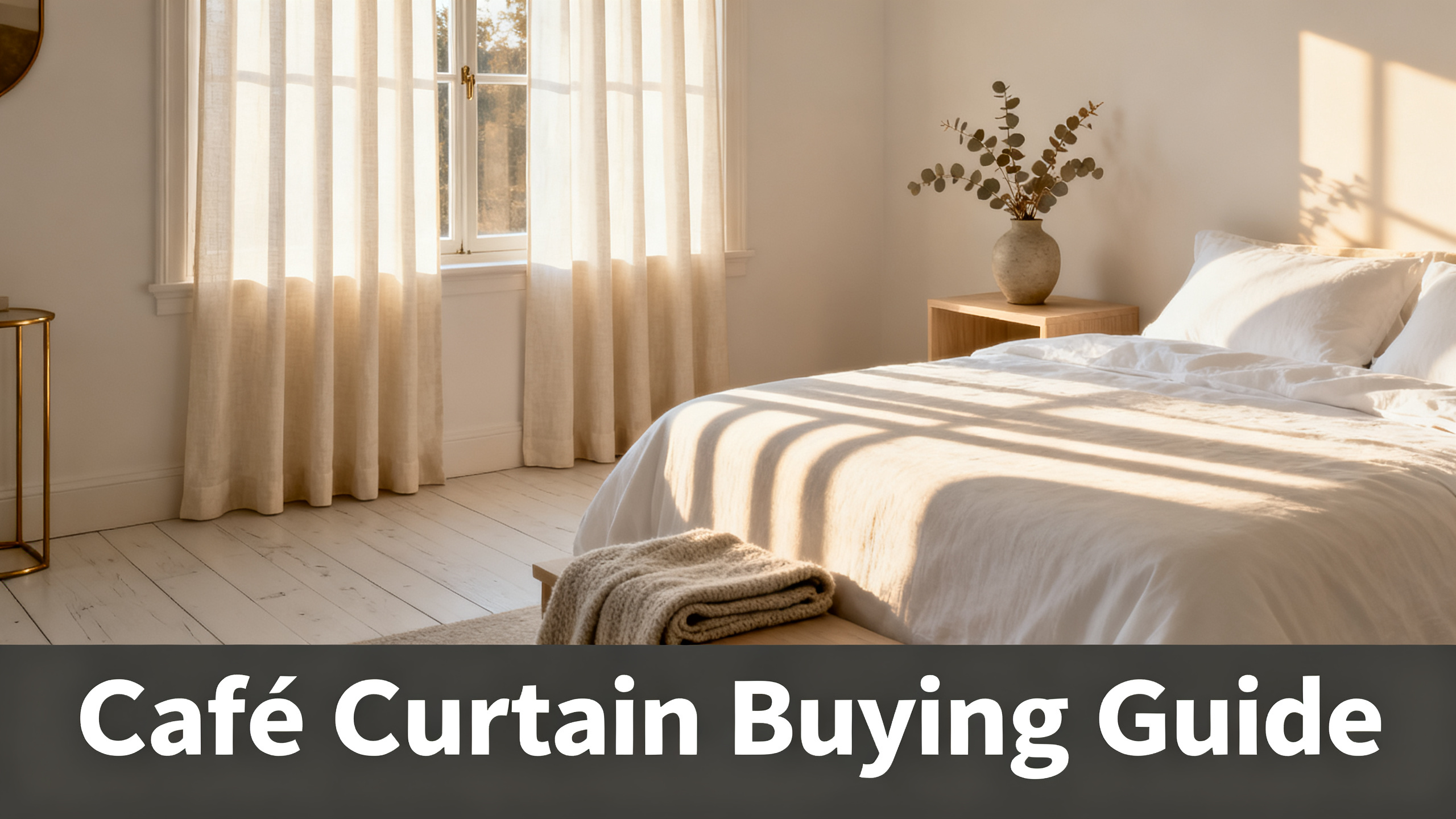
Cafe curtains split buyers into four tribes. The rental fixer who cannot drill. The homeowner refreshing a tired kitchen. The design-forward statement seeker chasing a specific print. The natural-fiber loyalist optimizing for a fabric that lasts a decade. Naming yours narrows the shelf from 40 SKUs to 3.
This guide walks the four tribes in order, with real Two Pages catalog prices, real header options per persona, and the honest tradeoffs owners flag on Trustpilot after a full year of morning light hitting the kitchen sink. If you want the wider pilier scope on tier curtains, valances, and designer collabs, our complete cafe curtains and valances hub maps the full landscape.
🧭 Cafe curtain persona triage: which tribe are you?
The Renter
No drill, small window, tension rod path. Hero pick: Liz Linen $59.99 or Custom Rod Pocket $49.99.
The Owner
Kitchen refresh, print or solid, real drape depth. Hero pick: Sara Le Print $89.99 or Liz Linen solid.
The Statement Seeker
Designer collab, velvet or block print, one wow window. Hero pick: Amy Switzer Velvet $75.99.
The Natural-Fiber Loyalist
Cotton or linen, OEKO-TEX, decade of use. Hero pick: Celia Plaid $65.99 or Liz Linen.
Two Pages carries a signature pick per persona at every price band from $49.99 to $119.00. We unpack each below.
🪟 Cafe Curtain 101: what actually differs from a full drape
Panel geometry
Half-height, 24″ / 36″ / 45″ drop. Covers the bottom of the window only. Top half stays bare for daylight.
Rod placement
At the mid-window mark, halfway between frame top and sill. Tension rod inside frame or wall bracket outside.
Sold as
Two Pages ships single panels by the panel, not pre-hemmed pairs. Order 1, 2, or 3 sized to your exact opening.

Editor’s pick, kitchen refresh
Liz Linen Pleated Cafe Curtains
from $59.99/panel · 100% linen face · pinch pleat header · 10 quiet neutrals · 24″ / 36″ / 45″ drop options. Final price depends on width and drop.
Use code JULY for 20% off · Free shipping over $300
For the Renter: No-Drill, Small Windows, Kitchen or Bath
Renting shapes the install path before it shapes the fabric. Landlord clauses on holes in the wall, a security deposit tied to zero visible mounting, and often a lease that reads more like a mortgage on your patience. The good news is that cafe curtains were, historically, the tier-curtain pattern that renters invented for exactly this reason. Half-height means a shorter rod. A shorter rod means tension fits inside the window frame, no drill required. That is the entire physics.
The Two Pages entry point for this persona is either the Liz Linen Cafe product page at $59.99 per panel in a pinch pleat header, or the Custom Rod Pocket Cafe Curtains at $49.99 per panel in a rod-pocket header. The rod pocket path is the more renter-native pick because it slides directly onto a tension rod without rings or hooks, and it drops back off in 8 seconds when it is time to move out. See also the CPSC window covering safety guidance if you are in a rental with kids or pets: cordless is the correct answer, and a cafe curtain on a tension rod is a fully cordless install.
How To Make Cafe Curtains From a Flat Panel
If you already own a full-length curtain you love, the DIY hem-and-header cut turns it into a cafe pair in about 40 minutes. Rod-pocket path with no sewing machine needed for the finished hem.
Rod pocket panels and tension rods
The rod pocket is a sewn channel at the top of the panel, roughly 1.5 inches deep, that swallows the rod entirely. On a tension rod, it gathers into soft cased ruffles that read casual, not formal. This is the correct aesthetic for a rental kitchen sink window or a small bathroom half. Where it breaks down: any drop longer than 36 inches on a tension rod risks the rod bowing under fabric weight, especially with the heavier 350 gsm blends.
The size guidance owners keep confirming in Trustpilot notes is simple. Measure your inside-frame width. Order a panel 1.5x to 2x that width per rod to get the cased-ruffle drape that reads intentional. A 30 inch inside frame width takes a 45 to 60 inch panel. Order two panels for a proper open-in-the-middle look on windows wider than 32 inches.
What to spend, what to skip
The bare panel is only half the cost of a renter cafe install. Add roughly $14 to $30 for a decent tension rod at the width you need (Milo Cafe Rod at $54.99 is the Two Pages house pick and it clears both 18-28 inch and 28-48 inch spans in two SKUs). Skip the drapery rings for the rod pocket path. Skip the tiebacks for a half-height panel, which is too short to read tied back without looking bunched. Total renter setup: bare panel $49.99 to $59.99, plus rod $14 to $54.99. Under $115 for a fully installed café pair with no drill.

🪟 Window sizing scenarios: three real openings, three answers
Over-sink kitchen window
Typical 30″ wide × 36″ tall. Rod at 18″ from sill. Panel 45″W × 24″L single, rod-pocket header, tension rod inside frame.
Breakfast nook window
Typical 48″ wide × 60″ tall. Rod at 30″ from sill. Two panels 42″W × 36″L each, pinch pleat, wall bracket outside frame.
Bathroom half window
Typical 24″ wide × 48″ tall. Rod at 22″ from sill. Panel 40″W × 24″L single, rod-pocket header, tension rod. Blackout backer optional.
For the Owner: Kitchen Refresh, Depth of Drape, Print or Solid
Homeowners refreshing a kitchen come to café curtains with a different budget calculus. The install is permanent (wall brackets, occasionally ceiling mount above a bay), the sightline stays for 8 to 15 years, and the fabric decision is not “what fits my rental” but “what suits my house”. This shifts the conversation from tension rod to pinch pleat depth of drape, and from “any print will do” to a specific light test.
Picture the moment the 4pm sun catches the countertop through a north-facing sink window. Solid linen (Liz at $59.99) reads as a quiet neutral field, letting the countertop and the backsplash carry the room. Printed linen (Sara Le at $89.99 in floral or plaid) reads as the room’s accent, pulling the eye up from the counter and framing whatever is on the windowsill. Neither is wrong. They answer different rooms. For a deeper dive on pinch pleat body and drape structure, the deep-dive Liz Linen full drape review covers the pleat mechanics that transfer directly to the cafe format.
Best Cafe Curtains for the Kitchen: Editor’s Roundup
The five picks that survived our shortlist across sink windows, breakfast nooks, and above-counter installs, with per-pick Trustpilot flags.
The pinch pleat depth question
The pinch pleat header pulls the panel into a cleaner, more furniture-like fold than the rod pocket. On a 45 inch drop it looks intentional, almost formal. On a 24 inch drop over a sink window, it still holds structure. The Sara Le collection ships with bonus body memory shaping included, which is a heat-set training pass that locks the pleat geometry for the life of the panel. Owners who skip that service and try to steam the pleats at home report the pleats loosening within 6 months of daily open-close cycles.
The width guidance is different from the renter path. For pinch pleat, order 2x to 2.5x the rod width in panel width to get the proper wave. A 42 inch rod takes a total of 84 to 105 inches of paneling, which usually means two panels 45 inches wide each.
Print or solid: the light test
Skip the online browsing rush. Order two swatches, tape them to the cabinet next to the window, and check them at three times of day: 8am, noon, 5pm. Print reads at 8am. Solid reads at noon. Both read at 5pm. If the print reads busy at any of those hours, it will read busy every day for the next 8 years. The Liz Linen fabric booklet ships flat for $1.00 and is the correct first order for this persona before committing to a $180 pair.
🧵 Header style visualizer: 4 cafe curtain headers, what they do to the drape
Pinch pleat
Cleanest fold, most structured drape. Best for permanent installs. Requires rings. Liz, Sara Le, Amy Switzer.
Rod pocket
Casual cased ruffle. Slides directly on the rod. Best for rentals, tension rods. Custom Rod Pocket Cafe.
Tab top
Fabric loops, farmhouse read. Handles medium panel weight. Manual pull-back to open. Custom option.
Eyelet / grommet
Metal ring set through fabric. Modern read. Slides silently. Handles heavy panels well. Custom option.
Investing in a decade of use
The kitchen refresh math for cafe curtains usually pencils out at 8 to 15 years of daily use before the panels feel dated. Owners who buy for a specific print (Sara Le’s Vintage Linen, Rebecca Hughes’s Vintage Print, Kate Frost’s cotton patterns) tend to keep them for the shorter end of that range because trend cycles move faster than fabric wear. Owners who buy a quiet linen solid (Liz in Ivory or Sand Beige, Doris in oatmeal) tend to keep them for the longer end.

Owner refresh, printed statement
Sara Le Print Linen Pleated Cafe Curtains
from $89.99/panel · 10% linen / 90% polyester blend · 350 gsm heavyweight · pinch pleat · 12 vintage floral and tartan prints. Bonus body memory shaping included.
For the Statement Seeker: Designer Collabs, Velvet, Bold Prints
This persona is chasing the one wow window. Usually it is a breakfast nook, an entryway half-window, or a powder room where the entire room’s identity hinges on the fabric decision. The rules are different. Fabric cost per panel doubles or triples. The print carries the room. The pick is often a designer collab (Amy Switzer, Stefana Silber, Sara Le, Rebecca Hughes) rather than a house pattern.
Real talk on the velvet path: the Amy Switzer Printed Velvet Cafe Curtain at $75.99 per panel is the current statement pick in the Two Pages catalog. It is printed on a velvet pile that catches light differently at every hour, which is exactly the point. It is also a dust magnet in a kitchen environment where cooking aerosols land on any fibrous surface. Owners in high-cook households report needing a quarterly steam vacuum to keep the velvet pile clear. If your kitchen is a Sunday-only kitchen, this is fine. If you cook 6 nights a week, choose a linen or cotton weave instead.
The block print alternative is Stefana Silber print linen review context, whose cafe format ships at $89.99 per panel in linen blend. Block prints hide dust better than velvet pile, and the flatter surface cleans with a lint roller instead of a vacuum head. For high-cook kitchens, block print is the right compromise between statement fabric and practical care.

Velvet cafe: reading the tradeoff
Velvet at cafe height is a specific move. On a full-length drape, velvet reads as a formal drapery statement. On a 24 or 36 inch cafe panel, it reads more like a soft accent, closer to an upholstery detail than a curtain. This is the visual math the designer collabs are exploiting. Amy Switzer’s Brushstrokes Berry Blue works because the print scale is proportioned for the half-height cut. A larger-scale velvet print would fight the geometry.
Block prints and colorways
Stefana Silber’s block prints run across roughly 6 colorways at cafe scale, ranging from soft neutrals (Cream, Khaki) to darker anchors (Charcoal, Ink). Sara Le’s vintage collection reaches 12 colorways, weighted toward warmer tones (Porcelain, Copper, Scarlett, Bronze, Ivy Brown). Both lines ship with body memory shaping as a bonus service.
The 3-window rule for statement fabric
If the room has more than 3 windows, statement fabric on all of them reads busy fast. The 3-window rule: keep statement fabric on one or two windows, use a quiet linen solid on the rest. A breakfast nook of 4 identical windows dressed in Sara Le’s Vintage Linen print will read as pattern overload by month 3.
| Fabric | Hand-feel | Kitchen suitability | Care load | Price band /panel |
|---|---|---|---|---|
| 100% linen (Liz) | Natural, soft, quiet drape | Excellent, all-cook | Low, spot clean or gentle wash | $59.99 |
| 100% cotton (Celia plaid) | Crisp, structured, matte | Excellent, all-cook | Low, machine washable cold | $65.99 |
| Linen blend 10/90 (Sara Le) | Heavyweight 350 gsm, print-forward | Good, 3-5 nights/week cook | Low, spot clean | $89.99 |
| Printed velvet (Amy Switzer) | Pile catches light, statement | Fair, Sunday-cook only | Medium, quarterly vacuum | $75.99 |
For the Natural-Fiber & Sustainability Loyalist
This persona optimizes across two axes at once: the fabric’s environmental provenance and its expected service life. Synthetic-blend panels are cheaper today and worse tomorrow, both for the landfill and for the eventual replacement cost. The loyalist path skips them.
The certification to look for is OEKO-TEX Standard 100 textile certification, which verifies that the fabric is free from harmful chemical residue at every stage of manufacture. Two Pages carries OEKO-TEX certification across the Liz Linen and Doris Linen collections, and across a subset of cotton lines. The certification is verifiable at the product page, not just a marketing claim.
Cotton plaid: the timeless anchor
The Celia Striped Plaid Cafe Curtain at $65.99 per panel is the current 100 percent cotton anchor in the catalog. It runs across 14 colorways spanning pinstripes, wide bar, and small plaid patterns in khaki, olive, black, blue, and red. The plaid pattern reads timeless (this style has been in circulation since the 1960s), machine washes cold without shrinking, and holds structure better than linen at cafe cut.
Honest note: Target and Walmart sell reproducible plaid cafe panels in the $18 to $28 range that will read visually similar from 6 feet away. The Two Pages difference is panel length precision, hem quality, and the color depth of the woven yarns, not the pattern itself. If you are furnishing a rental kitchen you plan to leave in 18 months, the $22 Target pick is defensible. If you are furnishing your own kitchen for the next 10 years, the fabric grade wears differently by year 3.

Linen: the longer-lived neutral
Linen outlasts cotton at cafe cut by roughly 2 to 4 years in a daily-use kitchen. The fiber wears in rather than out, softening across the first 60 washes but never losing structural integrity the way cotton eventually does. Liz Linen at 100 percent linen face is the loyalist’s pick for a neutral solid that reads intentional at 3 years and heirloom at 12 years. For sustainability-optimized households with kids, natural fiber cafe curtains are also the correct pick because they avoid the microplastic shedding of polyester blends during washing.
🌿 Opacity & backing card: how much light does a cafe curtain block?
Semi-sheer (20-40% block)
Unlined 100% linen at ~180 gsm. Silhouette-filtering at day. Translucent at night. Liz unlined path.
Semi-opaque (40-70% block)
100% cotton plaid at ~240 gsm, or blend at 350 gsm. Silhouette-hiding at day. Room glow at night. Celia, Sara Le.
Blackout backer add-on (90%+ block)
Any cafe fabric with a blackout roller shade layered behind. Only path to full night privacy. Order the pair as one system.
Cross-Persona: Sizing, Hardware, Cost of the Full Setup
Now where the tension rod path breaks down and the wall bracket path takes over. Any drop longer than 36 inches, any panel heavier than 300 gsm, or any width beyond 42 inches per rod: mount wall brackets. Tension is not enough. The Milo Cafe Curtain Rods with Rings at $54.99 per set is the Two Pages house hardware pick for the wall bracket path, in Warm Gold or Black finishes, spanning 18-28 inches (small) or 28-48 inches (large).
🔩 Rod & hardware options: three paths per install context
Tension rod inside frame
Renter path. Zero drill. Max drop 36″. Max panel weight ~250 gsm. Cost $14-30.
Wall bracket outside frame
Homeowner default. 4 anchor points. Handles heavier panels and 45″ drops. Milo Cafe Rod $54.99.
Ceiling mount
Bay windows, no wall real estate. Requires ceiling drill. Adds vertical height feel. Custom rod recommended.
The real cost of the full install
The bare panel is only 60 to 75 percent of the delivered install cost. The rod and rings add $14 to $70. If you order the blackout roller shade backer for the bathroom persona, add another $80 to $140 depending on width. Fabric booklet upfront: $1.00. Total renter setup runs $75 to $115. Total homeowner refresh runs $180 to $340 for a single window pair. Total statement seeker refresh runs $240 to $430 with velvet and premium hardware.
💵 Pricing by persona: full install cost per single window
The Renter
Panel $49.99-59.99 + tension rod $14-30 + booklet $1.00.
Total ~$75-95
The Owner
Panels $120-180 + Milo rod $54.99 + booklet $1.00.
Total ~$180-240
The Statement Seeker
Panels $150-240 + Milo rod $69.99 + booklet $1.00.
Total ~$225-315
The Loyalist
Panels $120-180 + Milo rod $54.99 + booklet $1.00.
Total ~$180-240
All pricing before code JULY (20% off sitewide). Free shipping over $300, which a 2-window install typically clears.
Order the Liz Linen Fabric Booklet
Kitchen light is unforgiving on linen: north-facing washes cool, south-facing warms every neutral. The booklet ships flat for $1.00 and lets you tape a swatch to the cabinet before you commit to a $180 pair order.
What to Do Next
Three steps, in order. This is the correct sequence for every persona in this guide, and skipping any one of them is the source of roughly 80 percent of the return requests Two Pages sees on cafe curtain orders.
✅ What to do next: the 3-step plan
Step 1
Measure the half-window
Inside frame width + rod-to-sill drop. Two numbers. Take them with a tape measure now, before anything else.
Step 2
Order the fabric booklet
$1.00 flat, ships in 3-5 days. Tape the swatch to your cabinet next to the window. Check at 8am, noon, 5pm.
Step 3
Configure the panel
Enter width, drop, header, colorway. Cart shows the price and 10-15 day lead time. Code JULY at checkout.
If it were my west-facing kitchen with a north-facing sink window, I would order the Liz Linen fabric booklet today, then configure Liz in Ivory White at 45 inches wide by 24 inches drop for the sink window, and Sara Le in Porcelain at 42 inches wide by 36 inches drop for the breakfast nook. Two orders, two personas answered, one house.
Configure Your Liz Linen Cafe Panels
100% linen face, pinch pleat header, 24″ to 45″ drop, 10 neutrals. from $59.99/panel. Code JULY (20% off) · Free shipping over $300 · Ships in 10-15 business days for custom pleats.
FAQ
What is a cafe curtain and how is it different from a tier curtain or valance?
A cafe curtain is a half-height panel that covers the lower half of a window while leaving the upper half open for daylight. Tier curtains are the same category, often sold as a matching pair for taller windows (bottom tier plus top tier). A valance is the reverse: a short decorative header at the top, with the lower half bare. The cafe panel prioritizes privacy at counter or sink height while keeping the room bright. Two Pages sells single panels sold individually, not pre-hemmed pairs, which lets you order one, two, or three panels sized to your exact window.
How long should cafe curtains be?
The standard drops are 24 inches, 36 inches, and 45 inches. A 24 inch drop covers a sink window from mid-height to the countertop. A 36 inch drop covers a taller kitchen window or a standard bathroom half. A 45 inch drop reads more like a mini-drape and works in breakfast nooks with tall windows. The rule of thumb: measure from the intended rod position down to a natural stopping point, then order the nearest standard drop up.
What rod height should cafe curtains hang at?
The rod sits at the mid-window mark, roughly halfway between the top of the window frame and the sill. On a 48 inch tall window, that means a rod at 24 inches from the sill. Owners refreshing rental kitchens often mount inside the frame with a tension rod for zero-drill install. Homeowners doing a permanent kitchen refresh mount wall brackets 1 to 2 inches above the window frame to gain a taller visual proportion.
Are cafe curtains still in style in 2026?
Yes, but the aesthetic has shifted. The 2010s farmhouse plaid look is dated in most kitchens now. The current cafe palette leans toward pinch pleat linens in quiet neutrals (Liz Linen, Doris flax), vintage prints for character kitchens (Sara Le, Rebecca Hughes), and statement velvet or block print for design-forward homes (Amy Switzer, Stefana Silber). The category is not out, the wrong pick just reads out.
Do cafe curtains offer any privacy for a bathroom?
A half-height cafe panel covers the lower window where a passerby would see in from countertop or sink level. For a ground-floor bathroom, that is the critical privacy zone. Fabric weight matters: a 100 percent linen unlined panel filters silhouette clearly at daytime but stays translucent at night with the light on. For full privacy after dark, layer a blackout roller shade behind the cafe or choose a heavier print like Sara Le at 350 gsm.
Can I use cafe curtains on a wide kitchen window with 3 panels?
Yes. The pattern is one panel per 24 to 32 inches of window width for pinch pleat coverage. A 72 inch wide window takes three panels sized to your exact rod width. Two Pages sells panels individually by the panel, not as pairs, which makes 3-panel or 5-panel wide-window installs straightforward. Order one fabric booklet first to confirm the color reads right across the wider expanse.
What is the difference between the Liz and Sara Le cafe curtain lines?
Liz Linen is the entry point at $59.99 per panel, 100 percent linen face, sold in 10 quiet neutrals, pinch pleat header, standard drops 24 to 45 inches. Sara Le Print Linen is $89.99 per panel, a 10 percent linen 90 percent polyester blend at 350 gsm heavyweight, sold in 12 vintage floral and tartan prints, pinch pleat header, and includes bonus body memory shaping for cleaner drape. Choose Liz for a quiet neutral base, choose Sara Le for statement print and heavier body.
