
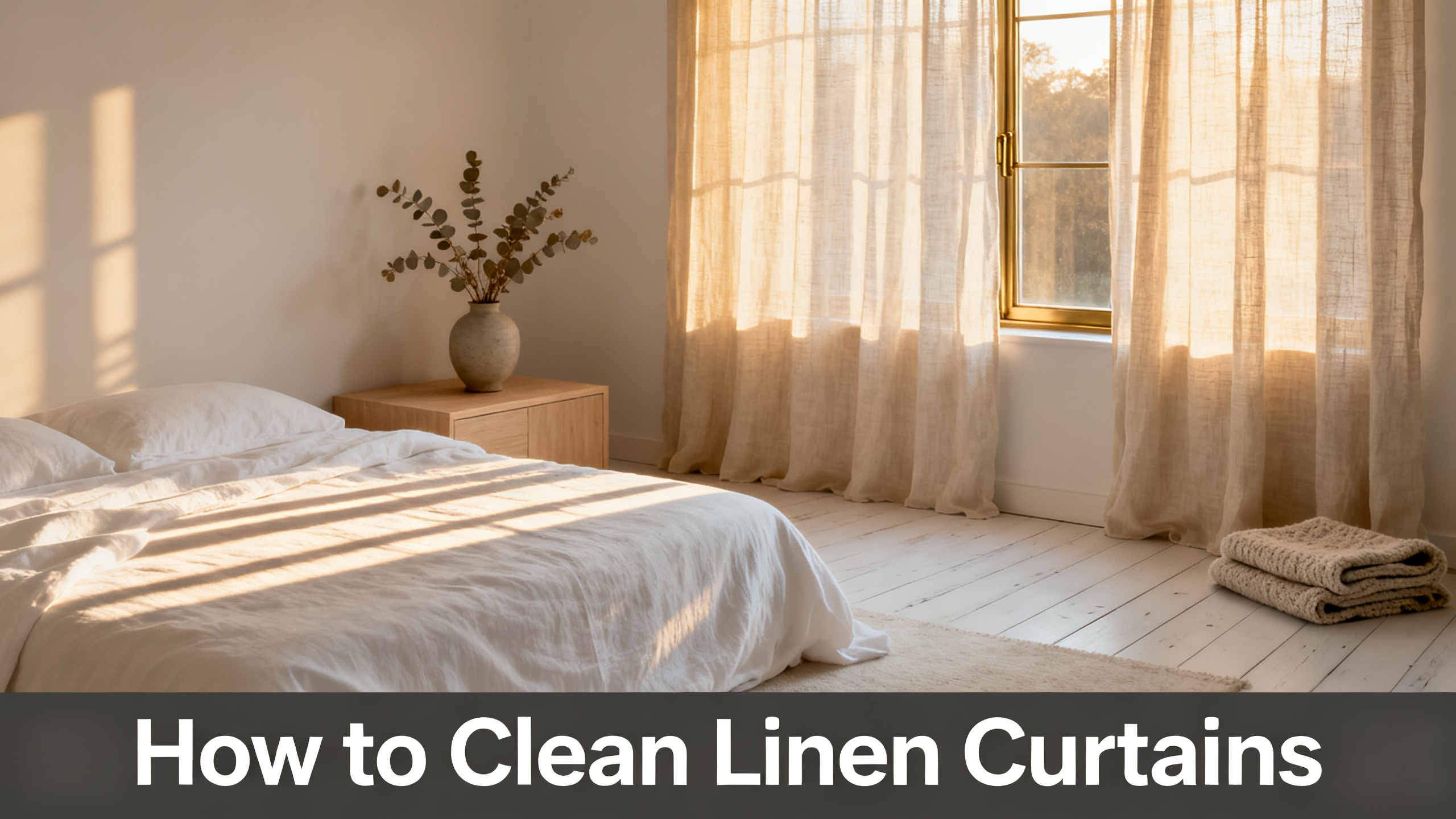
Here is the honest math on cleaning linen curtains. Done right, the whole process takes about 40 minutes and produces a panel that keeps its drape, its color, and its length. Done wrong, the same panel comes out of the machine 8% shorter, permanently wrinkled where the spin cycle folded it, or chalky-faded because someone used chlorine bleach on a fiber that hates chlorine.
Short answer
Yes, most linen curtains can be washed at home. Machine wash cold on delicate for linen blends. Hand-wash cold gentle for linen-cotton. Cold-hand-wash or dry-clean for 100% linen. Never hot water, never chlorine bleach, never wringing. Air-dry and iron damp.
This guide walks the fiber-grade-aware protocol that works on linen blends, linen-cotton, and 100% linen without wrecking any of them. The angle is composition-first, because the temperature that saves a Liz Linen blend will shrink a Belgian flax panel by 8% in a single cycle. For the fiber-by-fiber breakdown across velvet, wool, silk, and blackout, the full curtain care hub sits one click away.

The forgiving-linen panel this guide is built around
Liz Linen Drape Pleated
from $59.99/panel · 10% linen 90% polyester OEKO-TEX® · 350 gsm heavyweight · machine washable cold · 38 colorways · pre-shrunk blend that keeps its drape after washing. Final price depends on size and lining.
Use code JULY for 20% off · Free shipping over $300
Linen Curtains: The Full Buying and Fiber Guide
Care protocol depends on fiber composition. The linen hub maps 10/90 blends, 73/27 linen-cotton, and 100% Belgian flax so you know what you are actually washing.
Every linen curtain sits in one of three grades. Identify yours first, because the protocol changes with the composition.
🧵 The three linen grades, at a glance
GRADE 1
Linen Blend
10 to 30% linen, polyester-dominant
280 to 350 gsm
Shrink under 1%
Machine wash cold, delicate
e.g. Liz Linen 10/90
GRADE 2
Linen-Cotton
50 to 80% linen with cotton
220 to 280 gsm
Shrink 1 to 3%
Hand-wash cold, gentle
e.g. Jawara 73/27
GRADE 3
100% Linen
Belgian flax, European flax
180 to 260 gsm
Shrink 3 to 8%
Cold hand-wash or dry-clean
e.g. Quince, West Elm, RH
Grade 1: Linen Blend (10% to 30% Linen)
Real talk: the “linen curtain” label on a 10/90 blend is technically legal and completely misleading about how the fiber behaves in the wash. That is not a bad thing. It is exactly why Grade 1 forgives cleaning mistakes that would ruin a Belgian flax panel.
The Liz Linen Drape Pleated is the canonical Grade 1 reference: 10% linen, 90% polyester, 350 gsm heavyweight, and certified under the OEKO-TEX Standard 100 textile certification. That composition gives you the slub texture and matte finish of linen with the dimensional stability of a polyester core. Pre-shrunk at the mill, so first-wash shrinkage stays under 1% even in a full cycle.
Two Pages catalog data and Trustpilot owner feedback consistently mention Liz panels holding their pleats after a dozen washes. That is not a small claim. On a raw flax panel, twelve washes would already have dropped the drop by two inches.
Why blends forgive cleaning mistakes
Polyester fiber is dimensionally stable in water. Linen fiber is not. When you throw a 10/90 blend into a cold cycle, the polyester holds the panel geometry while the linen fiber does the little bit of relaxing it wants to do. You get texture without drama.
OEKO-TEX Standard 100 also means the dye system has been tested for skin contact and residual chemical safety. Translation: you can wash Liz on the same load as the pillowcases without a second thought. That is not true of every “designer” linen brand at three times the price.
Step-by-step wash protocol for Grade 1
Pre-wash prep. Take the panels down, remove all curtain hooks and rings, close any velcro tabs, and shake or vacuum with an upholstery attachment to lift surface dust. Slide each panel into a mesh laundry bag before it hits the drum. The mesh protects the pleated header from getting bent around the agitator.
Machine settings. Cold water 30°C maximum, delicate cycle, mild pH-neutral detergent (Woolite, Ecover Delicate, or an unscented liquid), low spin at 400 to 600 rpm. No fabric softener. No dryer sheets in the wash.
🌊 Grade 1 wash card
MACHINE
Cold 30°C
Delicate cycle, mesh bag, low spin 400 to 600 rpm.
DETERGENT
pH-neutral
Mild liquid. No softener. No dryer sheets in the wash.
CYCLE TIME
30 min
One panel per load if the drum is under 8 kg.
Dry and hang. Pull the panel out damp, not dripping. Skip the dryer or use tumble low for 10 minutes maximum to release wrinkles. Rehang on the rod while still damp so gravity does the ironing for you over the next six to eight hours.
⚠️ Never HOT water. 40°C max on any blend, 30°C on Grade 2 and 3. Heat sets wrinkles into the fiber permanently and can lift the OEKO-TEX dye system on darker colorways.
Grade 2: Linen-Cotton Blend (50% to 80% Linen)
Grade 2 is where the fiber starts behaving like actual linen. The Jawara Luxury Linen Cotton Curtain Pleated is the canonical reference here: 73% linen, 27% cotton, 274 gsm medium-weight, slubbed texture with artisanal horizontal striping. Breathable, natural-fiber-forward, and firmly in the “hand-wash cold” camp.
How to Clean Velvet Curtains (Without Crushing the Pile)
Velvet demands the opposite protocol from linen: never wash, always steam vertically, brush with the pile. The sister guide in the care hub.
Machine washing a Grade 2 panel is possible if the mill has pre-shrunk it and if you use a mesh bag on delicate. Two Pages catalog specifications do not confirm pre-shrink treatment on Jawara, so the conservative call is a tub hand-wash. Trustpilot buyers who report machine-washing Jawara mention getting away with it once or twice before the pleats start to lose their crispness.

Want a Higher-Linen Blend? Jawara Linen-Cotton
from $79.99/panel · 73% linen 27% cotton · 274 gsm medium-weight · slubbed texture · hand-wash cold recommended · 23 colorways. Cleaner protocol than 100% linen, richer feel than a blend.
Step-by-step wash protocol for Grade 2
Pre-wash prep. Same as Grade 1 (hooks off, velcro closed, dust removed), plus a dye spot-test. Wet a cotton ball with cold water, press it against a hidden hem corner for 60 seconds, and check for color transfer. Trustpilot owners report the darker Jawara colorways (dark grey, deep charcoal) sometimes bleed on the first wash.
Hand-wash cycle. Fill a clean tub or utility sink with cold water and a capful of pH-neutral detergent. Submerge one panel, agitate gently by hand for 15 minutes, keeping the fabric moving without twisting or wringing. For localized stains, use oxygen bleach only, and only after the spot-test. No chlorine bleach, ever.
Rinse and press. Drain, refill with clean cold water, rinse twice until the water runs clear. Press the water out between two large clean towels, pressing down with body weight. Never wring. Air-dry flat on a drying rack for an hour, then rehang damp on the rod to weight-drop wrinkles.
⚠️ No chlorine bleach on any linen, ever. It weakens the flax cellulose and yellows the fiber within three washes. Oxygen bleach only, and only for isolated stains.
Grade 3: 100% Linen (Belgian Flax, European Flax, Premium)
The reason this matters is that linen fiber remembers everything you do to it. A 100% flax panel from Quince, West Elm, Restoration Hardware, or any European mill sits at 180 to 260 gsm with zero polyester dimensional buffer. Every wash cycle, every ironing temperature, every folding line is recorded in the fiber.
Most Grade 3 tags say “dry-clean only.” Honestly? Those tags are often conservative. A careful cold hand-wash is possible, and many owners of Belgian flax panels do it once or twice a year without incident. The trade-off is that dry-cleaning eliminates shrink risk entirely, while a home wash carries a 3 to 8% first-wash shrink documented by the AATCC 135 dimensional change test method.
If it were my own 100% flax panel, I would dry-clean once a year and spot-clean between. But if you want to home-wash, the protocol below minimizes damage. Follow the Masters of Linen fiber care recommendations: cold water, gentle agitation, no chlorine, no wringing, air-dry flat.
🧵 Shrinkage reality
PRE-SHRUNK BLEND
0 to 1%
Liz Linen and comparable Grade 1 blends stabilize after the first two cycles. Under one inch of drop lost on a 96″ panel.
RAW 100% LINEN
3 to 8%
Belgian flax without pre-shrink treatment can lose 3 to 8 inches on a 96″ drop after a single hot cycle. AATCC 135 documents this range.
Cold hand-wash protocol for Grade 3
Prep and spot-test first. Grade 3 is unforgiving. Test a hem corner with cold water and a drop of mild detergent for 5 minutes, check for color loss and dimensional change. If the corner shrinks visibly, dry-clean is the only safe route.
Cold tub, minimal agitation. Fill with 20°C water (cool to the touch, not lukewarm). Add a splash of pH-neutral detergent. Submerge the panel, press it under with palms, let it soak 10 minutes with no agitation at all. Agitation is what distorts the weave irreversibly.
Rinse, press, air-dry. Drain, refill, rinse until clear. Press between two towels, rolling the towel-panel-towel sandwich to squeeze out water without wringing. Lay flat on a clean sheet to air-dry for four hours, then rehang damp. For a lightweight alternative that behaves more like Grade 2, the Kyla Linen Drapery Pleated sits between the two in weight and washability.
⚠️ Never wring 100% linen. Wringing distorts the weave irreversibly and creates permanent diagonal creases the iron will never smooth. Press water out between two towels instead.
Ironing and Steaming Linen
The universal rule across all three grades: iron damp, never dry. A dry iron on dry linen at high temperature scorches the surface and leaves a permanent shine mark that no amount of steaming will remove. Temperature adjusts by grade.
🔥 Iron temperature by linen grade
GRADE 1 BLEND
Max 200°C
Damp. Steam yes.
GRADE 2 LINEN-COTTON
Max 185°C
Damp. Cotton cloth.
GRADE 3 100% LINEN
Max 170°C
Damp. Cotton cloth mandatory.
DRY-CLEANED RECOVERY
Steam only
Vertical, no contact.
Handheld vertical steamer is the safer alternative for premium panels. It relaxes the flax cellulose without contact pressure, which eliminates the shine-mark risk entirely. For anyone who owns Belgian flax or European flax panels valued at $200 to $600 each, the steamer is worth its $60 to $120 cost within a single season.
🪟 Steam vs iron: how to choose
🌫️ Handheld steamer
Best for: Grade 2 and 3, deep-set wrinkles, panels on the rod.
Pros: Zero scorch risk, vertical work, no ironing board setup.
Cons: Slower on flat pleats. Cost $60 to $120.
🔥 Iron on board
Best for: Grade 1, sharp pleat lines, panels off the rod.
Pros: Fast on flat sections. Precise pleat control.
Cons: Scorch risk on 100% linen. Requires damp cotton cloth.
Technique for the iron: mist the panel evenly with a spray bottle of distilled water, cover with a thin damp cotton pressing cloth, medium heat, press don’t slide. Lifting and pressing preserves the weave structure. Sliding drags the fiber.
⚠️ Iron damp, not dry. A dry iron on dry linen at high temperature scorches the fiber and leaves a permanent shine mark on the surface. Mist first, cover with a damp cotton cloth, press don’t slide.
Drying and Storing Linen Curtains
Air-dry is the default across all three grades. Grade 1 tolerates low tumble for 10 minutes to release wrinkles before rod-hanging. Grade 2 tolerates 5 minutes on low if you are in a rush. Grade 3 never goes in the dryer above air-only, period.
The universal drying trick: rehang the panel damp on the rod after washing. Gravity pulls the fiber back toward its original drop over six to eight hours, which does most of the wrinkle work without an iron. The result is a panel that looks like it never left the rod.
⚠️ Never tumble dry on HIGH. Low or air-only. HIGH shrinks Grade 3 by 5 to 8% and warps the pleated header on Grade 1 and 2. This is the single most expensive laundry mistake in linen care.
📦 Storage do’s and don’ts
✅ DO
- Store in a breathable cotton bag or clean cotton pillowcase
- Cool, dark closet away from direct sun
- Cedar block or lavender sachet against moths
- Fold with tissue paper between layers to reduce creasing
⛔ DON’T
- Plastic bag or vacuum-seal (traps moisture, yellows linen)
- Damp closet (mildew starts inside 72 hours)
- Cardboard box direct contact (acid transfer)
- Naphthalene mothballs (residual smell locks into fiber)
Between deep washes, spot-clean stains within 24 hours, shake or vacuum monthly with an upholstery attachment, and mist with a fabric refresher spray on humid days. When a colorway starts to look weathered after two or three years of daylight, color-match a replacement panel against a fresh swatch before ordering.
Color-Match Before You Replace
Three years of daylight softens every linen colorway by 3 to 8%. The 38-color Liz booklet ships flat for $3.99 and lets you hold a fresh swatch against your weathered panel before ordering.
How Often Should You Actually Wash Linen Curtains?
Frequency tracks exposure and room function. Sunny living room panels take 1 to 2 washes per year: dust and pollen accumulate faster in daylight. Bedroom panels: 1 wash per year. Kitchen panels (grease, cooking odors): 3 to 4 per year. Kids’ room panels: 2 to 3 per year.
Between schedules, five red flags force a wash regardless of the calendar. Dust film visible when backlit by afternoon sun. Musty smell after a humid month. Visible food, wine, or grease stain (spot-clean within 24 hours or it sets). Allergen accumulation (obvious sneeze trigger when curtain moves). Pet dander buildup on lower half of the panel.
📊 Lifespan by care routine
RIGHT PROTOCOL
10 to 20 years
Cold wash, mild detergent, air-dry, damp iron. Dry-clean once yearly on Grade 3.
SPORADIC CARE
5 to 8 years
Occasional wash, occasional iron, no protocol consistency. Fiber compression starts year three.
WRONG PROTOCOL
2 to 3 years
Hot wash, chlorine bleach, tumble HIGH. Fiber breaks down by year two. Replacement forced.
Bridge: When the Panel Didn’t Survive
If the panel came out of the wash with a wrinkle set that will not iron out, a shrink over 3%, or a chalky color loss visible in daylight, the fiber has been compromised. Cleaning is not enough. The next decision is replacement.
Three indicators say replace, don’t rewash. Shrink over 3%: the panel is now shorter than the rod-to-floor distance and looks stunted. Permanent wrinkle set on Grade 3 (fiber memory has locked the crease at the cellulose level). Color loss over 10% comparing top-of-panel (sun-hit) to bottom-of-panel (protected). For most owners, the forgiving-blend Liz Linen at from $59.99/panel is the default replacement: it takes the wash you accidentally wrecked the last one with, and it looks like linen without behaving like it.
Panel Didn’t Survive? Replace It, Don’t Rewash It.
Liz Linen Drape Pleated. 10% linen 90% polyester OEKO-TEX®. 350 gsm. Machine washable cold. 38 colorways. from $59.99/panel. Code JULY (20% off) · Free shipping over $300 · custom sizes ship in 10-15 days.
Frequently Asked Questions
Can you wash linen curtains at home?
Yes, in most cases. Linen blends like the Liz Linen Drape Pleated (10% linen, 90% polyester, OEKO-TEX certified) machine wash cold on delicate cycle with a mild detergent, no fuss. Linen-cotton blends like Jawara (73% linen, 27% cotton) hand-wash cold with gentle agitation for 15 minutes. 100% linen (Belgian flax, European flax) can be washed at home in cold water if you accept a 3 to 8% shrink risk, otherwise dry-clean is the safer route. Never hot water, never chlorine bleach, never wringing.
Do linen curtains shrink when washed?
Grade depends. Pre-shrunk linen blends like Liz shrink under 1% on first wash and stabilize after two cycles. Linen-cotton blends shrink 1 to 3%. 100% linen (Belgian flax, European flax) shrinks 3 to 8% on first wash if not pre-treated, per the AATCC 135 dimensional change test method. To minimize shrink on Grade 3: cold water only (max 20°C or 68°F), no agitation, no tumble dry, hang damp on the rod so gravity elongates the fiber back toward its original drop.
How do I iron linen curtains without scorching them?
Iron linen damp, never dry. Mist the panel with a spray bottle until evenly moist, cover with a thin damp cotton cloth, and iron on medium heat for blends (max 200°C or 400°F) or medium-low for 100% linen (max 170°C or 340°F). Press, don’t slide. A dry iron on dry linen at high temperature creates a permanent shine mark on the surface that no amount of steaming will remove. Handheld vertical steamer is the safer alternative for premium panels.
Can linen curtains go in the dryer?
Blends (Grade 1) tolerate low tumble for 10 minutes to release wrinkles, then finish on the rod. Linen-cotton (Grade 2) tolerates low tumble for 5 minutes only, ideally air-dried. 100% linen (Grade 3) should never be tumble dried on any setting above air-only: heat shrinks the fiber 5 to 8% and warps the pleated header. Best practice across all three grades: hang damp on the rod and let gravity weight-drop the wrinkles as the panel dries over 6 to 8 hours.
How do I remove wrinkles from linen curtains without ironing?
Handheld vertical steamer, top to bottom, panel hung on the rod. Steam relaxes the flax cellulose without contact pressure, which avoids the shine-mark risk of iron on dry linen. For minor wrinkles: hang the panel damp after wash and let gravity plus room humidity release the creases over 24 hours. For deep-set wrinkles from folding storage: hang, mist with distilled water, steam, then let air-dry. Belgian flax and European flax panels respond particularly well to steam.
How often should I wash linen curtains?
Frequency tracks exposure. Sunny living room panels: 1 to 2 times per year (dust and pollen accumulate faster). Bedroom panels: 1 time per year. Kitchen panels (grease and cooking odors): 3 to 4 times per year. Kids’ room panels: 2 to 3 times per year. Between deep washes, spot-clean stains within 24 hours and shake or vacuum with an upholstery attachment monthly. Any musty smell, visible dust film against backlight, or wine or food stain triggers an immediate spot-clean regardless of schedule.
What is the difference between dry-cleaning and washing linen curtains at home?
Dry-cleaning uses a solvent (typically perchloroethylene) instead of water, which eliminates shrink risk on 100% linen and preserves crisp original drape. Cost: $15 to $40 per panel depending on size and region. Home cold wash costs nothing but carries a 3 to 8% shrink risk on Grade 3 and requires careful technique. For premium Belgian flax panels, alternating one dry-clean per year with a hand-wash cold spot-clean between is the balanced protocol most Trustpilot owners report using.
How long do linen curtains last with proper care?
Grade 1 linen blends (Liz Linen Drape Pleated, OEKO-TEX 350 gsm) last 10 to 15 years with the protocol in this guide (cold wash, mild detergent, air-dry, damp iron). Grade 2 linen-cotton lasts 8 to 12 years. Grade 3 100% linen (Belgian flax, European flax) lasts 12 to 20 years if dry-cleaned annually and never machine-agitated, versus 5 to 8 years with sporadic care and 2 to 3 years if washed hot, wrung, and tumble-dried on high. Sunlight exposure compresses every number by roughly 25% for south-facing installs.
