
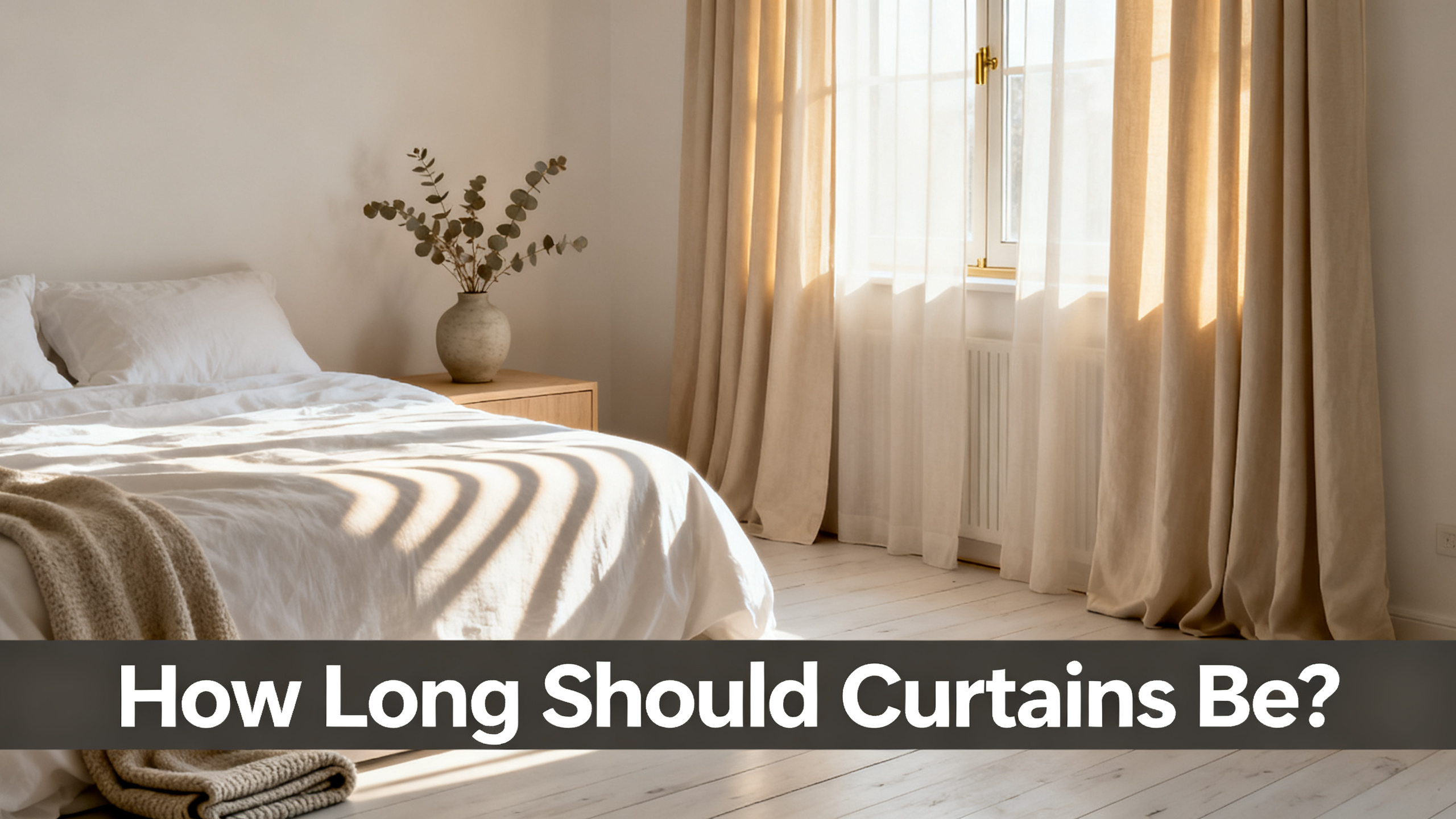
Before you pick a curtain length, five things need to be settled: a measuring tape, the rod height you actually plan to mount, your floor type, the room’s daily function, and the fabric you’re leaning toward. Miss any one of them and the panel arrives one to four inches wrong. The short answer designers work from: floor length by default, with a float of half an inch off the floor, a kiss that grazes it, or a break of 1 to 2 inches. Sill and apron lengths are for kitchens, baths, and windows blocked by radiators, seats, or counters.
Ready-made panels come in 63, 84, 96, and 108 inches, and once your rod sits at a real designer height, almost none of those land within an inch of your target. That’s why this guide leans on custom drops. It’s one chapter of our full install & measure hub.
Float
1/2″ gap
the tidiest look, easiest to vacuum under, safest with kids and pets
Kiss
0″ gap
the tailored, magazine look, best on smooth, level hard floors
Break
+1 to 2″
softer, forgiving of uneven floors, classic in traditional and formal rooms
Puddle
+6 to 8″
a statement look, catches dust and pet hair, keep out of walkways

Order the exact drop you just measured
Liz Loft Extra Long Pleated Curtains
from $59.99/panel · 10% linen / 90% polyester · 350 gsm heavyweight · pinch pleat · custom drops to 300 inches · 20+ colors. Final price depends on size and lining.
Use code JULY for 20% off · Free shipping over $300
Step 1: Decide the Finish (Float, Kiss, Break, Puddle)
Length starts with a look, not a number. The four finishes above cover almost every well-designed window in the country, and the numbers only make sense once you’ve picked one. Float is a hem sitting half an inch above the floor. Kiss is the hem touching the floor with no pressure. Break lets the panel overshoot the floor by 1 to 2 inches so the fabric folds gently at the base. Puddle pools 6 to 8 extra inches around the base of the panel.
Modern minimalist, Scandinavian, and most rental setups lean float. Traditional, transitional, and formal dining rooms lean break. Architectural Digest on curtain proportion puts kiss and break in the same “designer neutral” bucket. The one call this guide will make out loud: the high-water hem that stops 1 to 4 inches short is the one look worth avoiding at every price point. For the full decision by room, see our take on whether curtains should touch the floor.
Puddle looks romantic in a photograph and needs a real housekeeping tolerance in a life. It collects dust, pet hair, and small toys, and it drags every time you open or close the panel. It’s a look statement, not a default, and it belongs in bedrooms, sitting rooms, and formal dining, never in high-traffic hallways or nurseries.
Living / Dining
Float or Break
Break for traditional, float for clean-lined modern.
Bedroom
Float or Kiss
Blackout works best when the gap is 0 to 1/2 inch max.
Nursery / Kids
Float only
Never puddle. Feet, toes, and pull hazards live at hem height.
Kitchen
Sill or Apron
Counters and sinks block full-drop. Café curtains on the lower half work here too.
Bath
Sill
Moisture and privacy call for short. Skip floor-length entirely.
⚠️ Puddle warning. Anything longer than a break belongs out of walkways. Hallways, entry rooms, and mudroom windows drag the panel every time someone passes. If the floor sees traffic, cap the length at a 1 to 2 inch break.
Step 2: Measure Rod-to-Floor, Not Window-to-Floor
Here’s the arithmetic almost nobody does before clicking Add to Cart: the panel length is a function of the rod position, not the window. Every extra inch of rod above the trim buys you an extra inch of panel below the trim. Measuring from the top of the window down to the floor gives a number that has almost nothing to do with what you should order.
There are four points to measure from depending on the header style. For rings and grommets, measure from the ring eye or ring hole to the floor. For rod pocket, measure from the rod bottom down. For back-tab panels, measure from the bracket line. For pinch pleat on a decorative pole, measure from the pole face to the floor and add a fraction depending on hook drop.
| Ceiling | Rod height above trim | Rod-to-floor (typical) | Panel for float | Panel for break |
|---|---|---|---|---|
| 8 ft (96″) | 6″ min, up to 12″ | 86 to 92″ | 85.5 to 91.5″ | 87.5 to 94″ |
| 9 ft (108″) | 8 to 12″ | 98 to 104″ | 97.5 to 103.5″ | 99.5 to 106″ |
| 10 ft (120″) | 14 to 20″ | 108 to 116″ | 107.5 to 115.5″ | 109.5 to 118″ |
| Vaulted / double-height | Follow window line | 130 to 240″ | – | – |
How High To Hang Curtains: The Rod Rules for Every Ceiling
Length starts at the rod, and the rod height is where most people get it wrong. The exact inches by 8, 9, and 10-foot ceilings, plus the two-thirds rule.
Once you have the rod-to-floor number, do the finish math. Float: subtract half an inch. Kiss: order exactly rod-to-floor. Break: add 1 to 2 inches. Puddle: add 6 to 8. Simple as that. If you’re between two finishes, round to break rather than float: an extra inch tucks under; a missing inch reads high-water forever.
⚠️ Carpet compression. Fresh carpet loses 1/4 to 1/2 inch of pile height over the first year of foot traffic. Measure the drop with the tape resting on the floor as a firm, not as a fluff. Otherwise the panel will hover a quarter inch high once the pile settles.
Step 3: Match Ready-Made or Go Custom
The 96-inch panel is stocked because it’s a compromise, not a fit. Retail lengths (The Spruce standard length reference) sit at 63, 84, 96, and 108 inches. On paper that covers everything from an 8-foot ceiling to a 9-foot ceiling. In practice, the moment the rod goes to a real designer height, none of the stock lengths land within an inch of the target.
The most common miss: a 9-foot room with the rod at 100 inches, target panel 100.5, closest stock length 96. That’s a 4 inch high-water hem. The next size up is 108, which turns into a 7 to 8 inch puddle no one asked for. The window looks wrong either way, and both panels cost the same as ordering the exact drop.
Best Extra-Long Curtains (108″-144″+): 2026 Picks by Room
Once your drop crosses 96 inches, the shortlist shrinks fast. Five panels that actually come in 108, 120, 132, 144, scored by scenario.
The made-to-order path costs slightly more and takes roughly 10 to 14 days, and it’s where most designer projects land once the rod height is settled. Two Pages cuts to the exact inch, up to 300 inches, on the Liz Loft Extra Long product page. If you want the deeper spec breakdown, our full Liz Loft Extra Long review covers the 350 gsm body, drape behavior, and configurator pricing.
The Liz Loft Extra Long panels ship at from $59.99/panel, with 20+ colors and hooks included. Between us: if the target drop crosses 96 inches, the custom route is almost always the cheaper mistake to make than buying a stock length that doesn’t fit.
Ready-Made
63 / 84 / 96 / 108″
Stocked, shipped in 2 to 5 days, cheapest per-panel entry.
Fits a rod low above the trim on an 8-ft ceiling. Miss almost every designer height by 2 to 8 inches.
Custom Two Pages
Any inch up to 300″
10 to 14 day lead time, roughly 15 to 30% more per panel than mid-tier stock.
Hits float, kiss, or break to the inch. Handcraft tolerance ±1″, published in the specs.

The 96-Inch Panel Fits Almost Nobody
Standard drops land within an inch of your target maybe one time in five. Liz Loft Extra Long is cut to the exact inch you measured, up to 300, at from $59.99/panel in 350 gsm heavyweight.


Step 4: Adjust for Room Function
Two rooms with the same 9-foot ceiling can call for different drops if they don’t do the same things. A living room with an open plan and no children can carry a break at 1.5 inches, softening the panel and inviting the eye down. A living room with a golden retriever and two toddlers wants a float, half an inch off the floor, no negotiation.
Bedrooms almost always want float or kiss. If blackout matters, the gap between hem and floor is where light leaks last, and blackout linings work best when the gap is 0 to half an inch. Anything larger and you’ll see a bright bar at the base of the panel at 6am.
Nurseries are the one room where the answer never bends. Float only. Standing in a nursery at 3am, a puddle hem catches the toe every time, and a break becomes a pull hazard the moment a child can crawl. Kitchens and baths sit on the opposite end: sill or apron length, never floor-length, because counters, sinks, and sill-mounted radiators block full drops entirely. Café curtains on the lower half of a kitchen window handle privacy without giving up daylight, and they need a length matching the sash height plus 1 to 2 inches.
Decide the finish
Measure rod-to-floor
Match ready-made or custom
Adjust for room
Verify against fabric
⚠️ Radiator or vent under the window. Anything blocking full-drop clearance forces a call: either mount the rod extra high and let the panel float above the obstruction (sill or apron length only), or shift to café curtains on the lower half of the window. Floor-length draped over a radiator is a fire hazard the label warns about explicitly.
Step 5: Verify Against Fabric Behavior
The final inch is decided by the fabric, not the tape measure. Linen and linen-blend panels shrink 1 to 3 percent on the first wash. On a 100-inch drop, that’s a full 1 to 3 inch loss. The clean fix: order the target drop plus 1 inch. It falls perfectly after the first wash instead of hovering high forever.
Velvet and other heavyweight fabrics do the opposite. The pile drops half an inch or so under its own weight once installed and steamed, so ordering exactly at the target usually reads as a soft break instead of a kiss. If you want a tight break, subtract half an inch from your calculated drop. If you want a proper kiss, order exactly at target and let gravity do the finishing.
Two Pages In-Home Measurement & Installation Service
Uneven floors, radiators, or vent grilles at hem height? Two Pages sends a pro to measure the drop that actually works. Real eligibility, real cost, reviewed.
Linen & blends
+1″
Adds a buffer for 1 to 3% first-wash shrinkage. Order target drop + 1 inch.
Velvet & heavy
-0.5″
Steaming and pile weight gain about half an inch after install. Subtract for a tight break.
Pure polyester
±1″
Holds size after wash. Order exact drop and account for handcraft ±1″.
Handcraft tolerance is the honest bit most brands don’t publish. Two Pages tells you upfront that lengths vary by 1 inch because panels are sewn to order. If you’re ordering four panels for a matched wall, buy them in the same dye lot at the same time, and specify the finish (float, kiss, break) explicitly in the notes. Split orders across months and you’ll see color shifts a swatch card wouldn’t catch.
⚠️ Dye lot shifts. Faux linen counts on dye lots, and a reorder six months later won’t match the original run. Buy the full drop set at once, even if it means over-ordering by one panel and returning the extra.
Common Length Mistakes
Three misses come up over and over in Trustpilot reviews and designer post-mortems. Worth a plain summary before you buy.
High-water hem 1 to 4 inches short of the floor
The single most common mistake. It reads as a size problem the eye picks up before the color or texture. If the target drop is 100, ordering 96 stock is worse than ordering 108 and folding the excess into a break.
Ignoring the rug at the base of the drape
A rug edge running under a full-drop panel steals 1/2 to 1 inch of visible hem depending on pile height. Either extend the rug fully under the panel or subtract the pile height from the drop.
Puddle installed in a walkway
A romantic puddle in a hallway or entry becomes a tripping hazard within a week. Puddle belongs in low-traffic sitting rooms, formal dining, and primary bedrooms only.
Check the Color at Floor Level Before You Commit
Faux linen reads a full shade cooler near the floor than it does on the wall at eye level. The 38-color Liz booklet ships flat for $2.99 so you can tape a swatch at the exact hem line you’re considering before you order the drop.
From Measurement to Order
Coming back to the original question. If the rod is set at a real designer height, the room’s function is clear, and the fabric is chosen, the drop math takes about ninety seconds: rod-to-floor, minus half an inch for a float, plus 1 to 2 for a break, plus a shrinkage buffer if the panel is linen. Order that exact inch. If it were my dining room, the break would sit at 1.5 inches, and I would order 103.
Measure to order
Rod-to-floor → e.g. 102″
Finish → break +1.5″
Fabric → linen +1″ buffer
Order drop: 104.5″
Two Pages cuts to the exact inch, up to 300.
Handcraft tolerance ±1″ is baked in. Buy the full drop set at once to keep the dye lot matched.
You Know the Length. Order It to the Exact Inch.
Rod to floor, minus half an inch for a float or plus two for a break. Liz Loft Extra Long ships that drop with 350 gsm heavyweight body, 20+ colors, drops to 300 inches. Code JULY (20% off) · Free shipping over $300.
Frequently Asked Questions
How long should curtains be for a 9 foot ceiling?
On a 9-foot wall with the rod mounted 8 to 12 inches above the window trim, the panel needs to be 100 to 104 inches long once you decide between a float and a slight break. Standard store lengths stop at 96 inches, so 9-foot rooms almost always end up in custom territory. Made-to-order lines like Liz Loft Extra Long cut to the exact inch, up to 300, and the price gap versus a wrong 96-inch panel is smaller than most people expect.
Should curtains touch the floor?
In living rooms, dining rooms, and bedrooms, yes. The clean options are a float (hem half an inch off the floor, easiest to keep tidy), a kiss (hem just grazing the floor, the tailored look), or a break (1 to 2 extra inches, softer and more forgiving of uneven floors). A puddle of 6 to 8 inches reads romantic but collects dust and pet hair. Sill or apron length is only appropriate over radiators, window seats, kitchen counters, and bath vanities.
How much longer should curtains be than the window?
Ready-made curtains should overshoot the window by whatever it takes to reach floor level: usually 12 to 30 inches below the sill for a full-drop panel. The window itself is not the reference. What matters is the distance from the mounted rod to the floor, minus your finish (0 for kiss, half an inch for float, plus 1 to 2 for break).
What is the standard curtain length?
Retail stocks four standard lengths: 63, 84, 96, and 108 inches. Only 84 and 96 fit typical 8- and 9-foot ceilings when the rod is mounted low (right at the trim), which is exactly the mistake designers try to avoid. Once the rod goes to a designer height, custom becomes the reliable answer. Two Pages cuts to the exact inch up to 300.
Is it OK for curtains to be a little short?
No, and it is the single most common length mistake. A high-water hem that stops 1 to 4 inches above the floor makes the ceiling read lower and the window look pinched. If a ready-made panel comes in short, either lower the rod (rarely a good trade), swap for a longer stock length, or order custom. The exception is sill or apron length, which is a legitimate choice for specific rooms, not a fallback for a wrong panel.
How long should living room curtains be?
Floor length, with a float of half an inch, a kiss, or a break of 1 to 2 inches depending on the formality of the room. Modern minimalist and Scandi rooms lean float. Traditional and formal living rooms lean break. Puddle is a look statement, not a default, and it needs a housekeeping tolerance.
Do I need to add anything for shrinkage when ordering?
For linen and linen-blend fabrics, add 1 inch to the drop to absorb 1 to 3 percent shrinkage on the first wash. Pure polyester holds size within ±1 inch and does not need a shrinkage buffer. Velvet reads about half an inch longer once steamed for install, so order at your exact drop or subtract half an inch for a tight break. Two Pages lengths vary by 1 inch by design (handcraft tolerance): budget for that on top of any shrinkage buffer.


