
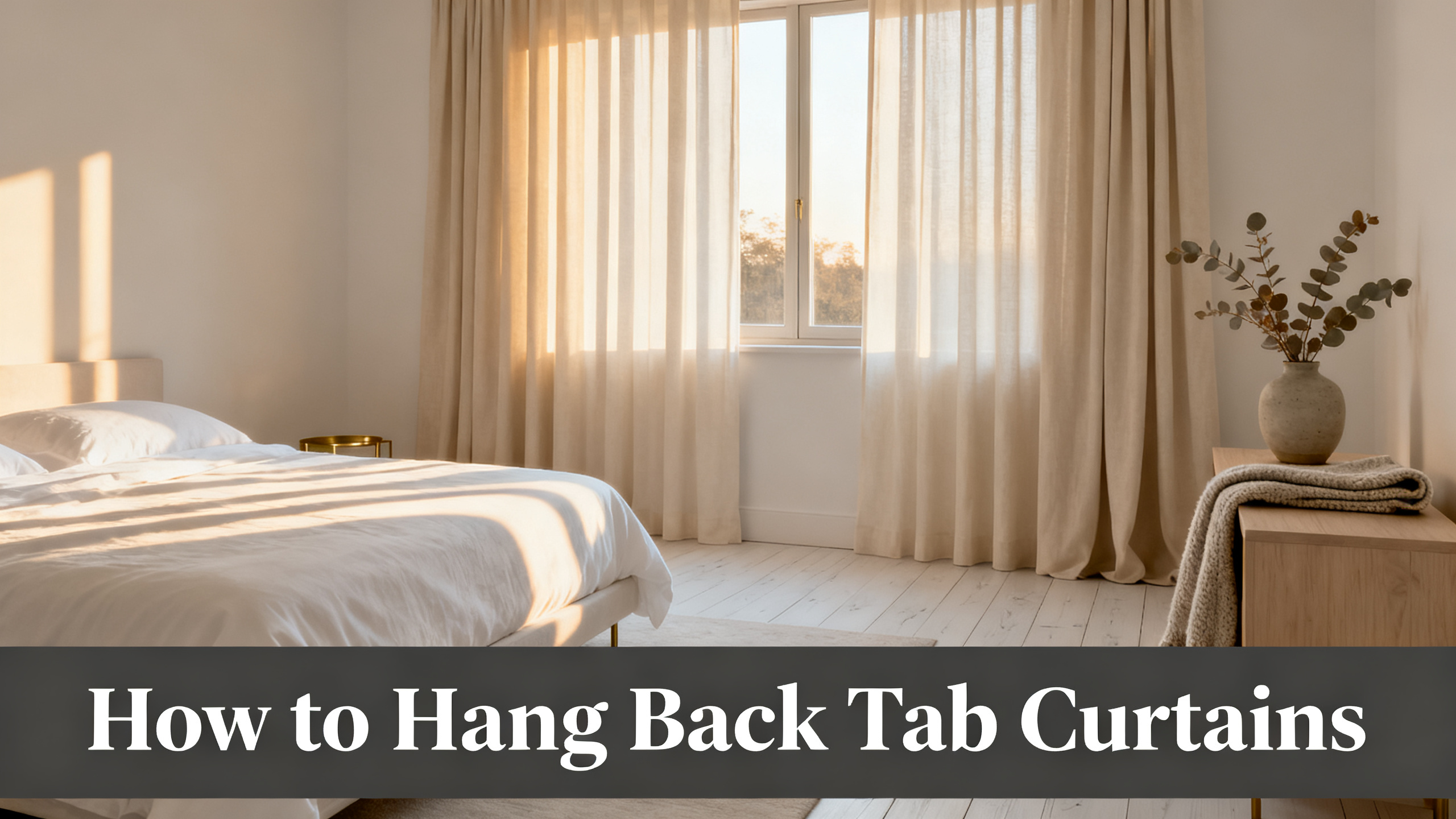
Done right, back tab is the 12 minute hang. Skip the loop count check and the drop math, and you re-measure twice, iron twice, and still see the rod peek through the folds.
The short answer is five steps: match the rod to the loop size, set the rod at the right height with the drop loss added, thread each loop, hand-fold the accordion, and train the folds for 48 hours. If you want the full rod, bracket, and height side of the process too, the full curtain install hub covers the hardware path end to end.

The panel with a real back tab option
Liz Linen Drape Soft Top
from $59.99/panel, 90% polyester and 10% linen, 350 gsm heavyweight, heading styles include 4-in-1, back tab, rod pocket, flat hook, and tab top, in 38 colors. Final price depends on size and lining.
Use code JULY for 20% off. Free shipping over $300.
What back tab curtains actually are (and why the loops matter)
A back tab curtain is a panel with a row of hidden fabric loops sewn along the back of the top edge. The rod threads through those loops, not through a pocket or a set of hooks, so the front of the header stays flat and the rod stays hidden behind it.
The loops are what make the drape read modern and relaxed. Each loop typically measures around 1.5 to 2 inches deep and 3 to 4 inches wide, spaced every 4 to 6 inches across the panel, which is why the folds fall in soft even waves. If you want a broader photo primer on what the top actually looks like on a real window, the The Spruce back tab curtain reference is a useful visual. Two Pages lists back tab as one of the five heading styles on Liz Linen Drape Soft Top, which means you configure it directly in the product page, no aftermarket sewing needed.
Back tab anatomy
Loop depth
1.5 to 2 in below the top edge
Loop width
3 to 4 in per loop
Loop spacing
4 to 6 in center to center
Two Pages heading style visualizer (Liz Soft Top)
🪝
4-in-1
Hidden hooks
🪟
Back tab
This guide
📏
Rod pocket
Rod hidden
📌
Flat hook
Flat header
🎀
Tab top
Visible loops
Step 1: Match the rod diameter to the loop size
The single fastest way to ruin a back tab hang is to force a fat rod through a loop that was sewn for a narrow rod. The panel will thread, but every loop will look pulled flat and the folds above the rod will bunch on themselves.
The rule is simple: rod diameter should be at least 0.5 inch smaller than the loop can accommodate stretched, and ideally 1 inch smaller so the loops still hang softly. For a Two Pages Liz Soft Top back tab configuration, a rod between 1 and 1.375 inches in diameter reads clean. Below 0.75 inch, the rod feels flimsy against a 350 gsm panel and starts to bow between brackets over time. Above 1.5 inches, the loops stretch flat and lose their curve.
| Panel weight | Rod diameter recommended | Loop clearance |
|---|---|---|
| Lightweight sheer (under 150 gsm) | 0.75 to 1 in | Comfortable slide |
| Mid-weight drape (150 to 300 gsm) | 1 to 1.25 in | Balanced |
| Heavyweight (Liz Soft Top 350 gsm) | 1.25 to 1.375 in | Firm hold, no sag |
| Blackout lined or extra-wide | 1.375 to 1.5 in | Loops stretched, still clean |
⚠️ Warning: A rod thicker than 1.5 inches on a standard back tab loop will make the top of the panel read like a stretched drum. The fabric loses its curve, the header lies flat and stiff, and no amount of steaming brings the softness back.
How to Hang Curtains With Hooks
When the panel is a 4-in-1 or flat hook header. Back tab and hooks solve the same problem two different ways: back tab hides the rod behind the header, hooks hide the rod under a pleated top line.
Step 2: Set the rod height and mark the drop
Back tab loses roughly 1.5 to 2 inches of visible drop above the rod, because the loops sit below the top edge of the panel and pull the fabric down onto the rod line. That means the rod has to sit higher than you would place it for a rod pocket panel, and the configured drop has to include those two inches back.
The general rule still applies. Mount the rod 4 to 6 inches above the window frame for a standard 8 foot ceiling, or all the way to the ceiling molding for a taller wall line. The Real Simple curtain hanging guide covers the visual proportions well. Then measure from the rod line down to your target break, whether that is a floor kiss, a puddle, or a half inch off the floor for renters.
How High To Hang Curtains
Back tab reads about 1.5 to 2 inches shorter than a hidden-hook install at the same drop, so rod height matters more here than on 4-in-1 hangs. This guide gives the wall math for 8 and 9 foot ceilings.
🧮 Drop loss formula
Visible drop = configured drop − 1.5 to 2 in
If you want the hem to break the floor at 96 inches below the rod, configure the panel at 97.5 to 98 inches. Otherwise the visible bottom will land above the floor and the whole hang will read short.

Order the panel in the right drop first
Back tab loses roughly 1.5 to 2 inches of visible drop above the rod because the loops sit below the top edge. Add that back into what you configure. Liz Soft Top ships in custom drops up to 120 inches and stops the day-one puddle miss.
Step 3: Thread the loops on the rod
Take the rod off its brackets first. Trying to thread a back tab panel with the rod still mounted almost always ends in one of two ways: torn loops from a finial that snags, or a rod that flexes and pops loose halfway through. Rest the rod flat across a table, a chair back, or two step ladders, then thread each loop one at a time from one end to the other.
How to Hang Curtain Rods
Bracket spacing, center support, and anchor logic sit here. Back tab hangs put concentrated weight on each loop, so a rod longer than 72 inches usually needs a center bracket.
Take the finials off before threading. On decorative rods, the finial diameter is often wider than the rod itself, and a loop sized for a 1 inch rod will not slide past a 1.75 inch ball finial. Unscrew the finial, thread every loop, then screw the finial back on before mounting the rod. On a 3 panel window, plan the order in advance so the seam edges face the wall, not the room.
⚠️ Warning: Threading loops with the finials still on the rod is the number one cause of a torn back tab. The loops are sewn to the fabric with a single stitch line, and a snagged finial rips that stitch instantly.
Step 4: Space the folds by hand and set the stack-back
Once the panel is on the rod and the rod is mounted, the fabric will hang bunched to one side of whichever hand you threaded from. The finish depends entirely on the next 60 seconds: hand-fold the panel into an accordion of 3 to 4 finger-width folds, walking down the panel from the top to the hem, and set the outer edge of the stack against the wall or the return of the rod.


The stack-back is the width the folded panel takes on the wall when the curtain is open. On a back tab hang, stack-back typically runs 15 to 20 percent of the panel width, so a 100 inch panel eats 15 to 20 inches of wall on each side. Plan the rod length so the stack sits over the wall next to the frame, not over the glass. If it lands on the glass, you lose visible daylight the moment the panel opens.
🧵 Iron before hanging
A back tab panel ships folded. Steam or iron on the wrong side at medium heat, 300°F max, before threading, focusing on the top 12 inches where the loops meet the header. That is the zone that reads first when the panel is closed.
Skip this and the crease from the shipping fold will telegraph across every fold for weeks. Two Pages Liz Soft Top slub weaves respond well to steam within the first 48 hours; after that, the crease sets and needs a full wash cycle to release.
Then leave the folds. Do not open and close the panel for 48 hours. That is the memory-training window: the fabric relaxes into the accordion shape you set, the loops settle onto the rod, and the whole drape starts to fall in the same wave pattern each time it closes.
Step 5: Fix sag, lean, and the flared-hem look
Three symptoms show up on day two if a step earlier in the sequence got skipped. Sag in the middle almost always means the rod is under-supported: on a rod longer than 72 inches, back tab needs a center bracket, and above 108 inches it needs two center brackets. The panels pull down on the rod through concentrated loops instead of the diffuse pressure of a rod pocket, and any flex in the rod becomes visible as a dip.
Panels that lean toward the center are almost always a rod height issue combined with a stack-back that landed on the glass. When you looked at the Liz Linen Drape Soft Top review photos, notice how the outer stack sits at least 6 inches past the frame on each side. That is what stops the lean.
Sag in the middle
Cause: rod flex.
Fix: add a center bracket at 72 in.
Panels lean inward
Cause: stack-back on glass.
Fix: extend rod 6 in past frame.
Hems flare outward
Cause: loop stretch.
Fix: switch to a rod under 1.5 in.
⚠️ Warning: If the panel already stretched the loops after a week on a too-fat rod, downsizing the rod later does not fully undo it. The loop fabric has a memory too. Order the right rod on day one, not day eight.
Order the Liz Linen 38-color booklet first
Back tab shows more of the top edge and the rod than hidden-hook installs, so the fabric color reads brighter against the wall. The booklet is $3.99 and gives you the actual 350 gsm slub in hand before you commit to a full panel order.
Why the fabric weight changes back tab drape
Back tab reads best on 200 to 400 gsm fabrics. Below 200 gsm the panel goes gauzy and the loops start to show through the front. Above 400 gsm, the concentrated pull on each loop starts to distort the top line unless the loops are reinforced. Two Pages Liz Soft Top sits at 350 gsm, which is the sweet spot: heavy enough for a soft break at the floor, light enough that the loops stay flexible.
OEKO-TEX certification also matters if the panel goes in a bedroom or a nursery. Two Pages carries the OEKO-TEX Standard 100 across its main linen and cotton lines, which means the fabric was tested for chemical residues at the finished-product stage. That is not a back tab specific requirement, but it is a reason to prefer Liz over an unbranded Amazon back tab panel of similar price.

FAQ
What is the difference between back tab and rod pocket curtains?
A rod pocket runs the rod through a sewn tube along the top edge of the panel, which hides the rod entirely and gives a gathered, cottage-style header. A back tab hides the rod behind a row of fabric loops sewn to the back of the header, which leaves the front flat and modern. Rod pocket is warmer and softer, back tab is cleaner and more architectural. Both use the same rod, no hooks needed.
Can you use hooks with back tab curtains?
Technically yes, no in practice. Most back tab panels also carry a hidden pocket for pin hooks, so you can flip the panel into a hook hang if you change your mind. But if you already bought a back tab panel, use the loops. Hooks change the drop by another 1 to 1.5 inches and shift the folds tighter, which usually means re-measuring the drop anyway.
How much drop do back tab curtains lose above the rod?
Roughly 1.5 to 2 inches. That is the height of the loop itself, plus the top edge of the panel that sits above where the rod meets the loop. Add those two inches to the configured drop if you want the hem to break the floor exactly.
What size rod do you need for back tab curtains?
Between 1 and 1.375 inches in diameter for a standard 350 gsm panel like Liz Soft Top. Below 0.75 inch, the rod flexes under a heavy panel and dips in the middle. Above 1.5 inches, the loops stretch flat and the header loses its curve. Always check the finial diameter separately: a 1 inch rod with a 1.75 inch ball finial still needs the finial off to thread.
Why do my back tab curtains sag in the middle?
The rod is flexing. Back tab concentrates the panel weight into each loop instead of spreading it along a rod pocket, so any rod longer than 72 inches needs a center bracket. Above 108 inches, plan two center brackets. Sag rarely comes from the panel itself, unless the fabric is above 400 gsm without reinforced loops.
How do you iron back tab curtains before hanging?
Steam or iron on the wrong side, medium heat, 300°F max, focused on the top 12 inches where the loops meet the header. Do this before threading, not after. Once the panel is on the rod, steaming from below is awkward and steaming from above risks knocking the rod off its brackets. Handheld garment steamers work well on Liz Soft Top slub weaves.
Final verdict
Back tab is the simplest hardware path of any curtain hang. No hooks, no clips, no rings, just a rod and a row of loops. The only real cost is the 1.5 to 2 inches of drop you have to add back into the configured length, and the rod diameter discipline that keeps the loops from stretching flat over time.
Now that you know the drop math, the rod diameter rule, and the two mistakes that make back tab hang wrong on day one, order the panel that already comes back tab ready.
Now that you know the drop math, order the panel that already comes back tab ready
Liz Linen Drape Soft Top ships with the back tab heading built in, at 350 gsm and 38 colors. No hooks, no clips, no extra hardware. from $59.99/panel. Code JULY for 20% off.
