
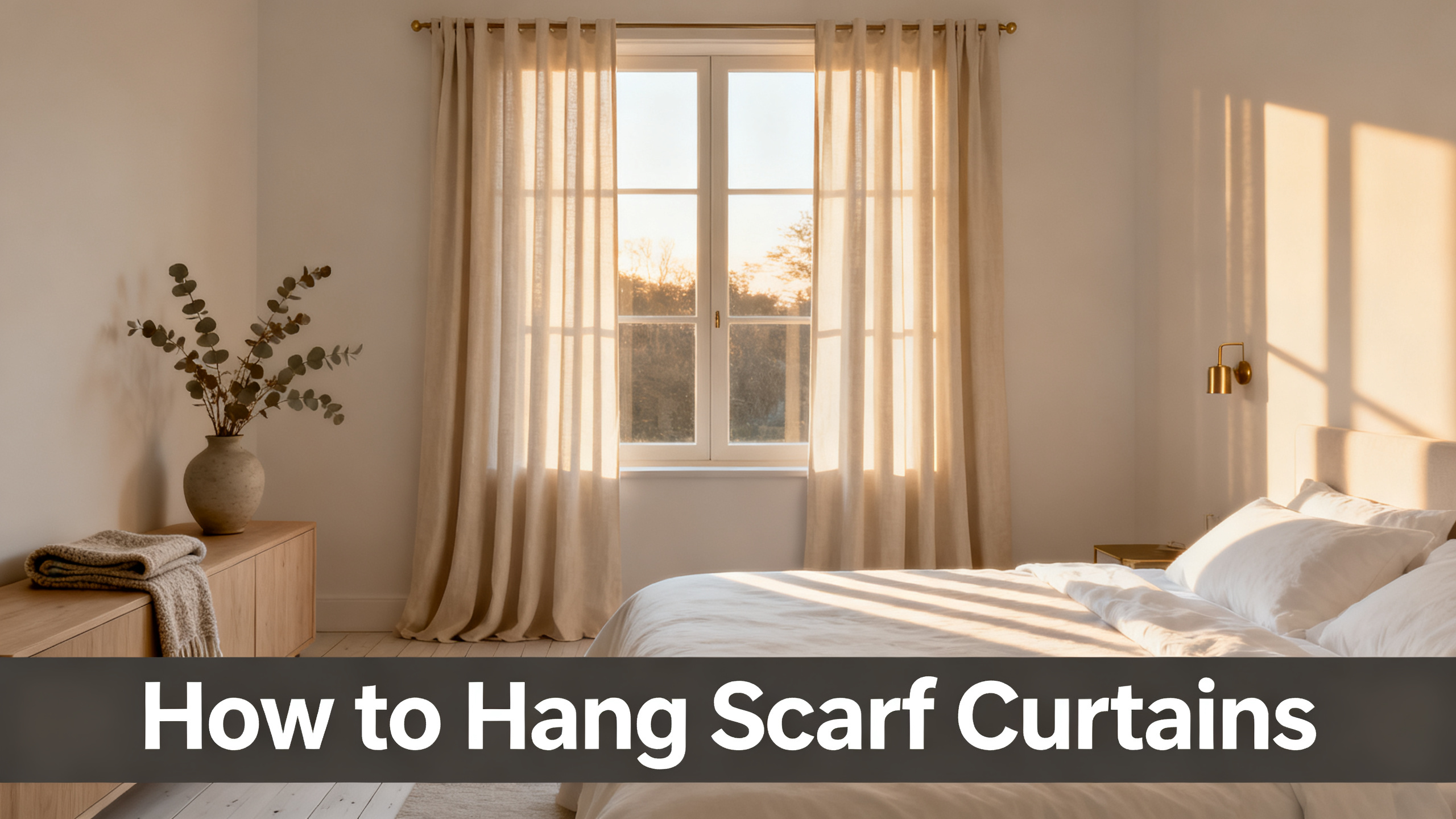
Most buyers walk into Target, grab a 63 inch pre-cut window scarf, drape it over the rod, and wonder why the finished look reads droopy and thin. Scarf curtains are not measured like regular panels. They need four times the window width to swag correctly, and off-the-shelf pre-cut lengths almost never hit that math.
A scarf is not a panel. It is a sculpted fabric run with a swag body at the center and two cascading tails on the sides, all held by gravity and one clever finial wrap. That geometry is why the 216 inch scarf you found at HomeGoods looks great on a 48 inch bathroom window and completely underdressed on a 72 inch living room casement.
The five steps below cover the anatomy, the anchor system, the length math, and the fabric weight that actually holds a swag. The framework fits inside our full curtain install hub, which has the wider rod, drilling and hardware playbook if you need it.
📐 Answer, no fluff
Drape the scarf over the rod at the center, pull the two tails to matching lengths, then wrap the fabric twice around each finial or scarf holder so the swag stays put. Total scarf length equals window width × 4, split as a swag body (window width × 2) plus two tails (window width × 1 each). Fabric should be voile at 50 to 90 gsm. Heavier and the swag turns lumpy.
The rest of this guide covers the anchor systems, the tail drop targets (sill, apron, floor), the 6 mistakes that ruin an otherwise correct swag, and the voile fabric that actually drapes.

Built for the scarf drape
Scandina Solid Voile Sheer Curtain, Soft Top
from $28.99/panel · 100% polyester voile · 50 gsm · 112″ wide · soft top rod pocket that swags cleanly over a 1″ to 2″ rod · custom drop to 102″ · 8 sheer colors. Final price depends on size and lining.
Use code JULY for 20% off · Free shipping over $300
Why Scarf Curtains Are Not Regular Panels
A regular curtain is a vertical piece of geometry. Header at the top, hem at the bottom, gravity pulls straight down. The HGTV window scarf styling guide makes the distinction cleanly: a scarf is horizontal geometry, a single fabric run laid across the top of the window and shaped into a swag by the way it drapes over the rod.
That difference changes the entire math. A panel needs drop length only, so you measure the wall from rod to floor and add a return for the header. A scarf needs a swag body plus two tails, and each of those three chunks has its own length target driven by window width, not window height.
📐 Scarf Anatomy
The Swag Body
Window W × 2
The central drape between the two anchor points. This is the U-shape you see hanging low across the rod.
The Left Tail
Window W × 1
Cascade from the left finial down toward sill, apron, or floor. Tail drop sets the drama level.
The Right Tail
Window W × 1
Mirror the left tail, same length. Asymmetry reads sloppy on a scarf, not intentional.
Total scarf length = swag + left tail + right tail = window width × 4.
The 5-Step Framework at a Glance
Here is the full workflow in five steps. Print or screenshot this before you head to the window. Each step expands into detail below with the H3 sub-sections doing the heavy lifting.
🪟 The 5 Steps
1
Measure the window and note the rod line
2
Pick and mount the rod
3
Choose your anchor points
4
Calculate scarf length and tail drop
5
Pick a fabric that actually drapes
Step 1: Measure the Window and Note the Rod Line
Window width and casing edge
Measure from the outside edge of the left casing to the outside edge of the right casing. If the window has no visible casing, measure the drywall opening and add 4 inches on each side for the tail room. This “outside casing plus 4” is the effective window width that feeds the scarf math.
The 4 inch return on each side matters because the tails need somewhere to fall past the trim without dragging against the drywall corner. Skip the return and the tails collapse behind the casing, killing the cascade.
The rod line height above the trim
Standard rod placement for a scarf sits 4 to 6 inches above the top of the trim, the same as for a regular panel. Go higher only if the wall is tall and you want a dramatic swag that fills more vertical space. The higher the rod, the deeper the swag can dip.
Step 2: Pick and Mount the Rod
Decorative rod vs scarf holder vs holdback
A decorative rod with wide finials is the workhorse for scarf installs. The finial acts as the anchor : you wrap the fabric around it twice, and friction plus the finial diameter holds the swag in place. Rods with skinny finials or plain end caps do not grip enough fabric.
Scarf holders are sculpted brackets that lock the swag at a fixed point mid-rod. Holdbacks are cousins of tie-backs and secure the tails partway down the wall. Avoid tension rods entirely : they cannot hold the swag weight of a full 4x scarf, and they slip within days.
Mounting the rod square
Bracket placement matches the return depth on the rod, standard 4 to 6 inches out from the wall, so the tails clear the trim and the casing. Deeper returns work if the window sits below a deep sill.
Level the rod with a laser or a spirit level before drilling. An out-of-level rod ruins a symmetric swag : one tail reads longer than the other and the eye picks that up immediately, even when the fabric is otherwise identical.
Full hardware walkthrough in our full rod install walkthrough, covering bracket types, wall anchors, and drilling depth for drywall vs plaster vs brick.
Step 3: Choose Your Anchor Points
The anchor system is what keeps the swag from sliding down one side of the rod at 2am. Three options cover 95% of installs : finial-only wrap, scarf-holder brackets, and ceiling-mount for special cases.
Finial-only is the simplest and reads most casual. Scarf-holder brackets lock a structured, symmetric swag. Ceiling-mount is a niche move for cathedral walls or window-free swags used as a room divider effect.
No Rod on Hand? Command-Hook Scarf Install
Renters and short-term stagers can swag a scarf on Command hooks or tension anchors if the fabric is under 60 gsm. The no-rod playbook covers weight math and anchor spacing.
Finial-only anchor
Wrap the scarf twice around each finial, tuck the fabric behind itself so the wrap self-locks, then let the tail cascade from that point. Two full wraps beat one wrap for slip resistance : friction scales with contact area.
Scarf-holder anchor (sculpted bracket)
A scarf holder is a metal or resin sculpted piece mounted on the wall at the same height as the rod. It grips the fabric at a fixed point, forcing a structured swag shape. Used for formal dining rooms and any install where the swag needs to keep its geometry across seasons.
Ceiling-mount swag setup
Rare but effective on cathedral walls. The scarf drops from ceiling-mounted brackets rather than window-trim rod, which extends the vertical drop dramatically. If it were my dining room in a high-ceiling loft, I would run a 240 inch voile off ceiling brackets and skip the scarf holder entirely.
Ceiling-Mount Scarf for Cathedral Walls
On a vaulted or double-height wall, the scarf can be swagged from a ceiling-mounted rod instead of over the window trim. The ceiling install guide covers joist finding and anchor load.
Step 4: Calculate Scarf Length and Tail Drop
Real talk on pre-cut 216 inch scarves : they work for windows up to 54 inches wide and fail on anything bigger. The math is straightforward. Total scarf length equals window width × 4. Split that as a swag body of window width × 2, plus two tails of window width × 1 each.
Tail drop is a separate decision from tail length. Length is measured along the fabric run. Drop is how far the fabric visually falls from the finial toward the floor. Short drops land at the sill, medium drops reach the apron, long drops touch or pool at the floor.
How to Measure for Curtains: The Complete Guide
Width, drop, and rod-projection math from a single Two Pages designer worksheet. The width chapter is exactly what feeds the scarf 4x rule.
Picture the moment the swag settles at the center of the rod and the tails cascade past the sill. On a 60 inch window, the numbers land at 240 inches of total scarf, 120 inches of swag body, and 60 inch tails each. A pre-cut 216 inch scarf falls 24 inches short of that target, which is why the cascade looks stubby and thin.
☀️ Scarf Length Calculator
36″ window
144″
72″ swag + 36″ each tail
48″ window
192″
96″ swag + 48″ each tail
60″ window
240″
120″ swag + 60″ each tail
72″ window
288″
144″ swag + 72″ each tail
96″ window
384″
192″ swag + 96″ each tail
Pre-cut cap
216″
Fails past 54″ window

A Sheer Long Enough to Swag AND Have Real Tails
The math says a scarf needs 4 times the window width for a proper swag with tails that reach the sill or the floor. Off-the-shelf pre-cut scarves top out at 216 inches. On a 60 inch window that leaves 24 inches shy of the 4x target. Scandina custom-cuts panel length up to 102 inches, so two panels stitched end to end give you the 240 inch scarf the swag actually needs. from $28.99/panel.
Step 5: Pick a Fabric That Actually Drapes
The right fabric is what turns a swag from Pinterest-worthy into Instagram-worthy. Sheer voile at 50 to 90 gsm hits the sweet spot. The Scandina Solid Voile product page lists custom drop up to 102 inches with a soft-top rod pocket header, which is the scarf-friendliest header option because it lets the fabric slide freely over the rod.
Weight math matters. 50 gsm voile is light enough to swag with gravity and heavy enough to resist twisting in a draft. If you have a ceiling fan or a nearby vent, that resistance is what keeps the swag from wobbling every time the AC kicks on. For maximum control, use the Scandina custom cut in the Scandina Solid Voile Sheer Curtain Soft Top and order the length that matches your 4x calculation.
Heavy linen at 200 gsm makes a lumpy scarf. The fabric refuses to fold cleanly and the swag reads as bunched fabric rather than a graceful curve. Blackout at 300 gsm is completely impossible to swag : the fabric hangs straight and stiff, defeating the entire point of a scarf install.
Rod Options Compared
The rod itself accounts for about 40% of the finished look on a scarf install. Skinny curtain rods with plain end caps are the wrong tool for the job. Here is the rod-type comparison at a glance.
🪟 Rod Options
Decorative Rod, Wide Finial
Best all-around choice
1 to 2 inch rod diameter, finial 3+ inches wide. Fabric wraps twice and friction locks the swag. Works with any anchor system.
Scarf Holder Brackets
For structured, formal swags
Sculpted metal or resin bracket grips the fabric at a fixed point. Locks the swag geometry season after season. No rod required.
Holdback + Rod Combo
For dramatic, low tails
Rod holds the swag at the top, holdbacks mounted mid-wall pull the tails to the side. Reads formal and theatrical. Best for tall windows.
6 Common Mistakes with Scarf Curtains
Six mistakes turn a Pinterest-worthy swag into a droopy dishrag. All six are common, and all six are fixable once you know the swag math and the anchor logic.
🍼 Mistakes That Kill the Swag
1. Pre-cut 216″ on a 72″ window
Total scarf is 24″ short of the 4x target. Cascade reads stubby.
2. Heavy linen or blackout fabric
200 gsm+ refuses to swag. Sticks to the rod like a curtain, not a scarf.
3. Single finial wrap
One wrap slips within 48 hours. Two wraps hold. Friction scales with contact.
4. Skinny curtain rod with end caps
Not enough finial diameter to grip fabric. Wraps unravel by morning.
5. Asymmetric tail lengths
One tail 6″ longer than the other reads sloppy. Eye picks it up instantly.
6. No return depth on brackets
Tails drag on the wall or the trim. Swag pushed too close to glass.
Pro Tips: What Stylists Do Differently
Four pro tips separate a home DIY swag from a shoot-ready stylist swag. Fabric weight math, ironing sheer voile without scorching, layering over drapes, and the anti-slip trick.
🧵 Pro Tips Stack
🧵 Fabric weight = swag body
Voile at 50 gsm swags cleanly. Cotton voile at 90 gsm swags with more body but folds slower. Anything above 120 gsm stops behaving like a scarf.
📏 Iron voile with a pressing cloth
Polyester setting at 300°F max, cloth between iron and voile. Or steam the scarf hung in place with a handheld steamer. The Spruce sheer curtain care covers scorch avoidance in depth.
🎨 Layer scarf over drape for warmth
A scarf over a plain white drape lifts the whole window into “editorial” territory. The scarf reads as jewelry, the drape as clothing.
⚠️ Anti-slip: safety pin behind the swag
One small safety pin behind the swag center, hidden in a fold, locks the geometry indefinitely. Stylist trick used on every shoot.
Order the Scandina Voile Swatch Before You Commit
Sheer voile reads very differently under morning north light vs afternoon south light. A swatch on a $1.99 fabric card lets you check how the ivory or beige looks at the actual window before you order the 240 inch scarf run. Especially useful when the room already has a warm-toned drape underneath that the scarf layers over.
Tail drop is the last variable most buyers get wrong. Short tails to the sill read informal. Medium tails to the apron read balanced. Long tails to the floor read dramatic. The table below maps the target tail drop by window height so you can size the fabric before ordering.
| Window height | Sill drop (informal) | Apron drop (balanced) | Floor drop (dramatic) |
|---|---|---|---|
| 36″ bathroom / kitchen | 42″ | 50″ | 78″ |
| 48″ bedroom | 54″ | 62″ | 84″ |
| 60″ living room | 66″ | 74″ | 96″ |
| 72″ picture window | N/A | 86″ | 108″ |
| 96″ floor-to-ceiling | N/A | N/A | 132″ |
Now You Know the Drape Math. Here’s the Fabric.
You have the drape math. The last variable is which voile actually holds a swag. With the anchor system picked, the total scarf length calculated from the 4x rule, and the tail drop targeted at sill, apron, or floor, the only decision left is the fabric.
Checklist for the order : rod at 4 to 6 inches above the trim, scarf total length = window width × 4, tail drop to sill / apron / floor per the table above, decorative rod with wide finials, voile at 50 gsm. That is the whole spec.
You Have the Swag Math. Now Order a Voile That Actually Drapes.
Scandina Solid Voile custom-cuts to your exact scarf length up to 102 inches per panel, at 50 gsm so the fabric holds a soft swag without turning stiff and boxy. from $28.99/panel. Code JULY (20% off) · Free shipping over $300 · lead time 7 to 14 days.
FAQ
How long should scarf curtains be?
The total scarf length equals 4 times the window width. On a 60 inch window, that is 240 inches, split as a 120 inch swag body plus two 60 inch tails. Off-the-shelf pre-cut scarves usually top out at 216 inches, so anything wider than 54 inches needs either two scarves stitched together or a custom-cut voile panel. Tail drop varies from sill (short) to floor (dramatic).
How do you drape a scarf curtain over a rod?
Center the scarf across the rod at the visual midpoint, pull the two ends down to matching lengths, then wrap the fabric twice around each finial or scarf holder to anchor the swag. The wrap-and-tuck at the finial is what keeps the swag from sliding to one side. If the rod has no wide finial, use a decorative scarf holder or a discreet safety pin behind the fabric fold.
How do you keep scarf curtains from slipping?
Three techniques : wrap the fabric twice around each finial instead of once so friction locks the swag, add a small safety pin or fabric clip behind the swag point where it meets the rod, or use sculpted scarf holders that grip the fabric at fixed points. Voile at 50 gsm slips less than heavy linen because the friction-to-weight ratio is more favorable.
Can I hang scarf curtains without a rod?
Yes for lightweight voiles under 60 gsm. Command hooks or self-adhesive holdbacks can anchor a scarf at three points (two side wraps + one center swag) if the fabric weight stays under about 2 pounds total. Heavier fabrics or wide windows require a real rod. Full guidance in the no-rod install guide covers weight math and anchor spacing.
How do you iron a sheer scarf curtain?
Set the iron to polyester setting (low, 300°F max) and press with a pressing cloth between the iron and the voile to prevent scorching or glazing. Steam works better than dry heat for voile. Or hang the scarf and steam it in place with a handheld garment steamer, which is what stylists use on shoot mornings.
What fabric is best for a scarf curtain?
Sheer voile at 50 to 90 gsm. Lighter than that and the fabric floats without body ; heavier and the swag turns lumpy or refuses to fold cleanly. Polyester voiles like Scandina hold pleats and swag lines better than natural cotton voiles because the synthetic filament stays springy. Linen and blackout fabrics do not work for scarves at all.
How wide should a scarf curtain be?
Scarf fabric width matches the window height in most cases. A 60 inch wide bolt cut to window width × 4 in length reads correctly for windows up to 8 feet tall. For very tall windows or floor-to-ceiling swags, order a 112 inch wide voile like Scandina and cut to length. Fabric width is what gives the swag its visual depth once the fold is dressed.
